Your Smile, Our Passion.

Missing Lower Molar With Braces Case Analysis
Image:
Severity:
Teeth Problems:
Missing Lower Molar With Braces: Expert Guidance on Space Closure, Dental Implants, and Long-Term Bite Health
Expert Dentist Commentary: Why a Missing Lower Molar Needs Careful Orthodontic Planning
A missing lower molar can affect more than the appearance of a smile. Molars play an important role in chewing and maintaining a stable bite. When one is missing during orthodontic treatment, the orthodontist must consider how the surrounding teeth, opposing teeth, gums, and jawbone may respond over time.
The most important question is not simply how to fill the gap, but whether the space should be closed with braces or maintained for a future replacement tooth.
The appropriate approach depends on the patient's bite, the position and health of neighboring teeth, the width of the missing-tooth space, bone support, age, and overall treatment objectives.
Braces can sometimes move neighboring teeth into the space left by a missing molar. In other cases, the orthodontist may need to preserve or recreate sufficient space for a dental implant, bridge, or removable partial denture.
An individualized treatment plan helps avoid unnecessary tooth movement and reduces the risk of compromising a future restoration.
Can Braces Close the Gap Left by a Missing Lower Molar?
Yes. In selected cases, orthodontic space closure can be a reasonable alternative to replacing a missing molar with an artificial tooth.
However, closing a molar space is a biomechanical challenge. The orthodontist must control the movement and angulation of the teeth, maintain appropriate bite relationships, and monitor the health of the surrounding tissues.
Factors that may influence this decision include:
-
Bite alignment: The patient's existing malocclusion may make space closure beneficial or undesirable.
-
Position of neighboring teeth: Tilted or rotated teeth may need to be uprighted before a gap can be managed predictably.
-
Bone and gum health: Adequate periodontal support is important for safe orthodontic movement.
-
Location of the missing molar: The treatment approach may differ depending on whether the first or second lower molar is absent.
-
Treatment goals: The orthodontist must consider chewing function, facial and dental relationships, treatment duration, and long-term stability.
Closing the space is not automatically better than placing an implant. It is one possible treatment strategy that must be evaluated against the patient's clinical needs.
Should You Get a Dental Implant Before or After Braces?
For many patients who need both orthodontic treatment and a dental implant, the implant is placed after the orthodontist has established the appropriate space and tooth positions.
A conventional dental implant integrates with the jawbone and does not move through bone in the same way as a natural tooth. Therefore, placing an implant too early may complicate planned movement of nearby teeth.
A coordinated treatment plan may involve:
-
Examining the teeth, gums, bite, and missing-molar area.
-
Reviewing appropriate dental X-rays and, when indicated, additional imaging.
-
Deciding whether the gap should be closed or preserved.
-
Completing the necessary orthodontic tooth movements.
-
Reassessing the available bone, gum condition, and implant site if replacement is planned.
-
Placing the implant and restoring it with a suitable crown when the site and treatment timing are appropriate.
The sequence is not identical for every patient. An implant dentist and orthodontist should coordinate the plan, especially when the missing tooth is part of a larger bite-correction treatment.
What Happens If a Missing Lower Molar Is Ignored During Braces Treatment?
A missing molar does not always produce immediate symptoms, but the surrounding teeth and bite may change over time.
Possible concerns include:
-
Adjacent teeth tilting or drifting into the space.
-
Changes in the contact between upper and lower teeth.
-
Food becoming trapped around irregular spaces or orthodontic components.
-
Plaque accumulation, gum inflammation, and tooth decay around braces.
-
Reduced bone volume at the missing-tooth site over time.
-
More complicated restorative planning if an implant is eventually required.
These outcomes are not inevitable, and there is no universal deadline such as 14 days after which complications must occur. The risk depends on the patient's anatomy, periodontal condition, tooth movements, and treatment plan.
The appropriate response is to arrange an orthodontic assessment rather than waiting for the gap to become painful.
How to Keep Your Gums Healthy Around Braces and a Missing Molar
Good oral hygiene is particularly important when braces create additional areas where food and plaque can collect.
Recommended daily care:
-
Brush twice daily with fluoride toothpaste, paying particular attention to the gumline and around brackets.
-
Use an interdental brush to clean accessible spaces around the orthodontic wire and brackets.
-
Clean between the remaining teeth with floss or an appropriate orthodontic flossing aid.
-
Rinse with water after meals when brushing is not immediately possible.
-
Follow your dentist's advice about fluoride mouthwash or other preventive treatments.
-
Attend professional cleanings and orthodontic appointments as recommended.
Avoid forcing brushes or floss into a tender extraction site or around loose orthodontic components. If a tooth, wire, or bracket becomes loose, contact the orthodontic clinic for advice.
When Should You Seek Dental Attention?
Contact your dentist or orthodontist promptly if you develop increasing pain, persistent gum swelling, pus, a bad taste associated with the missing-tooth area, or difficulty chewing.
Facial swelling, fever with dental pain, or rapidly worsening symptoms may indicate an infection requiring urgent assessment. Difficulty swallowing or breathing, or swelling that is spreading rapidly, requires emergency medical care.
A missing molar by itself is not usually a dental emergency, but the underlying cause of the tooth loss and the condition of the surrounding tissues should be evaluated.
Short Patient Story: Planning the Missing Molar Before the Braces Come Off
Illustrative educational scenario—not a documented patient testimonial.
Daniel, a fictional adult patient, was undergoing orthodontic treatment when he became concerned about the gap left by a previously extracted lower molar. He assumed that the simplest solution would be to request a dental implant as soon as his braces were removed.
During treatment planning, his dental team explained that the first step was to determine whether the existing space should be closed or preserved. They assessed his bite, the angulation of neighboring teeth, gum health, and the available bone using appropriate dental imaging.
After discussing the options, Daniel understood that the implant decision depended on the final orthodontic position of his teeth and the condition of the proposed implant site. He continued attending his orthodontic appointments and improved his cleaning routine around the brackets.
The lesson was simple: a missing molar should be part of the orthodontic treatment plan from the beginning, not an afterthought when the braces are removed.
Final Expert Takeaway
A missing lower molar during braces treatment can often be managed successfully, but the best solution depends on the entire bite rather than the empty space alone.
Some patients benefit from orthodontic space closure. Others need the space maintained for a future implant, bridge, or removable replacement. Regular examinations, appropriate imaging, good plaque control, and communication between the orthodontist and restorative dentist help guide the decision.
Online photographs and case descriptions cannot establish an individual diagnosis or determine whether a patient is suitable for a dental implant. An in-person clinical examination is necessary before selecting treatment.
Missing Lower Molar With Braces Case Analysis and Care Plan
What Is Seen in This Case
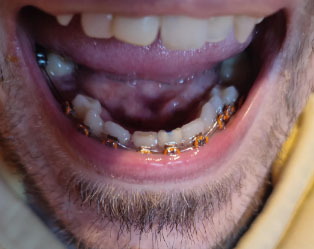
The image shows lower teeth with orthodontic braces, and a missing lower molar creating an open space along the dental arch. Brackets and wires are present on the remaining teeth, and plaque buildup is visible around orthodontic components. The gum tissue near the missing tooth appears healed but vulnerable.
This situation increases the risk of food trapping, tooth movement, and uneven bite forces during orthodontic treatment.
Most Likely Diagnosis
Based on visual examination, the most likely findings include:
-
Missing lower molar during active orthodontic treatment
-
Healed extraction site with open space
-
Increased plaque retention around braces
-
Risk of adjacent teeth shifting into the gap
-
Possible bite imbalance
A dental X-ray is recommended to assess bone level and spacing.
What Causes Problems When a Molar Is Missing With Braces
Common causes include:
-
Extraction of a badly decayed or infected molar
-
Delayed replacement planning
-
Orthodontic tooth movement pulling teeth toward the gap
-
Difficulty cleaning around brackets near the space
Braces can worsen spacing issues if the missing tooth is not properly managed.
Is This a Serious Problem
This condition is manageable, but if ignored, it may scale up into:
-
Unwanted tooth movement
-
Bite misalignment
-
Uneven chewing pressure
-
Increased plaque and cavity risk
-
Bone loss at the missing tooth site
-
Complicated future implant placement
Early planning prevents long-term orthodontic and restorative problems.
Recommended Treatment Process
Initial Assessment (Days 1–3)
-
Dental and orthodontic examination
-
Dental X-ray to check bone condition
-
Review of orthodontic treatment goals
Active Management Phase (Days 4–7)
Treatment may include:
-
Adjusting braces to control tooth movement
-
Professional cleaning around brackets
-
Planning for space maintenance or closure
Replacement or Long-Term Planning (Days 8–14)
Depending on the case:
-
Space may be closed orthodontically
-
Space may be preserved for a future dental implant
-
Temporary solutions may be discussed
Coordination between dentist and orthodontist is essential.
Expected Healing and Adjustment Time
-
Gum comfort around the space: 5–7 days
-
Orthodontic stabilization: up to 14 days
-
Bone preservation depends on timely replacement planning
What Happens If Treatment Is Delayed
If delayed beyond 14 days, this condition may lead to:
-
Teeth drifting into the empty space
-
Bite imbalance
-
Increased orthodontic treatment time
-
Bone loss making implants harder later
-
Higher overall treatment cost
Early coordination avoids complications.
Home Care Tips During Braces With a Missing Tooth
-
Brush carefully around brackets and the empty space
-
Use interdental brushes to remove trapped food
-
Avoid chewing hard foods on that side
-
Rinse with water or fluoride mouthwash after meals
Professional Comment
This case shows a missing lower molar during active orthodontic treatment, which requires careful planning. With proper coordination and hygiene, the orthodontic outcome can remain stable and successful.
Related Clinical Cases
Patients with lower front gum inflammation may also experience tartar buildup, periodontal disease, gum abscesses, or tooth decay. Explore these related clinical case studies.
Other topics:
Other Dental Clinic