We Bring Back the Sparkle in Your Smile.

Swelling of the Face After Root Canal Treatment in Oregon, USA: When Is It Normal and When Is It a Dental Emergency?
Language :
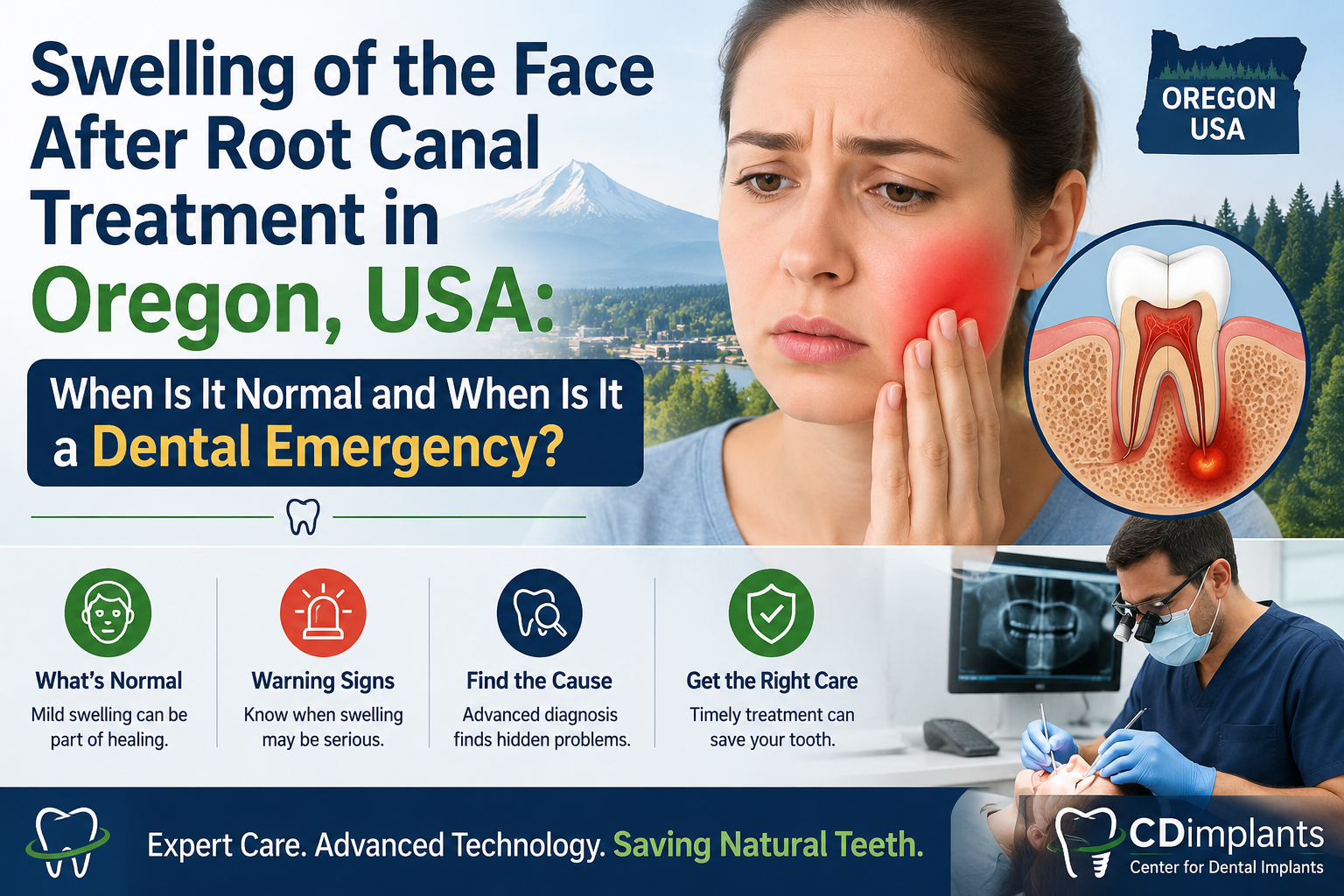
Few situations create more anxiety for a patient than waking up after a root canal treatment and noticing swelling on one side of the face is critical on daily life schedule. Whether the swelling appears near the cheek, jawline, under the eye, or around the neck, many patients immediately wonder if the treatment failed or if a serious infection is developing.
As an American dentist who has treated thousands of root canal cases, I can tell you that facial swelling after root canal treatment in Oregon is not always a sign of failure. In many situations, it is simply part of the body's inflammatory response while healing begins. However, in other cases, swelling can indicate a persistent infection, a missed canal, a cracked tooth, or a spreading dental abscess that requires immediate attention.
Oregon residents from Portland and Eugene to Salem, Bend, Medford, and the Oregon Coast frequently seek emergency dental care because they are unsure whether post-treatment swelling is normal or dangerous.
Understanding the difference can help save not only your tooth but potentially prevent serious health complications.
Why Does Facial Swelling Occur After a Root Canal?
A root canal treatment removes infected or inflamed pulp tissue from inside a tooth. Although the source of infection is cleaned, the tissues surrounding the tooth may remain irritated.
Several factors can trigger swelling after treatment.
Residual Infection
Many root canal procedures are performed on teeth that have been infected for weeks, months, or even years.
The surrounding bone and gum tissues may still contain inflammatory cells that continue reacting after treatment.
As the body begins healing, temporary swelling may occur.
Pre-Existing Abscess
If the tooth already had an abscess before treatment, swelling may actually increase temporarily before improving.
The body's immune system continues fighting bacteria that existed before the procedure.
Instrumentation Irritation
Root canal instruments clean deep inside the root system.
Occasionally, surrounding tissues become irritated during cleaning, creating mild inflammation.
Bacterial Release
During treatment, bacterial toxins can be disturbed and released into nearby tissues.
This may trigger a temporary inflammatory reaction.
Immune Response
The body naturally sends white blood cells and healing factors to the area.
This process can produce swelling, tenderness, and pressure sensations.
What Level of Swelling Is Considered Normal?
Mild swelling for a few days can be completely normal.
Patients may experience:
- Slight cheek puffiness
- Mild tenderness
- Pressure sensation
- Soreness when chewing
- Minor gum swelling
1. Slight Cheek Puffiness
-
What it means: Your body is sending extra fluid and blood to the area to help it heal.
-
The simple analogy: It’s just like the swelling you get when you bump your shin or get a bug bite. It looks scary in the mirror, but it's just your body's natural "cushion" for healing.
2. Mild Tenderness
-
What it means: The nerves outside and around the bottom of the tooth are raw and sensitive right now.
-
The simple analogy: Think of it like a bruised muscle. It doesn’t hurt constantly, but if you poke it or move your mouth a certain way, it feels sore.
3. Pressure Sensation
-
What it means: Because of that extra healing fluid packed into a tight space under your tooth, things are crowded.
-
The simple analogy: It feels like your tooth is "too tall" or being pushed upward. It’s just the fluid build-up creating a tight, full feeling in your jaw.
4. Soreness When Chewing
-
What it means: The ligament holding your tooth to the jawbone is temporarily bruised from the dentist working on it.
-
The simple analogy: If you walked on a sprained ankle, it would hurt. Chewing puts pressure on a bruised dental ligament, which is why it's best to stick to soft foods for a few days.
5. Minor Gum Swelling
-
What it means: The gums right around the tooth got irritated by the dental tools, the localized numbing injections, or the rubber shield used during the procedure.
-
The simple analogy: It's essentially a minor paper cut or scrape on your gums. It will look a little red and puffy, but the mouth heals incredibly fast.
The Golden Rule: All 5 of these symptoms are completely normal if they peak within 48 hours and start fading by day 3. If they get worse instead of better, that's when you call the dentist.
Life is full of drama because suddenly the bacteria worsen and most case that is the time a person take action instead of giving time when it was little pain. Typically, these symptoms begin improving within 48 to 72 hours.
Many Oregon patients report that the swelling feels worse on the morning after treatment and then gradually subsides.
This pattern is generally not alarming.
After a root canal, it is normal to notice some mild swelling, tenderness, pressure, or soreness for a few days. Your body is simply starting the healing process. Slight cheek puffiness happens because extra blood and fluid are sent to the area, similar to swelling after a minor injury. Mild tenderness feels like a bruised muscle that is sore when touched. A pressure sensation can make the tooth feel slightly raised because healing fluid is packed into a small space. Chewing may feel uncomfortable because the ligament around the tooth is temporarily irritated. Minor gum swelling is also common from dental instruments and injections. These symptoms usually peak within 48 hours and begin improving by day 3. If swelling, pain, or pressure becomes worse instead of better, contact your dentist promptly.
Signs the Swelling May Be Serious
Certain symptoms suggest the infection may not be resolving.
Seek immediate dental attention if you experience:
Rapidly Increasing Swelling
If your face becomes noticeably larger over hours instead of days, an active infection may be spreading.
Difficulty Swallowing
Swelling extending into the throat area can become dangerous.
Difficulty Breathing
This is a true medical emergency.
Immediate evaluation is required.
Fever
A fever often indicates the body is fighting a significant infection.
Pus Drainage
The presence of pus suggests ongoing bacterial activity.
Severe Throbbing Pain
Increasing pain instead of decreasing pain may indicate treatment complications.
Swelling Around the Eye
Upper tooth infections can spread into facial spaces surrounding the eye.
This requires urgent evaluation.
Can an Infection Spread After a Root Canal?
Unfortunately, yes.
Although modern root canal therapy has a high success rate, no procedure is 100% guaranteed.
Sometimes bacteria survive inside:
- Hidden canals
- Curved canals
- Calcified canals
- Root fractures
- Deep anatomical spaces
When bacteria remain trapped, swelling may continue or worsen.
Without treatment, infections can spread into:
- Facial spaces
- Sinuses
- Jawbone
- Neck tissues
- Bloodstream
While severe complications are uncommon, they are possible when infections are ignored.
Common Causes of Persistent Swelling
Missed Canal
Many molars contain complex anatomy.
Some teeth have four, five, or even more canals.
A missed canal remains infected and can continue causing swelling.
Vertical Root Fracture
A cracked root creates a pathway for bacteria.
Even a perfectly performed root canal cannot heal a fractured root.
Recontamination
If a temporary filling breaks or falls out, bacteria may re-enter the tooth.
Delayed Crown Placement
A root canal-treated tooth often requires a crown.
Delaying restoration can allow reinfection.
Resistant Bacteria
Certain bacterial species survive extremely well inside root systems.
Specialized retreatment may be necessary.
Why Oregon Patients Often Delay Treatment
Many patients throughout Oregon postpone dental care because:
- Busy work schedules
- Insurance concerns
- Fear of dental procedures
- Rural travel distances
- Temporary improvement of symptoms
Unfortunately, infections rarely disappear permanently on their own.
The pain may fade while the infection continues spreading silently.
This delay often transforms a manageable root canal case into a complex emergency.
Diagnostic Steps Your Dentist May Take
When facial swelling develops after treatment, dentists investigate carefully.
Digital X-Rays
Radiographs reveal hidden infections and bone loss.
CBCT 3D Imaging
Modern cone beam CT scans provide detailed three-dimensional images.
These scans can reveal:
- Missed canals
- Fractures
- Bone destruction
- Hidden infections
Clinical Examination
The dentist evaluates:
- Bite pressure
- Tooth mobility
- Gum health
- Drainage pathways
- Swelling location
Percussion Testing
Tapping on the tooth helps identify ongoing inflammation.
Treatment Options for Facial Swelling
Treatment depends on the underlying cause.
Observation
Minor swelling may simply require monitoring.
Anti-Inflammatory Medication
Reducing inflammation often improves comfort.
Antibiotics
When infection is actively spreading, antibiotics may be prescribed.
However, antibiotics alone rarely solve the underlying problem.
The source must also be addressed.
Root Canal Retreatment
The original root canal may need to be reopened and cleaned again.
Apicoectomy
This microsurgical procedure removes infected tissue from the root tip.
Extraction
When the tooth cannot be predictably saved, extraction may become necessary.
Fortunately, many teeth that appear hopeless can still be rescued by experienced specialists.
Worst-Case Scenario: What Can Happen If Swelling Is Ignored?
One of the greatest mistakes patients make is assuming swelling will eventually disappear.
Untreated infections may lead to:
Facial Cellulitis
A severe infection spreading through soft tissues.
Osteomyelitis
An infection involving the jawbone itself.
Sinus Infection
Upper molar infections frequently affect the maxillary sinus.
Deep Neck Space Infection
A potentially life-threatening condition.
Hospitalization
Advanced dental infections occasionally require intravenous antibiotics.
Tooth Loss
The longer infection persists, the more difficult tooth preservation becomes.
A Remarkable Oregon Success Story: Saving a Tooth That Seemed Hopeless
Several years ago, a patient from central Oregon arrived at our office after experiencing significant facial swelling.
We'll call him Michael.
Michael was 52 years old and worked in construction.
Months earlier, he had undergone root canal treatment on a lower molar.
Initially, the pain disappeared.
Then swelling returned.
At first it appeared only occasionally.
Eventually, the left side of his face became visibly enlarged.
He developed difficulty chewing and began avoiding solid foods.
Another office recommended extraction.
Michael desperately wanted to save the tooth.
When he arrived, the situation looked challenging.
A large swelling extended along the jawline.
The tooth had already undergone root canal treatment.
Many would assume the tooth was beyond saving.
However, we performed advanced CBCT imaging.
The scan revealed a hidden canal that had never been cleaned during the original procedure.
The infection was still thriving inside that untreated space.
The good news?
The tooth was not fractured.
That meant we still had a chance.
The Rescue Procedure
The retreatment process began immediately.
The old filling materials were carefully removed.
Using a dental microscope, we searched for the missing canal.
Eventually, it was located deep within the root system.
The hidden canal contained infected tissue and bacterial debris.
The canal was meticulously cleaned and disinfected.
Special antimicrobial solutions were used to eliminate bacteria.
Medication was placed inside the tooth.
Over the following weeks, something remarkable happened.
The swelling began shrinking.
The pain disappeared.
The drainage stopped.
Bone regeneration became visible on follow-up imaging.
Several months later, Michael returned for evaluation.
The large facial swelling was completely gone.
The infection had resolved.
The tooth remained functional.
A custom crown was placed for long-term protection.
Years later, that same tooth continues serving him well.
Instead of losing the tooth, proper diagnosis and skilled treatment preserved it.
Stories like Michael's demonstrate why a second opinion can sometimes save a tooth that appears hopeless.
Modern Technology Has Changed Root Canal Success Rates
Today's root canal procedures are dramatically different from those performed decades ago.
Advanced technology includes:
Dental Microscopes
Magnification reveals hidden anatomy.
CBCT Imaging
Three-dimensional scans uncover problems invisible on traditional X-rays.
Ultrasonic Instruments
Precise cleaning improves outcomes.
Nickel Titanium Files
Flexible instruments navigate curved canals.
Bioceramic Sealers
Modern materials improve long-term sealing.
Because of these advances, many Oregon patients can save teeth that once would have required extraction.
How to Reduce Swelling After a Root Canal
Patients can support healing by:
Applying Cold Compresses
Ice packs help minimize inflammation.
Taking Prescribed Medications
Follow all instructions carefully.
Staying Hydrated
Hydration supports immune function.
Avoiding Smoking
Smoking slows healing and increases complications.
Maintaining Oral Hygiene
Clean surrounding tissues gently.
Following Up With Your Dentist
Scheduled evaluations help ensure proper healing.
When Should You Call Your Dentist?
Contact your dentist immediately if:
- Swelling increases after three days
- Fever develops
- Pain becomes severe
- Swallowing becomes difficult
- Breathing becomes difficult
- Pus drainage appears
- Facial asymmetry worsens
Early intervention dramatically improves outcomes.
The Long-Term Outlook
The majority of root canal-treated teeth function successfully for many years.
Even when facial swelling develops, modern dentistry can often identify the cause and provide effective treatment.
The key is acting quickly.
Patients who seek prompt care generally enjoy:
- Better healing
- Less pain
- Lower costs
- Higher tooth survival rates
Waiting often allows small problems to become major complications.
Conclusion
Swelling of the face after root canal treatment in Oregon can range from a normal healing response to a serious dental emergency. Mild swelling may resolve naturally within a few days, but increasing swelling, fever, difficulty swallowing, or worsening pain should never be ignored.
Modern diagnostic tools allow dentists to identify hidden infections, missed canals, fractures, and other complications with remarkable accuracy. Even teeth that appear hopeless can sometimes be successfully rescued through retreatment or advanced endodontic procedures.
As Michael's story demonstrated, a severely infected tooth with significant facial swelling does not automatically mean extraction is inevitable. With careful diagnosis, advanced technology, and experienced treatment, many of the worst cases can still have a successful ending.
If you experience facial swelling after a root canal procedure, the safest decision is to contact your dentist immediately. Early treatment not only protects your health but may also save a tooth that can continue serving you for many years to come.
Can tooth extraction cause infection? Mild inflammation is normal, but increasing swelling, fever, or severe pain may indicate infection. Learn more about post-extraction infection warning signs in this detailed guide.
Book a consultation with our Cebu dental specialists for proper evaluation and care.
Ready to get expert guidance?
If you’re experiencing severe pain or delayed healing, book a consultation with our Cebu dental specialists to get proper evaluation and care.
Consultation or contact page .
Book a Consultation
For severe discomfort or delayed healing, book a consultation with our Cebu dental specialists today.
Looking for a dentist? Browse our Cebu dental directory to find trusted clinics near you.
Medical Review and Clinical Basis
This article is based on clinical dental guidelines and real patient recovery patterns observed after tooth extraction procedures. The information reflects common post-extraction healing stages, including normal clot formation, gum tissue repair, and signs of possible complications such as dry socket or infection.
While mild discomfort is expected after a dental extraction, worsening pain after Day 3, bad odor, exposed bone, or spreading pain may require professional evaluation. These symptoms are consistent with known post-extraction complications described in standard dental practice.
About Cebu Dental Implants
Important Medical Disclaimer
This content is for educational purposes only and does not replace professional dental diagnosis. Every patient heals differently. If symptoms worsen or do not improve within a few days, consult a licensed dentist for proper evaluation and treatment.
Author
This article was prepared by the Cebu Dental Implants content team in consultation with licensed dental professionals experienced in tooth extraction and implant procedures.
Related Clinical Cases
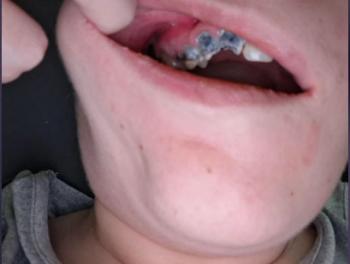
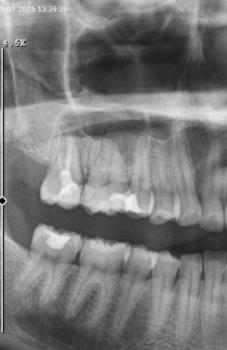
Patients with lower front gum inflammation may also experience tartar buildup, periodontal disease, gum abscesses, or tooth decay. Explore these related clinical case studies.



Other topics:
Other Dental Clinic
 |
 |
 |
 |