Modern Dentistry, Timeless Smiles.

Mastering the Inferior Alveolar Nerve Block: Precision, Anatomy, and Technique
Image:
Severity:
Teeth Problems:
Teeth Case/Image Analysis
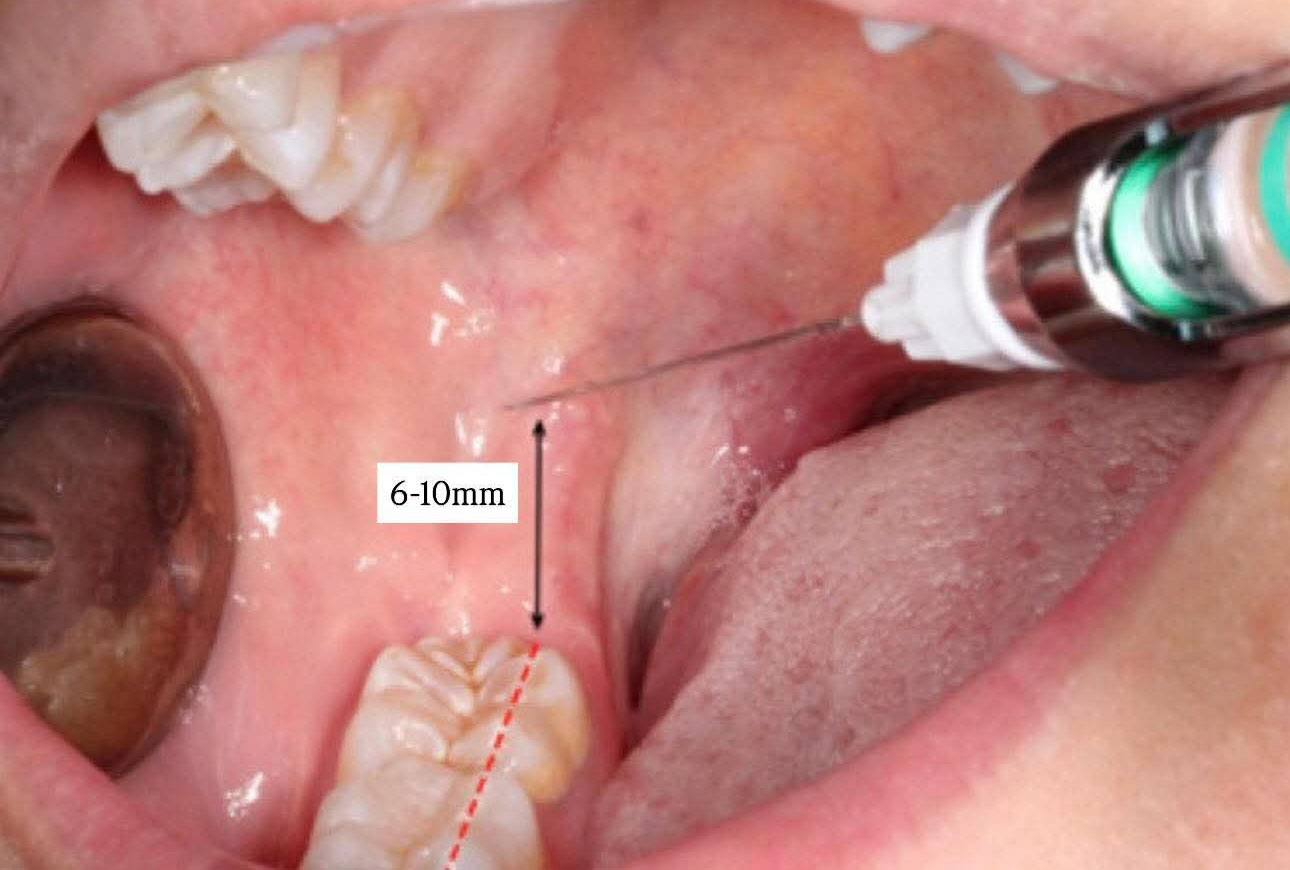
The image clearly depicts the administration of an Inferior Alveolar Nerve Block (IANB) injection, targeting the mandibular foramen to anesthetize the lower dental nerve.
-
Location: The needle is being inserted into the pterygomandibular space, medial to the internal oblique ridge and just above the occlusal plane of the mandibular molars.
-
Target Depth: A measurement guide is overlaid, indicating the target depth of insertion is 6-10 mm to reach the target area before bone contact is made (which should be the lingual aspect of the ramus).
-
Target Area: The goal is to deposit the anesthetic near the entrance of the mandibular foramen, which houses the Inferior Alveolar Nerve, before it enters the mandibular canal.
-
Clinical Relevance: The technique is critical for anesthetizing the pulpal tissue of all mandibular teeth on that side, the body of the mandible, the mucoperiosteum, and the skin/mucosa of the lower lip and chin.
Full Analysis and Diagnosis (Based on Provided Text)
Diagnosis: Suboptimal Inferior Alveolar Nerve Block success rate due to lack of precise anatomical targeting and improper technique.
Analysis Summary:
The text emphasizes that successful IANB is not about random posterior pointing but precise anatomical localization. The key determinants of success are:
-
Correct Entry Point: Accurately identifying the internal oblique line and the depression within the pterygomandibular space.
-
Correct Height: Directing the needle to the correct height of the mandibular foramen, which is typically slightly above the occlusal plane in adults.
-
Correct Trajectory/Angulation: Maintaining the syringe parallel to the occlusal plane and aiming toward the pterygomandibular depression to ensure the needle reaches the lingual aspect of the mandibular ramus (bone contact) without lateral deviation.
Timely Tips for Successful IANB (Dentist Said)
The provided tips are excellent guidelines for enhancing the predictability and effectiveness of the block:
-
TIP 1 (Angulation): Raise the elbow and keep the syringe parallel to the occlusal plane to prevent lateral deviation away from the foramen.
-
TIP 2 (Depth/Bone Contact):
-
No Contact: Indicates the needle is too far lateral or superior; requires removal and reorientation.
-
Too Soon Contact: Indicates the insertion is too anterior (too close to the internal oblique ridge); requires slight withdrawal and directing the needle more posteriorly.
-
-
TIP 3 (Anatomic Landmark): Visually confirm the pterygomandibular raphe as the key anatomical reference point.
-
TIP 4 (Patient Comfort/Diffusion): Inject the anesthetic slowly to minimize pain and promote optimal diffusion around the nerve bundle.
-
TIP 5 (Age Adjustment): Adjust the height of the injection based on the patient's age:
-
Young Patients: Foramen is typically lower.
-
Older Adults (Edentulous/Resorbed): Foramen can be higher.
-
Process to Execute & Time Frame
-
Process to Execute (IANB):
-
Patient opens wide.
-
Identify the pterygomandibular raphe and the internal oblique ridge.
-
Palpate the injection area or use the visualized landmarks.
-
Insert the needle at the correct height (slightly above occlusal plane for adults).
-
Advance the needle slowly, keeping the syringe parallel to the occlusal plane, aiming for bone contact at the proper depth (6-10 mm).
-
Aspirate to ensure the needle is not within a blood vessel.
-
If aspiration is negative, deposit the anesthetic slowly.
-
Slowly withdraw the needle and place the cap safely.
-
-
Time Frame to Heal: The process described is an anesthetic technique, not a procedure that requires a "time frame to heal."
-
Anesthetic Duration: Effective IANB provides pulpal anesthesia for approximately 1 to 5 hours, depending on the specific anesthetic agent used (e.g., Lidocaine, Articaine, Bupivacaine).
-
Healing Time (for subsequent procedure): If the anesthesia is for a minor procedure (e.g., filling, simple extraction), healing for that procedure may take a few days up to 14 days for soft tissue healing (like an extraction site) as mentioned in the prompt.
-
What will be the issue that will scale up
If the anesthesia is not successful (Failure to achieve block), the major issues that will scale up are:
-
Increased Patient Pain and Distress: The primary issue is that the procedure for which the anesthesia was intended cannot be performed without severe pain, leading to patient anxiety and potentially refusal of further treatment.
-
Increased Treatment Time and Cost: Repeated attempts at the injection, or the need to switch to alternative, less effective, or more complex anesthetic techniques (like intraligamentary or intraseptal injections) consume more time and resources.
-
Risk of Complications (Secondary): Repeated injections increase the risk of secondary complications, such as trismus (muscle soreness/spasm) or hematoma (bruising/bleeding) in the injection area.
Comments
Mastering local anesthesia, especially the Inferior Alveolar Nerve Block, is fundamental to painless and effective dental practice. The advice provided underscores that deep anatomical knowledge is the foundation for a predictable and reliable outcome. "If you understand anatomy, you never work blindly."
Related Clinical Cases
Patients with lower front gum inflammation may also experience tartar buildup, periodontal disease, gum abscesses, or tooth decay. Explore these related clinical case studies.



Other topics:
Other Dental Clinic
 |
 |
 |
 |