Transforming Smiles, Restoring Confidence.

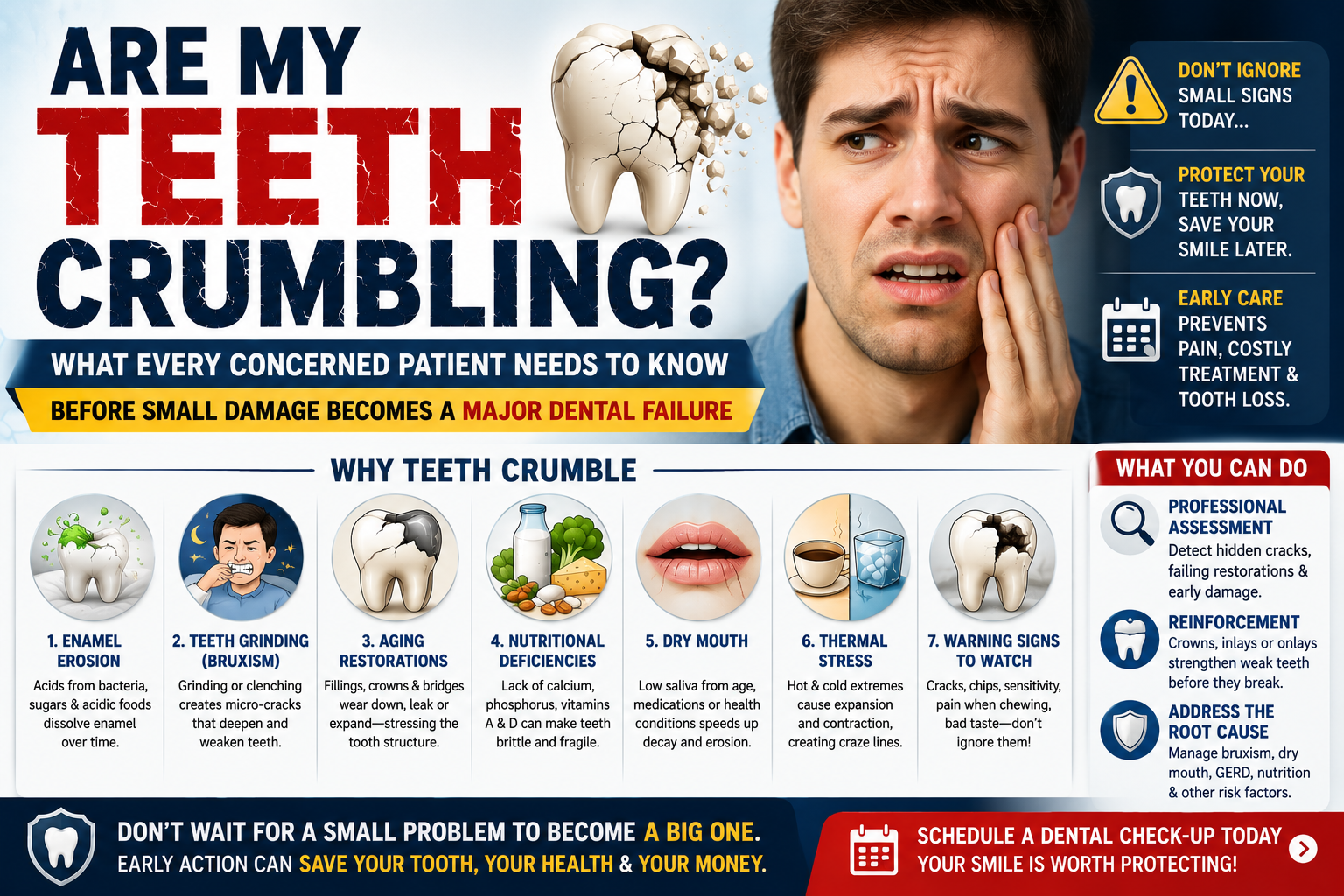
Are My Teeth Crumbling? What Every Concerned Patient Needs to Know Before Small Damage Becomes a Major Dental Failure
Language :
Topics:
"I keep checking my teeth in the mirror."
"Every time my tongue touches a rough edge, I become worried."
"A small piece chipped off last week, and now I'm afraid another piece will break tomorrow."
If these thoughts sound familiar, you are not alone.
Many patients become deeply concerned when they notice signs that their teeth may be "crumbling." Perhaps you discovered a sharp edge while eating breakfast. Maybe a tiny piece broke away while chewing something soft. Some patients notice new cracks appearing in the mirror, while others develop increasing sensitivity and begin wondering if their teeth are slowly falling apart.
What makes the situation especially frightening is that the damage often appears to happen suddenly.
One day your tooth seems normal.
The next day part of it is missing.
The truth, however, is that crumbling teeth are rarely the result of a single event.
In most cases, visible breakage represents the final stage of a process that has been weakening the tooth structure for months or even years.
Understanding what is happening inside the tooth is extremely important because failure to identify the cause can allow the damage to continue until more invasive treatment becomes necessary.
For conservative patients who want to preserve their natural teeth and avoid unnecessary complications, knowledge and early intervention are essential.
Understanding Why Teeth Crumble
Many people believe teeth should last forever because enamel is the hardest material in the human body.
While enamel is extraordinarily strong, it is not indestructible.
More importantly, enamel cannot repair itself.
Unlike skin, muscles, or bone, enamel contains no living cells capable of regeneration.
Once enamel is lost, cracked, or worn away, the body cannot rebuild it naturally.
Every small crack, every acid attack, and every episode of grinding leaves a permanent mark.
Over time, these small changes accumulate.
Eventually, the tooth reaches a point where visible structural failure occurs.
Patients often describe this moment as:
"My tooth suddenly crumbled."
From a dental perspective, the weakening process likely began long before the break became visible.
The Hidden Process Behind Tooth Breakdown
Think of a wooden bridge.
A bridge rarely collapses without warning.
Years of weather exposure, repeated stress, and gradual deterioration weaken the structure long before the visible collapse occurs.
Your teeth behave similarly.
Several factors slowly reduce their strength until they can no longer withstand everyday forces.
Understanding these factors is critical if you want to stop the damage before it becomes irreversible.
Cause #1: Gradual Enamel Erosion
One of the most common causes of tooth breakdown is enamel erosion.
Unfortunately, this process is often painless during its early stages.
Because patients do not experience discomfort immediately, they may not realize anything is wrong.
Meanwhile, enamel continues to lose minerals.
How Enamel Erosion Happens
Your mouth naturally contains bacteria.
These bacteria feed on sugars and starches from foods and beverages.
As they digest these substances, acids are produced.
These acids attack the enamel surface.
Normally, saliva helps neutralize acids and restore minerals.
However, repeated acid exposure overwhelms the repair process.
The enamel gradually becomes thinner.
As the enamel weakens, it becomes more vulnerable to:
- Chipping
- Cracking
- Sensitivity
- Structural failure
Common Sources of Acid
Many patients immediately think of candy.
However, acidic exposure often comes from sources people consider healthy.
Examples include:
- Soft drinks
- Sports drinks
- Energy drinks
- Citrus fruits
- Vinegar-based foods
- Carbonated beverages
- Sweetened coffee drinks
Frequent exposure throughout the day is often more damaging than occasional consumption.
Silent Acid Reflux
An often-overlooked contributor is GERD.
Many patients do not realize that stomach acid can reach the mouth.
Because stomach acid is extremely strong, repeated exposure can cause significant enamel loss.
Dentists frequently identify signs of reflux-related damage before patients receive a formal diagnosis.
Cause #2: Teeth Grinding (Bruxism)
One of the most destructive habits affecting teeth is grinding.
Many patients are completely unaware they do it.
Most grinding occurs during sleep.
Unfortunately, the forces involved can be enormous.
Why Grinding Is So Dangerous
During normal chewing, forces are controlled and distributed efficiently.
Grinding is different.
It creates repetitive stress in unnatural directions.
This stress causes:
- Enamel wear
- Tooth flattening
- Micro-cracks
- Crown fractures
- Filling failure
Over time, these microscopic defects deepen.
Eventually, the tooth can no longer withstand normal pressure.
A fracture occurs.
Patients often assume the food they were eating caused the break.
In reality, the grinding damage may have been developing for years.
Warning Signs of Bruxism
Common symptoms include:
- Morning headaches
- Jaw pain
- Neck stiffness
- Ear discomfort
- Worn teeth
- Tooth sensitivity
Many patients discover they grind only after a dentist identifies characteristic wear patterns.
Cause #3: Aging Dental Restorations
Fillings, crowns, and bridges play an important role in preserving teeth.
However, they are not permanent.
Every restoration has a lifespan.
As these restorations age, they can contribute to structural problems.
Why Older Fillings Become Risky
A filling replaces natural tooth structure.
The larger the filling, the less natural tooth remains.
Over time:
- Fillings may shrink
- Margins may leak
- Secondary decay may develop
- Stress concentrates in the remaining tooth walls
Eventually, the surrounding tooth structure becomes vulnerable to fracture.
Hidden Decay Under Existing Restorations
One of the most concerning problems is decay developing underneath an old restoration.
Because the decay is hidden, patients often have no symptoms.
The tooth may appear stable from the outside while significant weakening occurs internally.
When failure finally happens, it often feels sudden and unexpected.
Cause #4: Nutritional Deficiencies
Many patients focus exclusively on brushing and flossing.
While oral hygiene is important, nutrition also plays a major role in tooth strength.
Healthy teeth depend on proper mineralization.
Without adequate nutrients, enamel may become more vulnerable to wear and damage.
Calcium
Calcium is one of the primary building blocks of teeth.
Insufficient calcium intake may compromise mineral density.
Sources include:
- Dairy products
- Sardines
- Yogurt
- Cheese
- Leafy greens
Phosphorus
Phosphorus works together with calcium to strengthen tooth structure.
Sources include:
- Fish
- Poultry
- Eggs
- Nuts
Vitamin D
Vitamin D helps the body absorb calcium effectively.
Without adequate vitamin D, calcium utilization becomes less efficient.
Vitamin A
Vitamin A supports oral tissues and healthy saliva production.
Deficiencies may contribute to oral health complications.
Cause #5: Chronic Dry Mouth
Many patients underestimate the importance of saliva.
Dentists view saliva as one of the mouth's most powerful protective systems.
What Saliva Does
Saliva helps:
- Neutralize acids
- Wash away food particles
- Control bacterial growth
- Deliver minerals to enamel
- Protect soft tissues
Without sufficient saliva, teeth become significantly more vulnerable.
Causes of Dry Mouth
Common causes include:
- Blood pressure medications
- Antidepressants
- Allergy medications
- Diabetes
- Autoimmune diseases
- Aging-related medication use
Why Dry Mouth Accelerates Failure
Without adequate saliva:
- Decay develops faster
- Enamel erosion increases
- Sensitivity worsens
- Structural weakening progresses
Many patients are surprised to learn that dry mouth can dramatically increase their risk of tooth loss.
Cause #6: Thermal Stress
Temperature changes affect teeth more than most people realize.
Repeated exposure to extreme temperatures can contribute to structural damage.
Expansion and Contraction
When exposed to heat, materials expand.
When exposed to cold, they contract.
Teeth respond in the same way.
Repeated cycles of expansion and contraction create stress within the tooth.
Over time, this stress contributes to the formation of tiny cracks known as craze lines.
Common Examples
Examples include:
- Hot coffee followed by ice water
- Hot soup followed by cold beverages
- Frequent temperature extremes throughout the day
While occasional exposure is unlikely to cause immediate problems, years of repetition may contribute to structural fatigue.
Why Small Symptoms Matter
One of the biggest mistakes patients make is waiting for severe pain.
Unfortunately, pain often appears late in the process.
By the time pain develops, significant structural damage may already exist.
Early warning signs deserve attention.
Jagged or Rough Edges
Many patients first notice a problem when their tongue encounters a sharp surface.
This may indicate:
- Enamel loss
- A small fracture
- Structural weakening
Even minor chips should be evaluated.
New Cracks or Craze Lines
Thin cracks often appear harmless.
However, increasing visibility may signal ongoing stress.
Monitoring these changes is important.
Persistent Sensitivity
Sensitivity often develops before major fractures occur.
If one tooth repeatedly reacts to cold, heat, or pressure, further investigation may be necessary.
Pain While Chewing
Pain when biting may indicate:
- Cracks
- Structural instability
- Hidden fractures
Ignoring these symptoms can allow further deterioration.
Bad Taste Near a Specific Tooth
A persistent unpleasant taste can indicate:
- Hidden decay
- Infection
- Crown failure
- Bacterial leakage
This symptom should never be ignored.
Professional Treatment: Why Early Action Matters
Because structural damage is permanent, home remedies cannot rebuild lost enamel or repair fractures.
Professional evaluation is essential.
Comprehensive Assessment
A dentist can identify:
- Hairline fractures
- Hidden decay
- Failing restorations
- Bite problems
- Bruxism damage
Many of these issues remain invisible to patients until advanced stages.
Reinforcing a Weakened Tooth
Depending on the severity, treatment may include:
- Bonding
- Inlays
- Onlays
- Crowns
These restorations strengthen the tooth and prevent further breakdown.
Addressing the Underlying Cause
Simply repairing the tooth is not enough.
The underlying cause must also be managed.
Examples include:
Bruxism
Custom night guards help protect teeth from grinding forces.
GERD
Medical management reduces acid exposure.
Dry Mouth
Targeted therapies improve saliva production.
Nutritional Deficiencies
Dietary improvements support long-term oral health.
The Cost of Waiting
Many patients postpone treatment because the problem seems minor.
Unfortunately, delay often increases both complexity and cost.
A small crack today may become:
- A larger fracture
- Root canal therapy
- Crown placement
- Tooth extraction
- Dental implant treatment
The earlier intervention occurs, the more conservative the treatment options tend to be.
Final Thoughts
If you believe your teeth are crumbling, your concern is understandable. Visible chips, rough edges, sensitivity, and cracks are warning signs that should never be ignored. In most cases, these symptoms represent the final stage of a long-term weakening process involving enamel erosion, grinding, aging restorations, nutritional deficiencies, dry mouth, and thermal stress.
The encouraging news is that many teeth can still be saved when problems are identified early.
The key is understanding that teeth do not heal themselves. Every day that structural damage continues unchecked increases the risk of more serious complications.
If you notice rough edges, visible cracks, chewing discomfort, persistent sensitivity, or signs that your teeth no longer feel as strong as they once did, schedule a professional dental evaluation. Acting now may help preserve your natural teeth, avoid costly future treatment, and protect your smile for years to come.
Can tooth extraction cause infection? Mild inflammation is normal, but increasing swelling, fever, or severe pain may indicate infection. Learn more about post-extraction infection warning signs in this detailed guide.
Book a consultation with our Cebu dental specialists for proper evaluation and care.
Ready to get expert guidance?
If you’re experiencing severe pain or delayed healing, book a consultation with our Cebu dental specialists to get proper evaluation and care.
Consultation or contact page .
Book a Consultation
For severe discomfort or delayed healing, book a consultation with our Cebu dental specialists today.
Looking for a dentist? Browse our Cebu dental directory to find trusted clinics near you.
Medical Review and Clinical Basis
This article is based on clinical dental guidelines and real patient recovery patterns observed after tooth extraction procedures. The information reflects common post-extraction healing stages, including normal clot formation, gum tissue repair, and signs of possible complications such as dry socket or infection.
While mild discomfort is expected after a dental extraction, worsening pain after Day 3, bad odor, exposed bone, or spreading pain may require professional evaluation. These symptoms are consistent with known post-extraction complications described in standard dental practice.
About Cebu Dental Implants
Cebu Dental Implants provides comprehensive tooth extraction, surgical procedures, and dental implant services in the Philippines. Our team evaluates post-extraction healing, manages complications such as dry socket, and advises patients on proper aftercare to prevent infection and delayed healing.
If you experience severe pain or unusual symptoms after extraction, early professional assessment is recommended to prevent further complications.
Important Medical Disclaimer
This content is for educational purposes only and does not replace professional dental diagnosis. Every patient heals differently. If symptoms worsen or do not improve within a few days, consult a licensed dentist for proper evaluation and treatment.
Author
This article was prepared by the Cebu Dental Implants content team in consultation with licensed dental professionals experienced in tooth extraction and implant procedures.
Related Clinical Cases
Patients with lower front gum inflammation may also experience tartar buildup, periodontal disease, gum abscesses, or tooth decay. Explore these related clinical case studies.