Smile Again with Comfort and Confidence.

Why AI Adoption in Philippine Dental Education Is Still Slow
Language :
Topics:
Why AI Adoption in Philippine Dental Education Is Still Slow
AI Is Growing Fast Worldwide
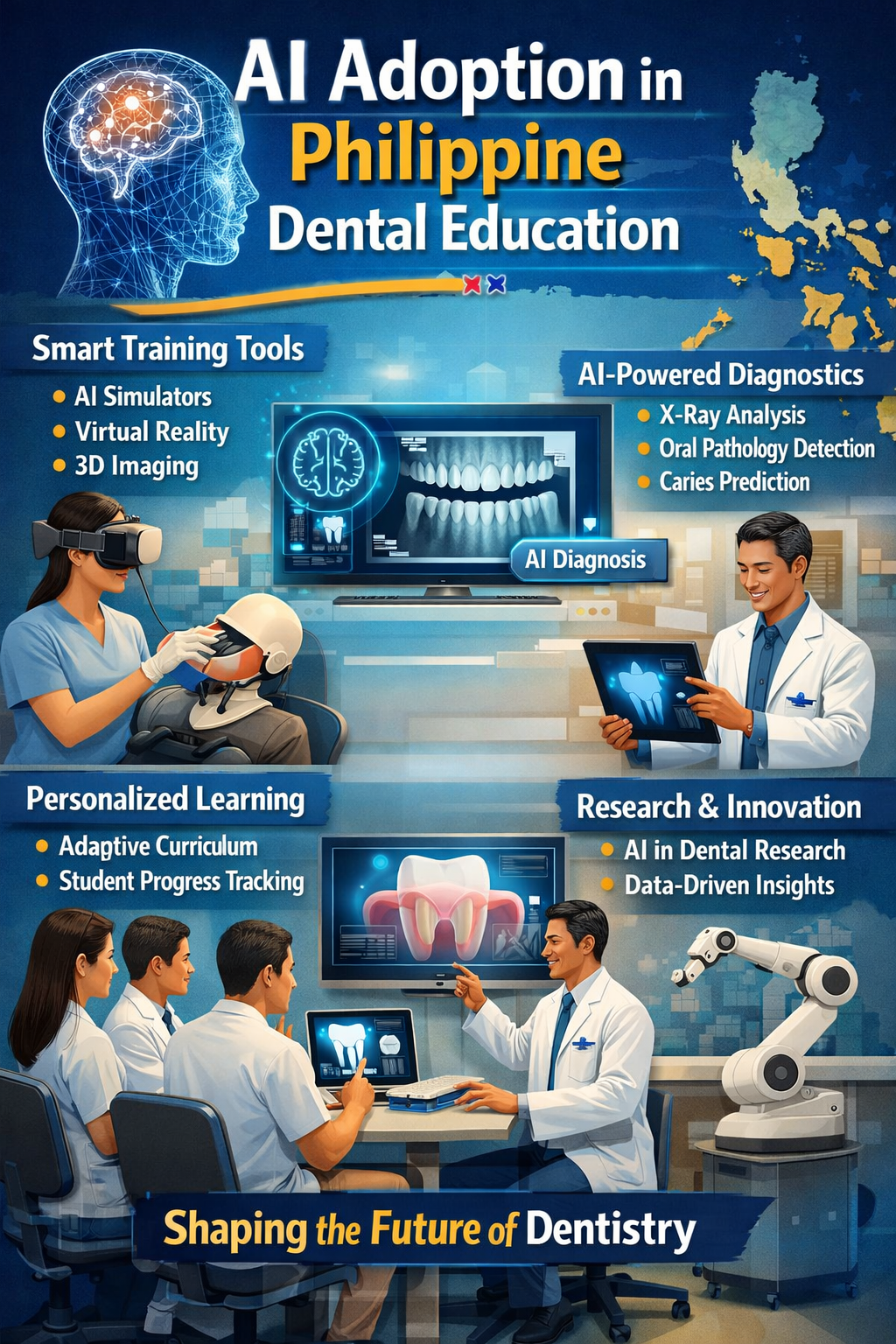
Artificial Intelligence is transforming dental education globally.
In countries like the United States, South Korea, Japan, and parts of Europe, AI is used for:
- Digital radiograph analysis
- 3D treatment simulation
- Virtual patient training
- Automated case assessment
- Predictive diagnosis tools
Recent global reports show:
- Over 60% of dental schools in developed countries use AI-supported learning tools
- More than 70% of advanced clinics use AI-integrated digital imaging
- The AI healthcare market is growing at over 35% annually
AI Adoption in the Philippines
In the Philippines, adoption remains limited.
- Less than 20% of dental schools integrate AI-based tools
- Most schools rely on traditional lectures and manual case reviews
- Digital equipment penetration is below 30% outside Metro Manila
- Rural institutions have minimal AI exposure
While some schools use digital radiography, full AI-assisted diagnostics and simulation training are still uncommon.
Why Is Adoption Slow?
1. Budget Limitations
AI software, scanners, and simulation labs require high investment. Many schools operate on limited funding.
Implementation requires:
- Hardware upgrades
- Licensed AI software
- IT infrastructure
- Faculty training
2. Traditional Curriculum Structure
Dental education still follows structured manual-based clinical training. Board exams emphasize conventional procedures.
3. Faculty Training Gap
Many faculty members were trained in traditional systems. Transitioning to AI requires continuous digital training and policy updates.
4. Infrastructure Inequality
Nearly one-third of dental schools are located in Metro Manila.
Provincial institutions often lack:
-
High-speed internet
-
Modern lab facilities
-
Digital equipment
This creates uneven technology exposure.
Comparison: Philippines vs Developed Countries
Developed Countries:
-
60 to 75 percent AI integration in dental education
-
Strong government funding for health tech
-
AI included in continuing education
Philippines:
-
Estimated 15 to 20 percent partial integration
-
Mostly urban-based adoption
-
Limited structured AI curriculum
The gap is not about talent. It is about system readiness.
H2
Is AI Replacing Traditional Learning?
No.
AI enhances learning but does not replace:
-
Manual dexterity training
-
Clinical experience
-
Patient communication skills
The best model is hybrid education:
Traditional foundation + AI-assisted diagnostics + Digital simulation
The Risk of Staying Behind
If adoption remains slow:
-
Filipino graduates may be less competitive globally
-
Local clinics may struggle with digital transformation
-
Patients may miss advanced diagnostic benefits
However, rapid adoption without regulation can also create risks.
Balanced modernization is key.
Future Outlook
AI adoption in Philippine dentistry is expected to grow gradually over the next 5 to 10 years as:
-
Private institutions invest in technology
-
Young dentists demand digital tools
-
Global standards influence local curriculum
-
Digital dentistry becomes more affordable
The transformation is coming. The speed depends on funding, leadership, and policy reform.
Looking for dentist : Visit directory list
Related Clinical Cases
Patients with lower front gum inflammation may also experience tartar buildup, periodontal disease, gum abscesses, or tooth decay. Explore these related clinical case studies.