Healthy Teeth, Happy Life.

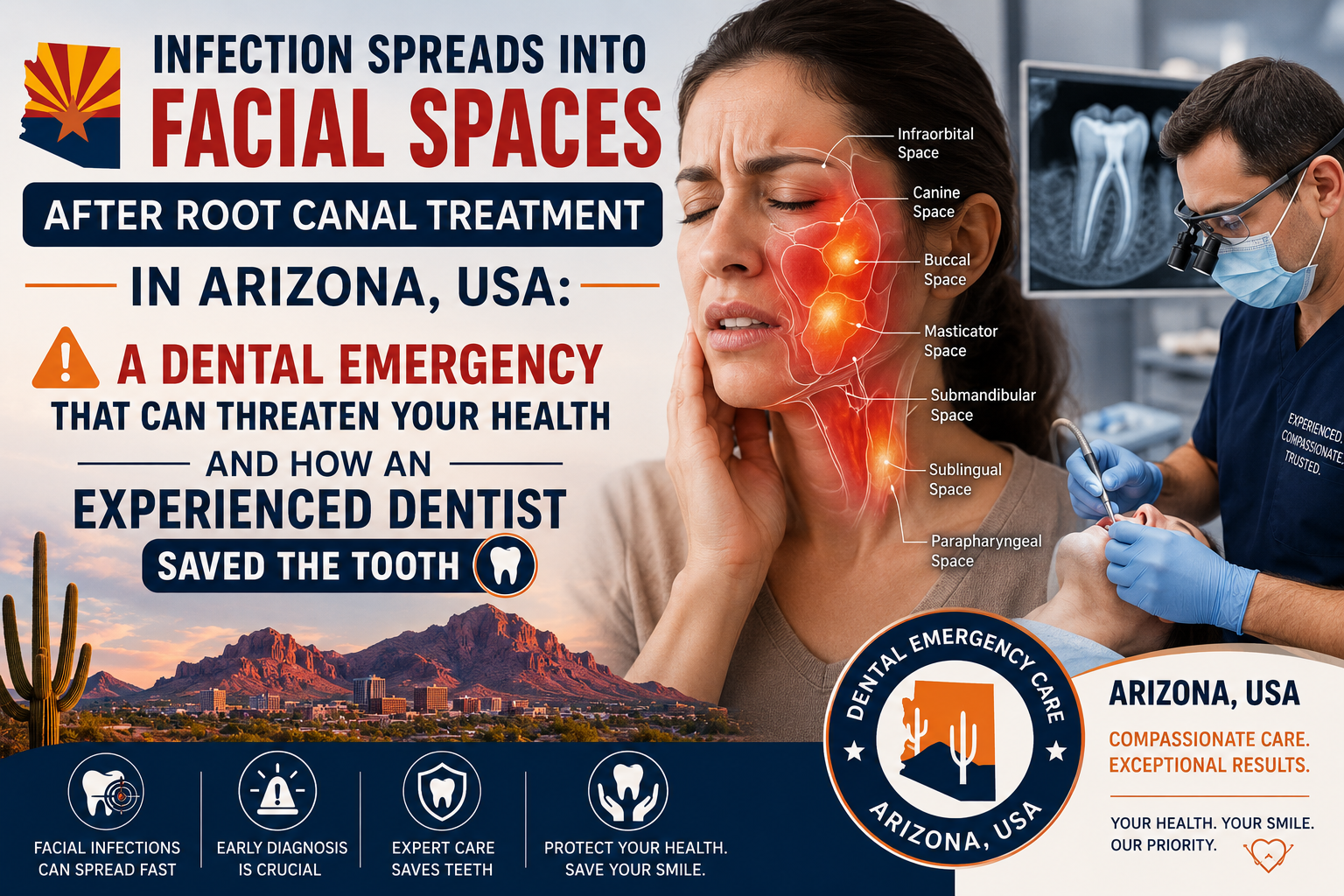
Infection Spreads Into Facial Spaces After Root Canal Treatment in Arizona, USA: A Dental Emergency That Can Threaten Your Health and How an Experienced Dentist Saved the Tooth
Language :
Most patients expect relief after a root canal treatment. In the majority of cases, root canal therapy successfully removes infection, eliminates pain, and allows the tooth to function for many years. However, in rare situations, infection may continue to spread even after treatment this is havoc in your mind you thought after treatment things get better yet the results it seems getting worsen everyday ask second wisdom from skilled dentist.. When this occurs, the consequences can become serious, especially if bacteria move beyond the tooth and into the facial spaces.
As a practicing dentist in the United States, I have seen patients throughout Arizona arrive with significant facial swelling, severe pain, difficulty opening their mouth, and even trouble swallowing after a root canal procedure. These situations can be frightening for patients making them dizzy thinking the worse pain are coming and their families because the infection appears to be getting worse rather than better.
The good news is that modern dental technology, advanced imaging with AI innovation technologies , and specialized treatment techniques can often stop the infection and save teeth that initially appear hopeless.
This article explains why facial space infections occur after root canal treatment, the warning signs every Arizona patient should recognize, the dangers of delaying care, and a remarkable case in which a severely infected tooth was successfully rescued.
Understanding Facial Space Infections
Many have neglected if the situation still small piece of irritation yet worse are coming more delay more and more bacteria are massively scaling at the deeper nerves in the body. The face contains multiple anatomical spaces between muscles, connective tissues, and bones. These areas normally remain infection-free.
When bacteria escape from an infected tooth, they can travel through bone and soft tissue into these spaces.
Dental infections most commonly spread into:
- Buccal space
- Canine space
- Submandibular space
- Sublingual space
- Masticator space
- Infraorbital space
- Parapharyngeal space
Understanding these spaces is critical because some infections can become life-threatening.
1. Buccal Space
Location
- Between the cheek muscles and the skin of the face.
- Usually associated with upper or lower molars. The face really change never neglect small pain. Ask for help earlier and ask consultation.
Signs and Symptoms
- Swollen cheek
- Facial asymmetry
- Tenderness when touching the cheek
- Mild to moderate pain
Severity
- Usually not life-threatening.
- Requires prompt dental treatment to prevent spread. This changes your life when you are the darkness time of your life.
Common Cause
- Infected upper or lower molars.
- Failed root canal treatment.
2. Canine Space
Location
- Above the upper canine tooth.
- Between facial muscles near the nose.
Signs and Symptoms
- Swelling beside the nose. This feels uneasy when you socialized with other communities.
- Upper lip swelling feels embarrassing situation anywhere you go seems sickness in your face.
- Loss of the natural crease between nose and cheek
- Facial pain
Severity
- More dangerous than buccal infections.
- Infection can spread toward the eye socket.
Common Cause
- Abscessed maxillary canine tooth.
3. Submandibular Space
Location
- Beneath the lower jaw (mandible).
Signs and Symptoms
- Swelling under the jaw
- Difficulty swallowing
- Fever
- Pain under the chin
Severity
- Potentially serious.
- Can lead to airway obstruction.
Common Cause
- Lower second and third molar infections.
Emergency Risk
- May progress to Ludwig's Angina, a life-threatening infection.
4. Sublingual Space
Location
- Under the tongue.
Signs and Symptoms
- Tongue elevated upward
- Difficulty speaking
- Difficulty swallowing
- Drooling
- Floor of mouth swelling
Severity
- Very dangerous.
- Can rapidly block the airway.
Common Cause
- Infections from lower premolars and first molars.
Emergency Risk
- Requires immediate medical evaluation.
5. Masticator Space
Location
- Around the muscles used for chewing.
Signs and Symptoms
- Severe jaw pain
- Difficulty opening the mouth (trismus)
- Swelling near the jaw angle
- Pain while chewing
Severity
- Serious deep facial infection.
Common Cause
- Infected wisdom teeth.
- Severe lower molar infections.
Complications
- Spread into deeper neck spaces.
6. Infraorbital Space
Location
- Below the eye socket.
Signs and Symptoms
- Swelling under the eye
- Eyelid swelling
- Facial pain
- Eye discomfort
Severity
- Potentially dangerous.
Common Cause
- Upper premolar and canine infections.
Complications
- Infection may spread into the orbit (eye socket).
7. Parapharyngeal Space
Location
- Deep space beside the throat.
Signs and Symptoms
- Severe difficulty swallowing
- High fever
- Neck swelling
- Difficulty breathing
- Muffled voice ("hot potato voice")
Severity
- Extremely dangerous.
- Medical emergency.
Common Cause
- Spread from severe dental infections.
- Untreated molar abscesses.
Complications
- Airway obstruction
- Sepsis
- Spread into the chest (mediastinitis)
Which Dental Infection Spaces Are Most Dangerous?
Highest Risk (Life-Threatening)
- Parapharyngeal Space
- Sublingual Space
- Submandibular Space
Moderate Risk
- Masticator Space
- Infraorbital Space
- Canine Space
Lower Risk
- Buccal Space
Warning Signs Requiring Immediate Emergency Care
Seek emergency treatment if a dental infection causes:
- Difficulty swallowing
- Difficulty breathing
- Tongue swelling
- Swelling under the jaw
- Fever above 101°F (38.3°C)
- Rapidly increasing facial swelling
- Inability to open the mouth
- Voice changes
- Confusion or weakness
A simple tooth infection or failed root canal can spread from the tooth into the buccal, canine, submandibular, sublingual, masticator, infraorbital, and parapharyngeal spaces, with the latter three neck-related spaces carrying the greatest risk of hospitalization, airway compromise, and even death if not treated promptly.
Once bacteria enter these areas, swelling can become extensive and potentially dangerous.
Unlike a simple toothache, facial space infections involve larger portions of the face and neck.
Immediate treatment is often necessary.
Why Can Infection Spread After a Root Canal?
Many patients believe a root canal instantly removes every bacterial organism from the tooth.
Unfortunately, dentistry is more complex than that.
Root canal systems often contain:
- Tiny side canals
- Curved canals
- Calcified canals
- Hidden branches
- Complex anatomical structures
Even under ideal conditions, bacteria can occasionally survive.
Common reasons for persistent infection include:
Missed Root Canals
Some molars contain additional canals that are difficult to locate.
If one remains untreated, infection can continue growing.
Cracked Teeth
A fracture allows bacteria to repeatedly enter the tooth.
Incomplete Healing
Long-standing infections may require time before complete healing occurs.
Reinfection
Broken fillings or delayed crowns may allow bacteria to re-enter the root canal system.
Resistant Bacterial Colonies
Certain microorganisms survive exceptionally well inside root structures.
Arizona's Unique Risk Factors
Arizona patients face several factors that can worsen dental infections.
Dry Climate
Dehydration can negatively affect oral health and healing.
Delayed Treatment
Many residents in rural Arizona travel considerable distances for specialty dental care.
Extreme Temperatures
Heat exposure can contribute to dehydration and increased discomfort.
Busy Lifestyles
Patients often postpone treatment because symptoms temporarily improve.
Unfortunately, infections rarely disappear permanently without proper care.
Warning Signs That Infection Is Spreading
After root canal treatment, mild soreness may be normal.
However, facial space infection produces symptoms that should never be ignored.
Significant Facial Swelling
The face may appear visibly enlarged.
One side may become noticeably different from the other.
Severe Throbbing Pain
Pain often becomes constant and difficult to control.
Fever
An elevated body temperature frequently indicates infection.
Difficulty Opening the Mouth
Known as trismus, this symptom can signal deeper infection.
Difficulty Swallowing
This may indicate spread into deeper tissue spaces.
Difficulty Breathing
This represents a medical emergency.
Swollen Lymph Nodes
The body's immune system reacts aggressively to spreading bacteria.
General Illness
Patients may experience fatigue, chills, and weakness.
How Dental Infections Travel Through the Face
Many people are surprised by how quickly a dental infection can spread.
A lower molar infection may extend into:
- The jaw
- The cheek
- The neck
- Under the tongue
An upper tooth infection may spread toward:
- The sinus cavity
- The eye region
- Facial soft tissues
Because facial spaces are interconnected, bacteria may travel beyond the original tooth.
This is why dentists treat serious swelling aggressively.
Can Facial Space Infections Become Life-Threatening?
The answer is yes.
Although uncommon, severe dental infections can become medical emergencies.
Complications may include:
Airway Obstruction
Swelling can interfere with breathing.
Hospitalization
Intravenous antibiotics may be necessary.
Bone Infection
The jawbone itself can become infected.
Bloodstream Infection
Bacteria may enter circulation.
Deep Neck Infection
This condition requires urgent medical attention.
Tooth Loss
Delayed treatment significantly reduces the chance of saving the tooth.
Fortunately, early intervention dramatically improves outcomes.
Diagnosing the Source of Infection
Modern dentistry relies on advanced diagnostic methods.
Clinical Examination
The dentist evaluates:
- Swelling location
- Gum condition
- Bite function
- Tooth mobility
Digital Radiographs
X-rays help reveal hidden infection.
Cone Beam CT Imaging
Three-dimensional imaging provides exceptional detail.
CBCT scans can identify:
- Missed canals
- Bone destruction
- Fractures
- Hidden abscesses
Thermal Testing
Evaluates neighboring teeth.
Percussion Testing
Determines inflammatory activity around the root.
Treatment Options for Facial Space Infections
Treatment depends on severity.
Antibiotics
These help reduce bacterial activity.
However, antibiotics alone rarely solve the problem.
The source must be addressed.
Drainage Procedures
Sometimes accumulated infection must be drained.
Root Canal Retreatment
Previously treated teeth may require additional cleaning.
Apicoectomy
Surgical removal of infected root tips may be necessary.
Extraction
If the tooth cannot be saved predictably, removal becomes the safest option.
A Remarkable Arizona Case: Saving a Tooth That Seemed Beyond Rescue
Several years ago, a patient from the Phoenix metropolitan area arrived at our office in distress.
We will call him David.
David was a 47-year-old electrician who had undergone root canal treatment on a lower molar approximately six months earlier.
Initially, everything appeared successful.
The pain disappeared.
He returned to work.
Life seemed normal.
Then subtle symptoms began appearing.
His jaw occasionally felt tender.
Chewing became uncomfortable.
A mild swelling developed near the lower cheek.
He assumed it would resolve on its own.
Instead, it gradually worsened.
One morning, David woke up and immediately noticed something was wrong.
The entire side of his face appeared swollen.
His jaw felt stiff.
Opening his mouth became difficult.
Eating was painful.
His wife insisted he seek emergency treatment.
The Initial Evaluation
Upon examination, significant facial swelling was present.
The lower jaw region appeared enlarged.
The tissues were tender.
A previous root canal had clearly been performed.
At first glance, the tooth looked hopeless.
Many patients assume extraction is inevitable in situations like this.
However, our team wanted answers before making that decision.
A CBCT scan was obtained.
The images revealed a surprising finding.
The original tooth contained an additional hidden canal that had never been cleaned.
This canal remained infected.
The infection had slowly expanded beyond the tooth and entered nearby facial spaces.
The root itself remained structurally intact.
No vertical fracture was visible.
That finding completely changed the treatment plan.
The tooth still had a chance.
Developing a Treatment Strategy
The goal was straightforward:
- Eliminate infection.
- Preserve healthy tooth structure.
- Stop facial space involvement.
- Prevent future recurrence.
Immediate antibiotics were prescribed.
Drainage pathways were carefully evaluated.
Retreatment of the root canal system was scheduled.
Because swelling was significant, timing was critical.
Finding the Hidden Cause
During retreatment, previous filling materials were removed.
Using high-powered magnification and microscopic visualization, the root system was carefully inspected.
Deep inside the tooth, the previously missed canal was finally located.
The canal contained infected debris and bacterial contamination.
This hidden space had likely been responsible for the patient's ongoing problems from the beginning.
Specialized instruments were used to clean the canal thoroughly.
Advanced irrigation solutions eliminated bacterial biofilms.
Antimicrobial medication was placed inside the root system.
The tooth was sealed temporarily.
The First Signs of Improvement
Within several days, David noticed encouraging changes.
The swelling stopped increasing.
Pain levels decreased.
Jaw movement improved.
His appetite returned.
The body was finally able to begin healing because the source of infection had been addressed.
At his follow-up visit, facial swelling had visibly decreased.
This was an important milestone.
Long-Term Healing
Over the following months, bone regeneration became visible on radiographs.
The surrounding tissues normalized.
Inflammation resolved.
The infection disappeared.
Once healing was confirmed, a permanent crown was placed.
The final restoration protected the tooth and restored full function.
Today, years later, the tooth remains healthy.
David avoided extraction, avoided an implant, and preserved his natural tooth.
What initially appeared to be a hopeless situation became a successful rescue because the true cause was identified.
Lessons From This Case
David's story highlights several important principles.
Never Ignore Swelling
Even mild swelling deserves evaluation.
Advanced Imaging Matters
Traditional X-rays may miss important findings.
Hidden Canals Exist
Complex anatomy can challenge even experienced clinicians.
Early Treatment Improves Outcomes
The sooner infection is addressed, the greater the chance of saving the tooth.
Not Every Failed Root Canal Requires Extraction
Many teeth can be successfully retreated.
Preventing Future Root Canal Complications
Patients can reduce risk by following several important guidelines.
Attend Follow-Up Visits
Regular evaluations help identify problems early.
Obtain Permanent Crowns Promptly
Temporary restorations are not designed for long-term use.
Maintain Excellent Oral Hygiene
Healthy gums support long-term tooth survival.
Avoid Tobacco Products
Smoking significantly impairs healing.
Seek Care Quickly
Do not wait for symptoms to become severe.
What Arizona Patients Should Do If Swelling Develops
If facial swelling occurs after a root canal:
- Contact your dentist immediately.
- Take prescribed medications exactly as directed.
- Avoid self-diagnosing online.
- Monitor breathing and swallowing.
- Seek emergency care if symptoms worsen rapidly.
Prompt intervention can prevent serious complications.
The Future of Root Canal Treatment
Modern endodontics continues advancing rapidly. As the global community share expert and experience giving best advise to each clients. Global scale connection accelerate information thru implementation.
Current technologies include:
- Dental operating microscopes
- CBCT imaging
- Ultrasonic instrumentation
- Bioceramic materials
- Advanced irrigation systems
These innovations dramatically improve treatment success rates.
Many teeth that would have been extracted decades ago can now be preserved successfully.
Things to remember
Infection spreading into facial spaces after root canal treatment in Arizona is a serious condition that requires immediate professional evaluation. While root canal therapy remains one of the most successful procedures in modern dentistry, persistent infection can occasionally occur due to missed canals, fractures, reinfection, or complex anatomy.
The good news is that advanced AI technologies diagnostics and modern treatment techniques often allow dentists to identify the underlying problem and save teeth that initially seem beyond repair.
David's case demonstrates the importance of proper diagnosis, advanced imaging, and timely intervention. A hidden canal allowed infection to spread into facial tissues, creating significant swelling and discomfort. Yet through careful retreatment and modern dental technology, the infection was eliminated and the tooth was successfully preserved.
If you experience facial swelling, worsening pain, fever, difficulty swallowing, or jaw stiffness after a root canal procedure, do not delay seeking care. Early treatment may not only save your tooth but also protect your overall health and prevent potentially dangerous complications.
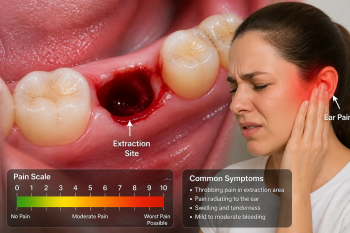
Can tooth extraction cause infection? Mild inflammation is normal, but increasing swelling, fever, or severe pain may indicate infection. Learn more about post-extraction infection warning signs in this detailed guide.
Book a consultation with our Cebu dental specialists for proper evaluation and care.
Ready to get expert guidance?
If you’re experiencing severe pain or delayed healing, book a consultation with our Cebu dental specialists to get proper evaluation and care.
Consultation or contact page .
Book a Consultation
For severe discomfort or delayed healing, book a consultation with our Cebu dental specialists today.
Looking for a dentist? Browse our Cebu dental directory to find trusted clinics near you.
Medical Review and Clinical Basis
This article is based on clinical dental guidelines and real patient recovery patterns observed after tooth extraction procedures. The information reflects common post-extraction healing stages, including normal clot formation, gum tissue repair, and signs of possible complications such as dry socket or infection.
While mild discomfort is expected after a dental extraction, worsening pain after Day 3, bad odor, exposed bone, or spreading pain may require professional evaluation. These symptoms are consistent with known post-extraction complications described in standard dental practice.
About Cebu Dental Implants
Cebu Dental Implants provides comprehensive tooth extraction, surgical procedures, and dental implant services in the Philippines. Our team evaluates post-extraction healing, manages complications such as dry socket, and advises patients on proper aftercare to prevent infection and delayed healing.
If you experience severe pain or unusual symptoms after extraction, early professional assessment is recommended to prevent further complications.
Important Medical Disclaimer
This content is for educational purposes only and does not replace professional dental diagnosis. Every patient heals differently. If symptoms worsen or do not improve within a few days, consult a licensed dentist for proper evaluation and treatment.
Author
This article was prepared by the Cebu Dental Implants content team in consultation with licensed dental professionals experienced in tooth extraction and implant procedures.
Video:
Short Story:
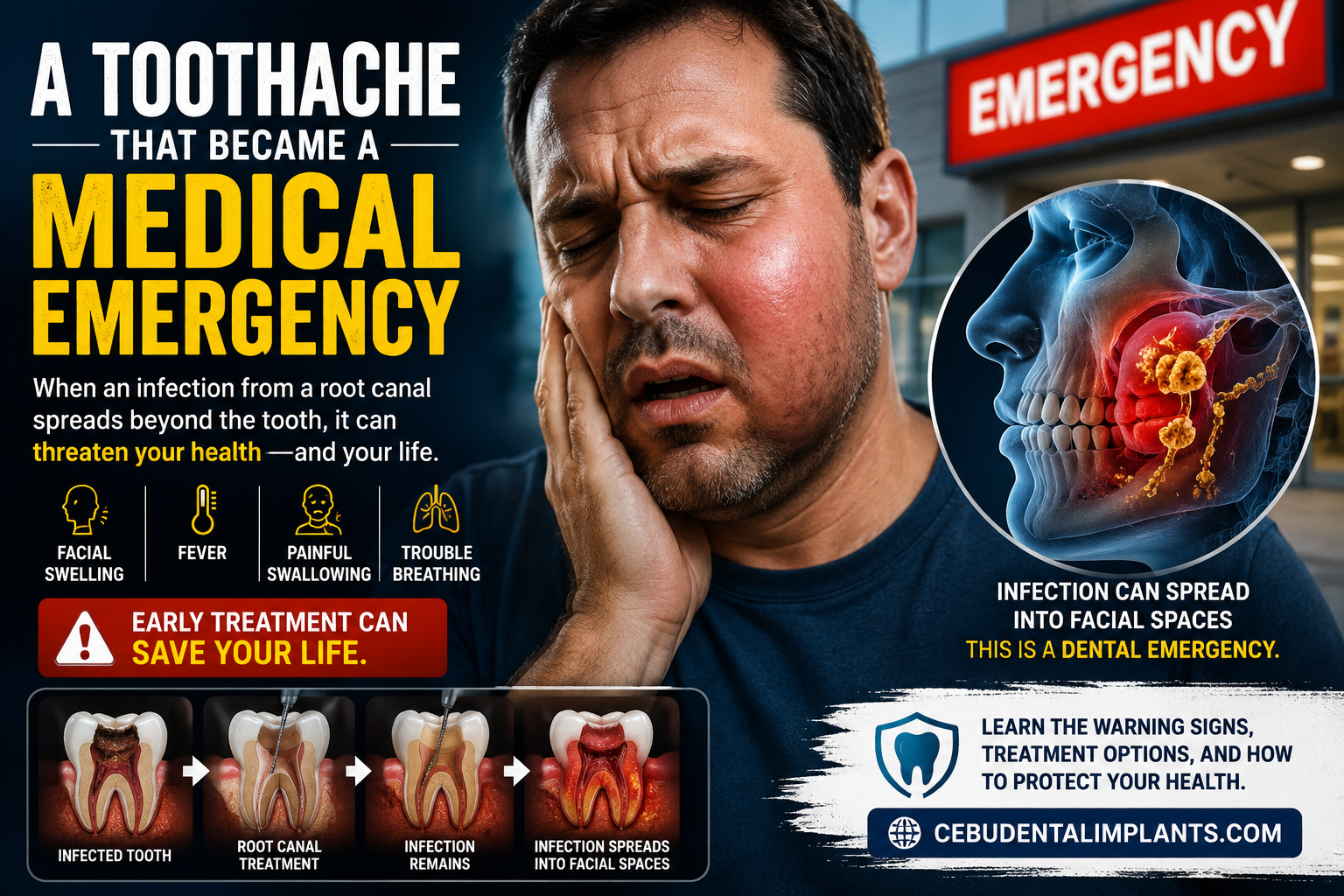
A Toothache That Became a Medical Emergency
Mark, a 42-year-old father from Arizona, thought the worst was over after his root canal treatment. For the first day, everything seemed normal. But by the third morning, he woke up with a swollen cheek and increasing pain.
He assumed it was part of the healing process.
Within hours, the swelling spread beneath his jaw. He struggled to open his mouth, developed a fever, and swallowing became painful. His dentist immediately recognized the warning signs—an infection had spread into the facial spaces, a condition that can become life-threatening if left untreated.
Mark was rushed for emergency care, where doctors drained the infection and started intravenous antibiotics. Thanks to quick treatment, he made a full recovery.
His experience is an important reminder: facial swelling after a root canal should never be ignored, especially if it is rapidly getting worse or is accompanied by fever, difficulty swallowing, or trouble breathing.
Read the complete case study, warning signs, emergency treatment options, and prevention tips here:
Related Clinical Cases
Patients with lower front gum inflammation may also experience tartar buildup, periodontal disease, gum abscesses, or tooth decay. Explore these related clinical case studies.
Other topics:
Other Dental Clinic