Missing Teeth? Find Your Smile Again.

Why Are Dental Implants So Expensive in Denmark? A Complete 2026 Guide to Costs, Quality, and Ways to Save
Language :
Topics:
Dental implants have become the gold standard for replacing missing teeth. They offer exceptional stability, preserve jawbone structure, improve chewing function, and provide a natural-looking appearance that closely mimics real teeth. For many patients, implants represent a life-changing investment in both oral health and confidence.
However, one question consistently arises among Danish residents and international patients considering treatment in Denmark: Why are dental implants so expensive?
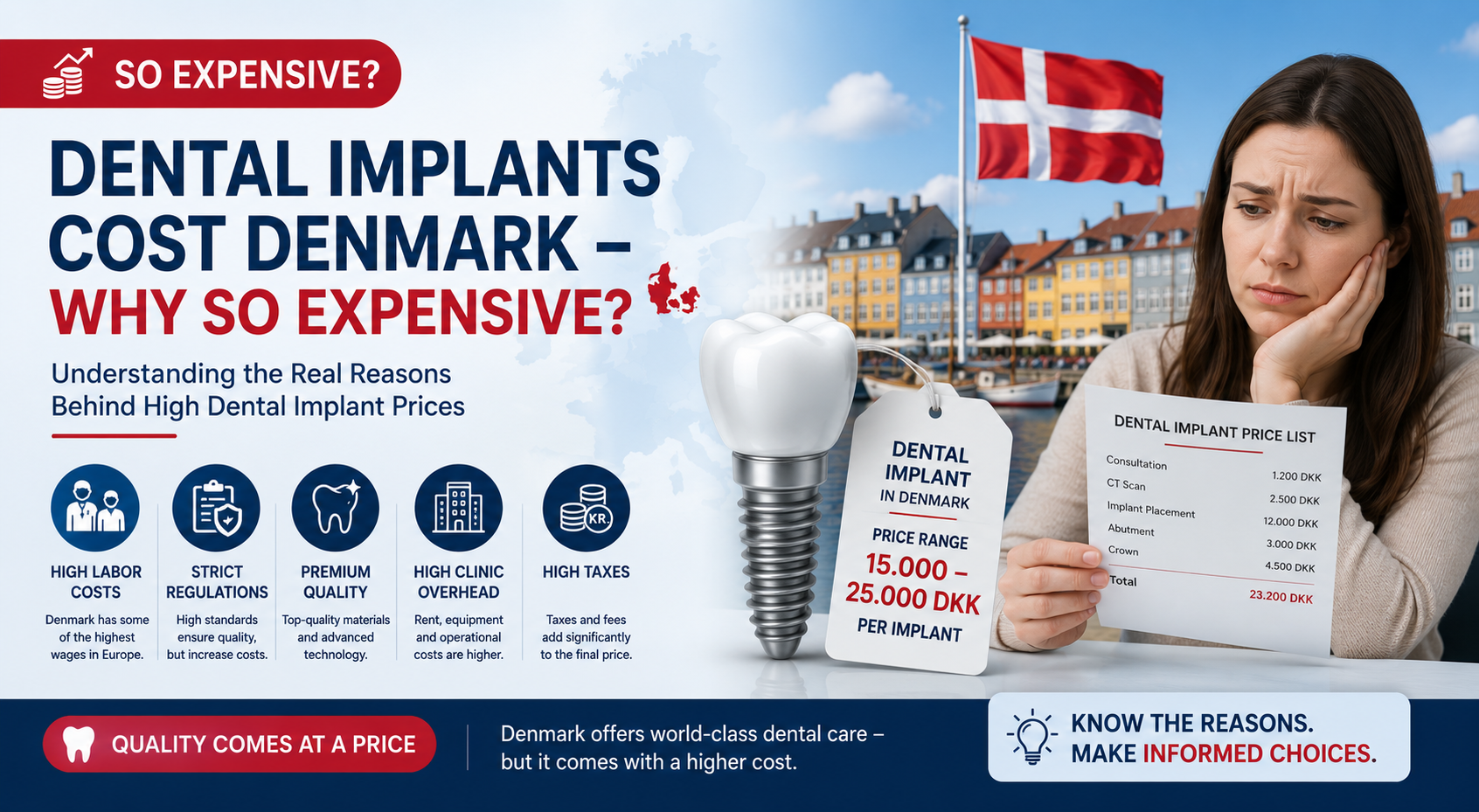
A single dental implant in Denmark commonly costs between 10,000 DKK and 25,000 DKK (€1,350–€3,350), while more complex treatments involving multiple implants, bone grafting, or full-mouth restorations can cost substantially more. Compared with some neighboring countries and dental tourism destinations, Danish implant prices may initially appear surprisingly high.
The reality is that implant costs in Denmark reflect a combination of economic factors, strict healthcare regulations, highly trained professionals, premium materials, advanced technology, and a healthcare system that generally does not subsidize implant treatment. Rather than representing excessive pricing alone, implant fees often reflect the true cost of delivering modern, evidence-based dental care at a consistently high standard.
This comprehensive guide explains why implants cost what they do in Denmark, what is included in treatment fees, how patients can compare clinics effectively, and what strategies may help reduce overall treatment costs without sacrificing quality.
Understanding Dental Implants
Before discussing costs, it is important to understand what a dental implant actually involves.
Many patients mistakenly assume they are paying for a single artificial tooth.
In reality, implant treatment consists of several separate components and procedures.
A dental implant typically includes:
- The implant fixture (post)
- The abutment
- The custom-made crown
- Diagnostic imaging
- Surgical placement
- Follow-up care
- Laboratory fabrication
- Clinical expertise
Each component contributes to the final cost.
What Is a Dental Implant?
A dental implant is a small titanium or zirconia post surgically placed into the jawbone.
After healing, the implant serves as an artificial tooth root.
Once integration with the bone is complete, a connector called an abutment is attached.
A custom-made crown is then placed on top to restore appearance and function.
The result closely resembles a natural tooth.
Why Denmark Has Some of Europe's Higher Implant Prices
Denmark consistently ranks among the world's most expensive countries in terms of living costs.
This affects nearly every aspect of healthcare delivery.
Several factors contribute to implant pricing.
High Cost of Living
One of the most significant drivers is Denmark's high cost of living.
Dental clinics face expenses similar to other businesses, including:
- Rent
- Utilities
- Insurance
- Equipment maintenance
- Administrative costs
Operating expenses in Danish cities can be substantially higher than those in many European countries.
These costs ultimately influence treatment pricing.
Highly Paid Dental Professionals
Danish healthcare workers receive competitive compensation.
Dental clinics employ:
- Dentists
- Oral surgeons
- Prosthodontists
- Dental hygienists
- Dental assistants
- Laboratory technicians
- Administrative personnel
Their salaries reflect Denmark's strong labor market and high living standards.
Because labor represents one of the largest clinic expenses, staffing costs significantly influence implant fees.
Extensive Education and Specialist Training
Dental implant treatment requires advanced clinical expertise.
Most implant providers undergo years of additional training beyond dental school.
This may include:
- Implantology programs
- Surgical training
- Prosthodontic education
- Continuing professional development
Patients are paying not only for materials but also for years of accumulated expertise.
Strict Danish Healthcare Regulations
Denmark maintains exceptionally high healthcare standards.
Dental clinics must comply with regulations covering:
- Infection control
- Sterilization
- Radiation safety
- Documentation
- Professional licensing
- Quality assurance
Compliance requires substantial investment in equipment, training, and facility maintenance.
These safeguards protect patients but also increase operating costs.
Premium Implant Systems
Another major factor involves the implant brands commonly used in Denmark.
Most reputable clinics utilize internationally recognized implant systems.
Examples include:
- Nobel Biocare
- Straumann
- Astra Tech
- BioHorizons
- Camlog
These companies invest heavily in:
- Clinical research
- Product development
- Long-term testing
- Quality assurance
Premium implant systems generally cost more than generic alternatives.
However, they often provide:
- Strong scientific support
- Extensive documentation
- Reliable components
- Manufacturer warranties
Many dentists consider these advantages worthwhile.
The Role of Scientific Research
Leading implant brands have decades of published clinical research supporting their products.
Research demonstrates:
- High success rates
- Long-term durability
- Predictable outcomes
Patients effectively benefit from years of scientific development built into each implant system.
This contributes to higher costs but also greater confidence in long-term performance.
Advanced Technology Increases Precision
Modern implant treatment increasingly relies on digital technologies.
Many Danish clinics invest heavily in advanced diagnostic and planning tools.
Cone Beam Computed Tomography (CBCT)
CBCT scans provide three-dimensional imaging of:
- Bone structure
- Nerve locations
- Sinus anatomy
- Implant sites
This technology improves treatment planning and reduces surgical risks.
However, CBCT equipment can cost tens of thousands of euros.
Digital Implant Planning
Many clinics now use software to plan implant placement virtually before surgery.
Benefits include:
- Greater accuracy
- Improved safety
- Better aesthetics
- Reduced complications
Digital planning systems represent another significant investment.
Computer-Guided Surgery
Guided surgery uses custom surgical templates to position implants precisely.
Advantages include:
- Improved implant positioning
- Faster procedures
- Better outcomes
- Increased predictability
While highly beneficial, guided surgery adds laboratory and planning costs.
CAD/CAM Crown Fabrication
Modern implant crowns are frequently produced using CAD/CAM technology.
Computer-aided design and manufacturing provide:
- Enhanced precision
- Better fit
- Improved aesthetics
However, these systems require substantial equipment investments.
Understanding Denmark's Fragmented Billing Structure
One reason implant treatment appears expensive is that fees are often presented separately.
Unlike some countries that advertise all-inclusive packages, Danish clinics commonly itemize treatment.
Typical Implant Cost Breakdown
Patients may see separate charges for:
- Initial consultation
- CBCT scan
- Surgical planning
- Implant placement
- Bone grafting
- Healing abutment
- Final abutment
- Crown fabrication
- Laboratory fees
- Follow-up visits
Each component contributes to the final treatment cost.
Why Itemized Billing Can Be Beneficial
Although itemized pricing can seem expensive, it offers transparency.
Patients can clearly understand:
- What they are paying for
- Which services are included
- Which optional procedures are recommended
This reduces surprises during treatment.
What Is Usually Included in Implant Treatment?
When evaluating quotes, patients should understand what is actually included.
Implant Fixture
The implant itself serves as the artificial root.
This component is surgically inserted into the jawbone.
Premium implants often represent a significant portion of treatment cost.
Abutment
The abutment connects the implant to the crown.
Custom abutments frequently improve aesthetics and function.
These components are usually manufactured individually.
Crown
The visible replacement tooth is custom fabricated.
Materials may include:
- Zirconia
- Porcelain
- Ceramic
The crown is often one of the most expensive components.
Surgical Expertise
Implant placement is a surgical procedure requiring considerable skill.
The clinician's expertise contributes substantially to treatment fees.
Patients benefit from:
- Diagnosis
- Treatment planning
- Surgical execution
- Long-term monitoring
Follow-Up Care
Postoperative appointments are essential for:
- Monitoring healing
- Detecting complications
- Ensuring implant stability
These visits are often included in treatment costs.
Why Location Matters
Implant prices vary across Denmark.
Copenhagen
As Denmark's capital, Copenhagen typically has:
- Higher rent
- Higher salaries
- Greater demand
As a result, implant prices are often among the highest in the country.
Aarhus
Denmark's second-largest city also experiences relatively high treatment costs.
However, prices may vary significantly between clinics.
Regional Areas
Patients sometimes find lower fees in smaller cities and towns.
Reduced overhead expenses can lead to modest savings.
However, treatment quality should always remain the primary consideration.
Are Cheaper Implants Always a Better Deal?
Many patients focus exclusively on price.
This can be risky.
The lowest quote may not provide the best value.
Questions to Ask About Lower Prices
If one clinic appears dramatically cheaper, ask:
- Which implant system is used?
- Is CBCT imaging included?
- Are laboratory fees included?
- Is the crown included?
- Are follow-up visits included?
Apparent savings sometimes disappear after hidden costs emerge.
The Cost of Bone Grafting
Some patients require additional procedures before implant placement.
One common example is bone grafting.
Why Bone Grafting Is Needed
Bone loss often occurs after tooth extraction.
If insufficient bone remains, implant placement may not be possible.
Bone grafting helps rebuild the foundation.
Additional Costs
Bone grafting can add several thousand kroner to treatment costs.
Patients should discuss these possibilities before beginning treatment.
Sinus Lifts and Other Advanced Procedures
Implants in the upper jaw may require sinus augmentation.
This procedure increases available bone height.
Although highly predictable, it adds complexity and expense.
Comparing Implant Quotes Effectively
Many patients make the mistake of comparing only total prices.
A more effective approach involves evaluating:
- Materials
- Technology
- Experience
- Included services
This ensures a fair comparison.
Ask for Written Treatment Plans
Always request a detailed written estimate.
The plan should specify:
- Implant brand
- Number of implants
- Crown material
- Additional procedures
- Expected timeline
Written documentation improves transparency.
How to Reduce Implant Costs in Denmark
Although implants remain expensive, several strategies can help.
Compare Multiple Clinics
Obtaining two or three consultations often reveals significant pricing differences.
Different clinics may:
- Use different materials
- Offer different approaches
- Structure fees differently
Comparing options can identify value opportunities.
Consider Regional Providers
Regional clinics sometimes offer lower fees than those in central Copenhagen.
However, quality and experience should remain top priorities.
Verify Potential Subsidies
Although implants themselves are usually excluded from public subsidies, related treatments may qualify.
Examples may include:
- Examinations
- Periodontal therapy
- Certain diagnostic procedures
Patients should discuss eligibility with their clinic.
Maintain Excellent Oral Health
Preventing tooth loss remains the most cost-effective strategy.
Healthy habits include:
- Brushing twice daily
- Daily flossing
- Regular check-ups
- Professional cleanings
- Smoking cessation
Avoiding tooth loss eliminates the need for implants altogether.
Are Dental Implants Worth the Cost?
Despite the expense, implants offer unique advantages.
Benefits of Dental Implants
Advantages include:
- Preservation of jawbone
- Natural appearance
- Excellent chewing ability
- Long-term durability
- Improved confidence
For many patients, these benefits justify the investment.
Longevity
With proper care, implants may function successfully for decades.
This long lifespan can improve long-term value compared with alternative treatments.
Alternative Treatment Options
Patients unable or unwilling to pursue implants may consider:
- Dental bridges
- Partial dentures
- Full dentures
Each option has advantages and limitations.
A thorough consultation can help determine the best solution.
Final Thoughts
Dental implants in Denmark are expensive for several legitimate reasons. High labor costs, strict healthcare regulations, advanced technology, premium implant systems, and extensive professional expertise all contribute to treatment pricing. While the initial investment may seem substantial, these factors also support the high standards of care that characterize Danish dentistry.
Patients should recognize that implant treatment involves far more than simply purchasing an artificial tooth. The total fee reflects sophisticated diagnostics, surgical planning, premium materials, laboratory fabrication, follow-up care, and the skills of highly trained clinicians. Understanding this broader picture helps explain why implant costs can vary significantly between providers and regions.
Before beginning treatment, patients should request detailed written estimates, compare multiple clinics, verify what services are included, and discuss potential additional procedures such as bone grafting or sinus lifts. Although implants themselves are generally not covered by public subsidies, certain associated services may qualify for partial reimbursement depending on individual circumstances.
Ultimately, dental implants remain one of the most reliable and successful methods for replacing missing teeth. When performed by experienced professionals using quality materials, they provide long-term functional and aesthetic benefits that can significantly improve quality of life.
Can tooth extraction cause infection? Mild inflammation is normal, but increasing swelling, fever, or severe pain may indicate infection. Learn more about post-extraction infection warning signs in this detailed guide.
Book a consultation with our Cebu dental specialists for proper evaluation and care.
Ready to get expert guidance?
If you’re experiencing severe pain or delayed healing, book a consultation with our Cebu dental specialists to get proper evaluation and care.
Consultation or contact page .
Book a Consultation
For severe discomfort or delayed healing, book a consultation with our Cebu dental specialists today.
Looking for a dentist? Browse our Cebu dental directory to find trusted clinics near you.
Medical Review and Clinical Basis
This article is based on clinical dental guidelines and real patient recovery patterns observed after tooth extraction procedures. The information reflects common post-extraction healing stages, including normal clot formation, gum tissue repair, and signs of possible complications such as dry socket or infection.
While mild discomfort is expected after a dental extraction, worsening pain after Day 3, bad odor, exposed bone, or spreading pain may require professional evaluation. These symptoms are consistent with known post-extraction complications described in standard dental practice.
About Cebu Dental Implants
Cebu Dental Implants provides comprehensive tooth extraction, surgical procedures, and dental implant services in the Philippines. Our team evaluates post-extraction healing, manages complications such as dry socket, and advises patients on proper aftercare to prevent infection and delayed healing.
If you experience severe pain or unusual symptoms after extraction, early professional assessment is recommended to prevent further complications.
Important Medical Disclaimer
This content is for educational purposes only and does not replace professional dental diagnosis. Every patient heals differently. If symptoms worsen or do not improve within a few days, consult a licensed dentist for proper evaluation and treatment.
Author
This article was prepared by the Cebu Dental Implants content team in consultation with licensed dental professionals experienced in tooth extraction and implant procedures.
Related Clinical Cases
Patients with lower front gum inflammation may also experience tartar buildup, periodontal disease, gum abscesses, or tooth decay. Explore these related clinical case studies.




Other topics:
Other Dental Clinic