From Pain to Perfect — We Care for Your Smile.

The Economic Struggle of Filipino Families: Rising Inflation, Declining Purchasing Power and the Growing Desire to Build a Better Life Abroad
Language :
Topics:
When surviving becomes more difficult than living
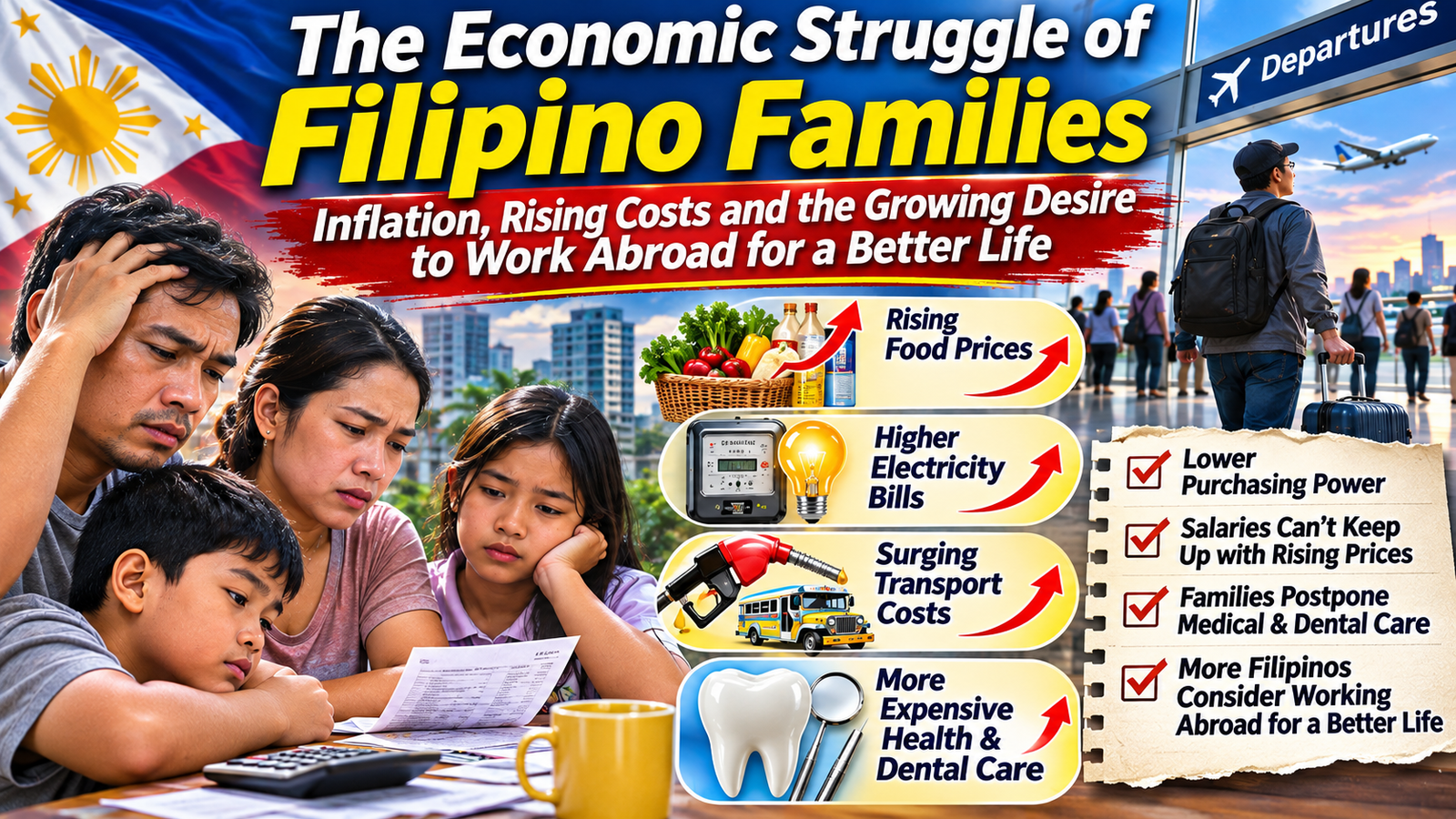
For millions of Filipino families, the rising cost of living is becoming more than an economic concern. It is a daily struggle that affects food, housing, transportation, education, healthcare and the ability to save for the future.
People wake up early, travel long distances to work, spend hours in traffic and work hard to earn a living. Yet, despite their efforts, many families feel that their salaries are no longer sufficient to support their basic needs.
The problem is not simply that prices are increasing. It is that household incomes often struggle to keep pace with the increasing cost of essential goods and services.
A salary that once provided reasonable financial security may now cover only food, rent, electricity, transportation and other necessities.
For some families, savings are disappearing. For others, borrowing has become necessary to cover monthly expenses.
And increasingly, Filipinos are considering a difficult question:
Would life be better if we worked and raised our families in another country?
This growing desire to explore opportunities abroad deserves serious attention. It reflects not only individual ambition but also the economic challenges facing households across the Philippines.
1. The broader economic squeeze: Inflation and the Filipino household
The macroeconomic figures translate into very personal experiences.
According to the Philippine Statistics Authority, headline inflation accelerated to 7.8% in October 2026, compared with 7.2% in September. Transport inflation reached 20.1%, while inflation for housing, water, electricity, gas and other fuels reached 9.3%.
Philippine Statistics Authority+1
Even more concerning is the pressure on lower-income households.
The PSA reported that inflation for the bottom 30% of income households reached 9.5% in October 2026. This means the measured basket of goods and services for these households experienced even faster price growth than the national headline rate.
Philippine Statistics Authority
Why does this matter?
Lower-income families generally have less room to adjust their spending. A greater proportion of their income goes toward necessities, leaving less money for savings, healthcare, education and unexpected expenses.
1.1 The real-wage deficit
An increase in a worker's nominal salary does not necessarily mean an improvement in living standards.
Consider this hypothetical example:
|
Household situation |
Monthly amount |
|---|---|
|
Previous monthly salary |
₱20,000 |
|
Salary after adjustment |
₱21,000 |
|
Previous essential expenses |
₱16,000 |
|
New essential expenses |
₱18,500 |
|
Previous remaining income |
₱4,000 |
|
New remaining income |
₱2,500 |
The worker received a ₱1,000 salary increase, but the remaining money after essential expenses declined by ₱1,500.
This illustrates the difference between nominal wage growth and real purchasing power.
The actual impact varies depending on household size, location, consumption patterns and wage adjustments.
1.2 Families are sacrificing their financial security
When basic expenses consume most of a household's income, families begin making difficult choices.
-
Postponing medical and dental appointments.
-
Reducing the quality or quantity of food purchases.
-
Delaying education-related expenses.
-
Avoiding recreational activities.
-
Using savings to cover ordinary bills.
-
Borrowing money before the next payday.
-
Postponing home repairs and other necessary purchases.
These decisions can create long-term consequences.
A family that continuously spends its savings on everyday necessities becomes more vulnerable to unemployment, illness, accidents and unexpected emergencies.
2. The growing desire to leave the Philippines: Is migration becoming an economic alternative?
One of the most important developments in understanding Filipino economic aspirations is the increasing willingness of people to consider working or living abroad.
This is not merely an observation from social media conversations.
A 2026 nationwide OCTA Research survey found that 57% of adult Filipinos were willing to live or work abroad if given the opportunity. Meanwhile, 39% were unwilling to migrate and 4% were undecided. The survey interviewed 1,200 adults and had a margin of error of approximately ±3 percentage points.
Claudeth Mocon-Ciriaco+1
The reasons are particularly revealing.
Among respondents willing to migrate:
Top motivations for considering migration
Better job opportunities
67%
Higher salaries
61%
Improved quality of life
58%
Education opportunities
20%
International experience
20%
Family reunification
16%
OCTA Research survey results reported in June 2026. Respondents could identify multiple reasons.
Claudeth Mocon-Ciriaco
These figures reveal something important: migration is not exclusively about escaping hardship.
For many Filipinos, it represents the possibility of earning more, developing professional careers, providing better education for their children and achieving long-term financial security.
2.1 Why overseas employment looks attractive
Imagine two workers with similar professional qualifications.
One works locally and struggles to cover rent, transportation, food and family expenses.
The other obtains a legitimate overseas employment opportunity with better compensation, employer-provided accommodation or additional benefits.
The second worker may have a greater opportunity to save, support family members and build financial assets.
This is not guaranteed. Overseas workers also face expensive relocation, taxes, living expenses, recruitment risks, separation from loved ones and cultural adjustment.
However, the potential income difference remains an important motivation.
2.2 The younger generation is looking beyond national borders
The OCTA findings also indicate particularly strong migration interest among younger adults.
More than eight in ten respondents aged 18–24 were reportedly willing to consider living or working abroad if given the opportunity.
Octa survey+1
This raises a significant question about the Philippines' future workforce.
If young professionals increasingly view overseas employment as their best route toward career advancement, the country must consider how to create competitive salaries, professional development opportunities and more secure employment locally.
A country needs its educated and skilled workforce to develop its economy.
Migration can benefit families through remittances and international experience, but excessive dependence on exporting talent can also create shortages in certain professions and industries.
3. The hidden cost of migration: Families are separated to survive economically
Behind every overseas worker is often a family making sacrifices.
A father may work in the Middle East while his wife and children remain in the Philippines. A mother may work in Japan, Hong Kong or Singapore while her children grow up under the care of grandparents.
Some families spend years living apart because they believe overseas employment provides a better opportunity to secure their children's future.
The financial benefits can be significant:
-
Monthly remittances help pay for food and household expenses.
-
Overseas salaries may finance college education.
-
Families may purchase land or build homes.
-
Medical expenses become more manageable.
-
Some workers save enough to start businesses after returning home.
But there is another side to this story.
Children grow up without daily contact with one or both parents. Marriages experience the pressure of long-distance relationships. Parents miss important family occasions, birthdays and milestones.
Economic survival can come at the expense of family togetherness.
The question is whether Filipino families should continually have to choose between financial security and living together.
4. Energy and transportation: The expenses that affect almost everything
The Philippines is exposed to international energy-market movements because it relies heavily on imported petroleum products.
When international fuel prices rise, the consequences can spread throughout the economy.
4.1 Transportation expenses
Higher fuel prices affect:
-
Jeepney and bus operators.
-
Tricycle drivers.
-
Delivery businesses.
-
Agricultural transport.
-
Freight and logistics companies.
-
Workers commuting every day.
A delivery company facing higher fuel expenses may increase its service charges. A transportation operator may need to adjust fares or accept lower earnings.
Businesses transporting food and consumer products may also face additional distribution expenses.
Ultimately, ordinary consumers can experience these costs through higher prices.
4.2 Electricity expenses
Electricity is another major household and business concern.
Higher energy costs can affect families using air-conditioning, refrigeration, computers and household appliances.
Small businesses also face difficult decisions.
A bakery, restaurant, manufacturing operation or dental clinic cannot simply stop using electricity. Equipment, refrigeration, lighting, computers and essential machinery must continue operating.
For businesses already experiencing declining profit margins, increased utility expenses can become a serious financial burden.
5. The healthcare consequences: When families can no longer prioritize their health
One of the most concerning effects of household financial pressure is the possibility that families will postpone healthcare.
People do not necessarily stop needing medical treatment when their income becomes insufficient.
Instead, they may delay seeking it.
A family experiencing financial difficulties may prioritize food, rent, school expenses and transportation before visiting a doctor or dentist.
This can lead to several problems.
5.1 Deferred medical and dental treatment
Some patients may postpone:
-
Routine medical examinations.
-
Dental consultations.
-
Professional teeth cleaning.
-
Dental fillings.
-
Root canal treatment.
-
Prescription medication.
-
Diagnostic examinations.
The danger is that preventive healthcare becomes reactive healthcare.
A small dental cavity may progress into extensive decay. An untreated tooth infection can develop into a serious condition requiring urgent professional attention.
A procedure that could have been relatively affordable at an early stage may become considerably more expensive when treatment is delayed.
5.2 Dental care becomes increasingly difficult to afford
Dental clinics also experience inflation.
Imported dental materials, equipment, laboratory services, electricity, rent and employee compensation all contribute to operating costs.
When these expenses increase, clinics face pressure to adjust treatment prices.
This creates a difficult situation:
-
Dental clinics need sufficient income to remain operational.
-
Patients need affordable treatment.
-
Dentists must maintain professional and clinical standards.
-
Families have limited disposable income.
The result could be a growing affordability gap in Philippine oral healthcare.
5.3 Public healthcare facilities may experience additional pressure
When private healthcare becomes unaffordable, some patients may turn to public hospitals and community health facilities.
This can increase demand for limited public resources, especially where staffing, equipment and available treatment schedules are already constrained.
Expanding access to preventive care and affordable treatment is therefore important for both public and private healthcare providers.
6. The economic gap between international income and local purchasing power
An important issue affecting Filipino families is the difference between earning in Philippine pesos and purchasing goods and services priced according to international markets.
For example, imported electronics, medical equipment, specialized dental products and certain medicines may be affected by international prices and currency movements.
A Filipino professional earning locally may find these products increasingly expensive relative to their salary.
Meanwhile, someone earning in US dollars, euros, Japanese yen or other foreign currencies may have different purchasing power depending on their location and expenses.
This helps explain why overseas employment remains attractive.
However, earning a foreign salary does not automatically guarantee wealth. Housing, taxes, insurance, food and other living costs abroad can be substantial.
The meaningful comparison is not simply salary versus salary. It is disposable income after essential expenses, savings potential and quality of life.
7. Medical and dental tourism versus the affordability of local healthcare
The Philippines has an established medical and dental tourism sector.
International patients may consider Philippine clinics because some procedures can be competitively priced compared with their home countries.
But this creates an important economic distinction.
A dental procedure that appears affordable to an international patient earning in a stronger currency may still be expensive for a Filipino household earning local wages.
For example, a dental implant package costing several thousand dollars may be relatively competitive internationally, yet represent many months of income for an ordinary local worker.
This demonstrates why international competitiveness and domestic affordability are not the same thing.
The Philippine healthcare industry must consider both.
It should continue developing quality services for international patients while improving access for local communities.
8. The effect on small businesses and local employment
Small businesses are important to the Philippine economy.
They provide employment, support local suppliers and help communities remain economically active.
But small businesses often have limited financial reserves compared with large corporations.
When operating costs rise, business owners may experience:
-
Declining profit margins.
-
Reduced customer spending.
-
Higher inventory costs.
-
Increased rental expenses.
-
Electricity and transportation pressures.
-
Difficulty expanding operations.
-
Delayed employee salary adjustments or recruitment.
Some businesses may reduce operating hours, postpone expansion, relocate or close.
It is important not to assume that every business closure is caused by inflation alone. Competition, management, debt, changing demand and other factors also matter.
Nevertheless, sustained cost pressures can make it harder for small businesses to survive.
And when businesses close, workers may lose their jobs, further weakening household purchasing power.
Related Clinical Cases
Patients with lower front gum inflammation may also experience tartar buildup, periodontal disease, gum abscesses, or tooth decay. Explore these related clinical case studies.