Dentures That Feel Natural, Look Beautiful.

Dental Insurance in France – What Is Covered?
Language :
Understanding the French Dental Insurance System in 2026
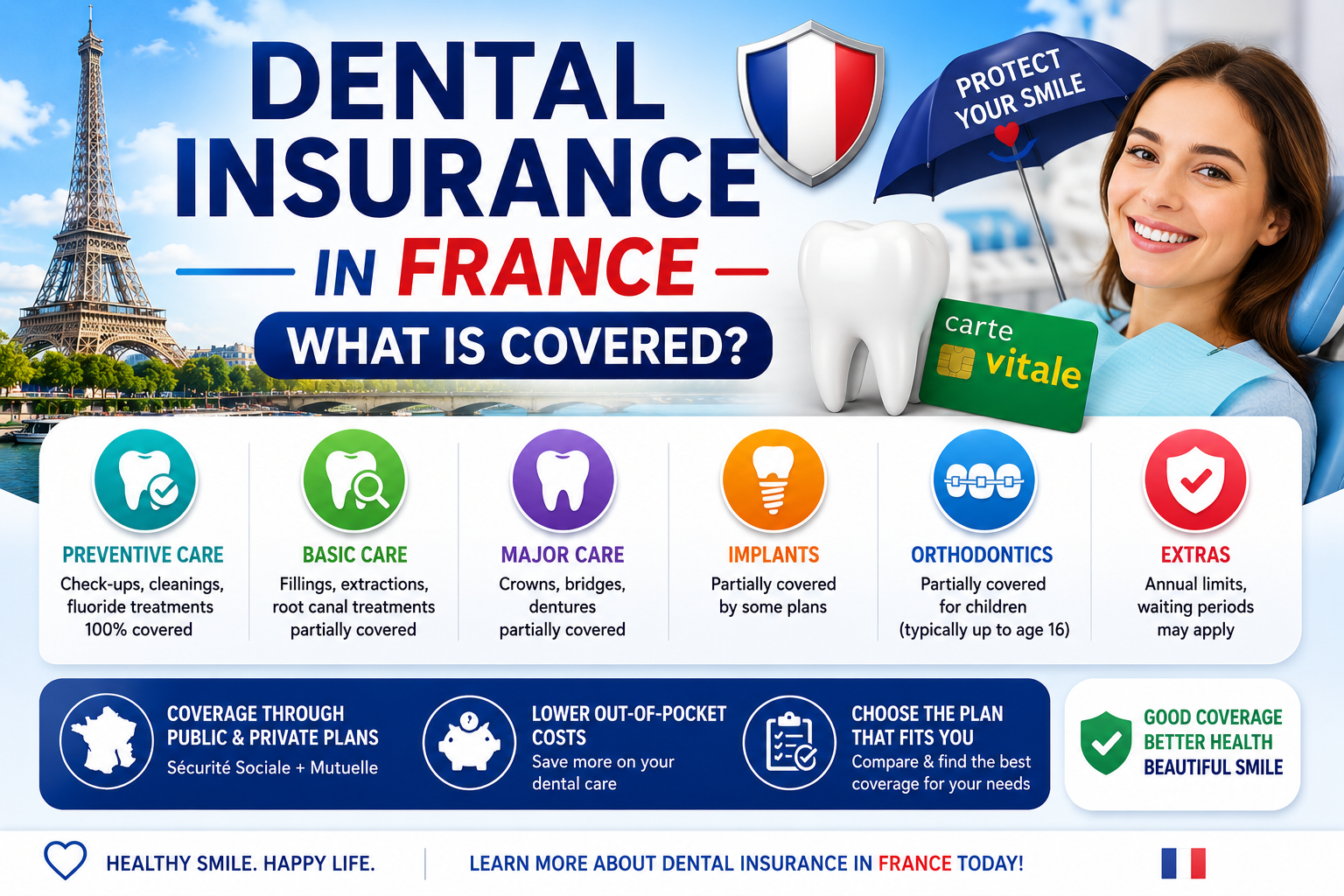
France is often recognized for having one of the strongest healthcare systems in the world. However, when it comes to dental treatment, many international patients and even French residents become surprised by how coverage actually works.
As a dental expert familiar with both the U.S. insurance system and international healthcare models, I can say that France offers better baseline dental support than many countries — but significant out-of-pocket expenses still exist, especially for advanced procedures like dental implants, cosmetic dentistry, orthodontics, and full-mouth rehabilitation.
Many patients assume “French healthcare covers everything.” That is not entirely true.
Basic dental care may receive substantial reimbursement through the public healthcare system, but complex restorative procedures often require supplemental insurance known as a mutuelle.
This guide explains how dental insurance works in France, what treatments are covered, what remains expensive, and how French residents manage dental costs in 2026.
How the French Dental Insurance System Works
France uses a combination of:
- Public healthcare coverage
- Supplemental private insurance
- Patient co-payments
The public healthcare system is managed through Assurance Maladie, which reimburses part of dental treatment costs based on official government fee schedules.
However, dentists may charge fees above these official reimbursement levels.
This creates the difference patients must pay themselves unless they have additional private coverage.
What Is Assurance Maladie?
Assurance Maladie France is the French national health insurance system.
It provides partial reimbursement for many dental services, including:
- Consultations
- Fillings
- Tooth extractions
- Root canals
- Certain crowns
- Preventive treatment
Coverage percentages are calculated from a government-set base rate called the tarif conventionné.
Why Patients Still Pay Out-of-Pocket
One major misunderstanding involves reimbursement calculations.
The government reimbursement is not always based on the actual amount charged by the dentist.
Example
A dentist may charge:
- €600 for a crown
But the official reimbursement base may only be:
- €120
Assurance Maladie might reimburse 60% to 70% of that base amount, not the dentist’s full fee.
This leaves a large remaining balance for the patient.
What Is a Mutuelle?
A mutuelle is supplemental private health insurance used by most French residents.
It helps cover:
- Remaining dental balances
- Hospital expenses
- Vision care
- Specialist fees
- Orthodontics
- Higher-end dental treatment
Without a mutuelle, patients may face large personal expenses for major dental work.
Are Dental Checkups Covered in France?
Yes.
Routine examinations are generally well covered under the public system.
Typical preventive services include:
- Dental consultations
- Basic cleanings
- X-rays
- Oral examinations
Children often receive stronger preventive support through public oral health programs.
Coverage for Fillings and Basic Restorative Treatment
Basic restorative care usually receives moderate reimbursement.
Covered procedures may include:
- Composite fillings
- Temporary restorations
- Tooth extractions
- Root canal treatment
However, coverage amounts depend on:
- Tooth location
- Complexity
- Dentist fees
- Insurance category
Are Dental Crowns Covered?
Yes, partially.
France introduced reforms under the “100% Santé” system to improve access to certain dental prosthetics.
Some crown categories may qualify for:
- Full reimbursement
- Partial reimbursement
- No full reimbursement depending on material chosen
Understanding the 100% Santé Dental Reform
The 100% Santé reform was designed to reduce out-of-pocket healthcare expenses.
It created three categories for dental prosthetics:
| Category | Coverage |
|---|---|
| 100% Santé Basket | Fully covered |
| Controlled Pricing Basket | Limited extra charges |
| Free Pricing Basket | Higher patient costs |
Which Dental Crowns Are Fully Covered?
Certain crowns may qualify for full reimbursement if:
- The patient has a qualifying mutuelle
- Approved materials are selected
- The procedure fits government guidelines
Typically covered crowns include:
- Metal crowns on molars
- Certain ceramic crowns on front teeth
Higher-end esthetic materials may still involve additional fees.
Are Dental Implants Covered in France?
This is one of the most important questions patients ask.
In general:
Dental implants are poorly covered by the French public healthcare system.
Assurance Maladie usually does not reimburse implant surgery itself.
However:
- Some mutuelles offer partial implant reimbursement
- Coverage limits vary widely
- Annual caps often apply
Why Dental Implants Remain Expensive in France
Even with insurance, implants often remain costly because:
- Implant surgery is excluded from standard public reimbursement
- Premium materials increase costs
- Advanced surgical technology is expensive
- Laboratory fees are high
Typical implant treatment in France may still cost:
- €2,000 to €4,000 per tooth
even with partial insurance support.
Are Dentures Covered?
Yes.
Traditional removable dentures receive significantly better reimbursement than implants.
This is one reason some patients choose dentures despite preferring implant solutions.
However, esthetic upgrades or premium materials may still increase costs.
Orthodontic Coverage in France
Orthodontics receives stronger coverage for children than adults.
Children
Orthodontic treatment may receive partial reimbursement if treatment begins before a certain age.
Adults
Adult orthodontics usually receives limited or no public reimbursement unless medically necessary.
This includes:
- Braces
- Clear aligners
- Invisalign-type systems
Many adults rely on mutuelle coverage for assistance.
Cosmetic Dentistry and Insurance
Purely cosmetic treatment is generally not covered.
Examples include:
- Teeth whitening
- Veneers
- Cosmetic bonding
- Smile makeovers
Patients pay these costs privately.
Root Canal Treatment Coverage
Root canals are partially reimbursed under the public system.
However, reimbursement may still not fully match actual specialist fees.
Molars often cost more because treatment complexity increases.
Can Foreigners Access Dental Care in France?
Yes.
Coverage depends on residency status, employment, and insurance enrollment.
International residents may access care through:
- French public healthcare registration
- European Health Insurance Card (EHIC)
- Private international insurance
- Travel insurance
Emergency Dental Care in France
Emergency dental treatment is available throughout France.
Coverage may apply for:
- Severe infections
- Dental trauma
- Acute pain
- Abscesses
Private emergency clinics may charge additional fees.
How French Dentists Set Prices
French dentists fall into different fee categories.
Some strictly follow government-regulated fees.
Others may legally charge higher amounts depending on specialization and location.
Large cities often have higher dental prices.
Why Paris Dental Costs Are Higher
Dental treatment in Paris tends to cost more because of:
- Higher rent
- Greater operational expenses
- Increased specialist demand
- International patient volume
Patients in smaller cities sometimes travel outside Paris to save money.
Waiting Times in France
Routine dental visits may be relatively accessible.
However, specialist appointments for:
- Implantology
- Oral surgery
- Orthodontics
can involve waiting periods depending on the region.
How French Patients Reduce Dental Costs
French residents often combine:
- Public reimbursement
- Mutuelle coverage
- Payment plans
- Treatment abroad
Some patients also travel to:
- Spain
- Portugal
- Hungary
- Turkey
- Thailand
- Philippines
for major implant treatment.
Why Dental Tourism Is Growing Among French Patients
Even with insurance, advanced dentistry remains expensive.
Patients seeking:
- Multiple implants
- Full-mouth reconstruction
- Cosmetic rehabilitation
sometimes save thousands by seeking treatment abroad.
However, follow-up care and quality control remain important concerns.
Are Private Dental Clinics Better?
Not necessarily.
France has many excellent private clinics with advanced technology.
But quality depends more on:
- Dentist experience
- Continuing education
- Implant systems used
- Sterilization standards
- Treatment planning
than whether a clinic is public or private.
Digital Dentistry in France
Modern French dental clinics increasingly use:
- Intraoral scanners
- 3D CBCT imaging
- Guided implant surgery
- CAD/CAM crowns
- Digital smile design
Technology standards are generally high.
The Importance of Preventive Dental Care
Insurance systems work best when patients maintain preventive care.
Regular maintenance helps reduce:
- Cavities
- Gum disease
- Tooth loss
- Expensive future procedures
Routine cleanings remain one of the smartest long-term financial decisions for oral health.
Common Misunderstandings About French Dental Insurance
“Everything is free.”
False.
Patients often still pay substantial balances.
“Implants are covered.”
Usually not fully.
“Mutuelle covers everything.”
Coverage depends heavily on the plan selected.
“French dentistry is cheap.”
Basic care may be affordable, but advanced dentistry can still be expensive.
Questions Patients Should Ask Their Insurance Provider
Before treatment, patients should verify:
- Reimbursement percentages
- Annual limits
- Implant exclusions
- Orthodontic benefits
- Prosthetic coverage
- Waiting periods
- Out-of-network policies
Understanding these details avoids unexpected costs later.
Final Thoughts on Dental Insurance in France
France offers a strong dental insurance foundation compared with many countries, especially for preventive and essential care.
However, advanced dentistry — particularly implants, cosmetic procedures, and full-mouth rehabilitation — may still create significant personal expenses.
The combination of:
- Assurance Maladie
- Mutuelle coverage
- Government reforms like 100% Santé
helps many residents manage dental costs more effectively than in countries without public healthcare systems.
Still, patients should understand that “covered” does not always mean “free.”
The smartest approach involves:
- Reviewing insurance details carefully
- Comparing treatment options
- Choosing experienced providers
- Prioritizing preventive care
before major dental problems develop.
FAQ – Dental Insurance in France
Does French healthcare cover dental treatment?
Yes. Basic dental treatment is partially reimbursed through the public healthcare system.
Are dental implants covered in France?
Generally, implant surgery receives little or no public reimbursement, although some mutuelle plans provide partial assistance.
What is a mutuelle?
A mutuelle is supplemental private insurance that helps cover medical and dental costs not fully reimbursed by the public system.
Is cosmetic dentistry covered?
No. Cosmetic procedures such as whitening and veneers are usually paid entirely by the patient.
Are crowns fully covered in France?
Some crowns qualify under the 100% Santé reform for full reimbursement if approved materials and insurance conditions are met.
Related Topics
1. Dental Implant Prices in France vs Philippines
Many French patients compare domestic implant costs with overseas treatment options to reduce expenses while maintaining quality care.
2. 100% Santé Dental Reform Explained
The 100% Santé program transformed reimbursement rules for crowns, bridges, and dentures in France.
3. Best Mutuelle Insurance Plans for Dental Coverage
Different mutuelle plans provide very different levels of reimbursement for implants, orthodontics, and major restorative procedures.
Can tooth extraction cause infection? Mild inflammation is normal, but increasing swelling, fever, or severe pain may indicate infection. Learn more about post-extraction infection warning signs in this detailed guide.
Book a consultation with our Cebu dental specialists for proper evaluation and care.
Ready to get expert guidance?
If you’re experiencing severe pain or delayed healing, book a consultation with our Cebu dental specialists to get proper evaluation and care.
Consultation or contact page .
Book a Consultation
For severe discomfort or delayed healing, book a consultation with our Cebu dental specialists today.
Looking for a dentist? Browse our Cebu dental directory to find trusted clinics near you.
Medical Review and Clinical Basis
This article is based on clinical dental guidelines and real patient recovery patterns observed after tooth extraction procedures. The information reflects common post-extraction healing stages, including normal clot formation, gum tissue repair, and signs of possible complications such as dry socket or infection.
While mild discomfort is expected after a dental extraction, worsening pain after Day 3, bad odor, exposed bone, or spreading pain may require professional evaluation. These symptoms are consistent with known post-extraction complications described in standard dental practice.
About Cebu Dental Implants
Cebu Dental Implants provides comprehensive tooth extraction, surgical procedures, and dental implant services in the Philippines. Our team evaluates post-extraction healing, manages complications such as dry socket, and advises patients on proper aftercare to prevent infection and delayed healing.
If you experience severe pain or unusual symptoms after extraction, early professional assessment is recommended to prevent further complications.
Important Medical Disclaimer
This content is for educational purposes only and does not replace professional dental diagnosis. Every patient heals differently. If symptoms worsen or do not improve within a few days, consult a licensed dentist for proper evaluation and treatment.
Author
This article was prepared by the Cebu Dental Implants content team in consultation with licensed dental professionals experienced in tooth extraction and implant procedures.
Teeth Case
 |
 |
 |
 |
 |
 |