Where Bright Smiles Begin.

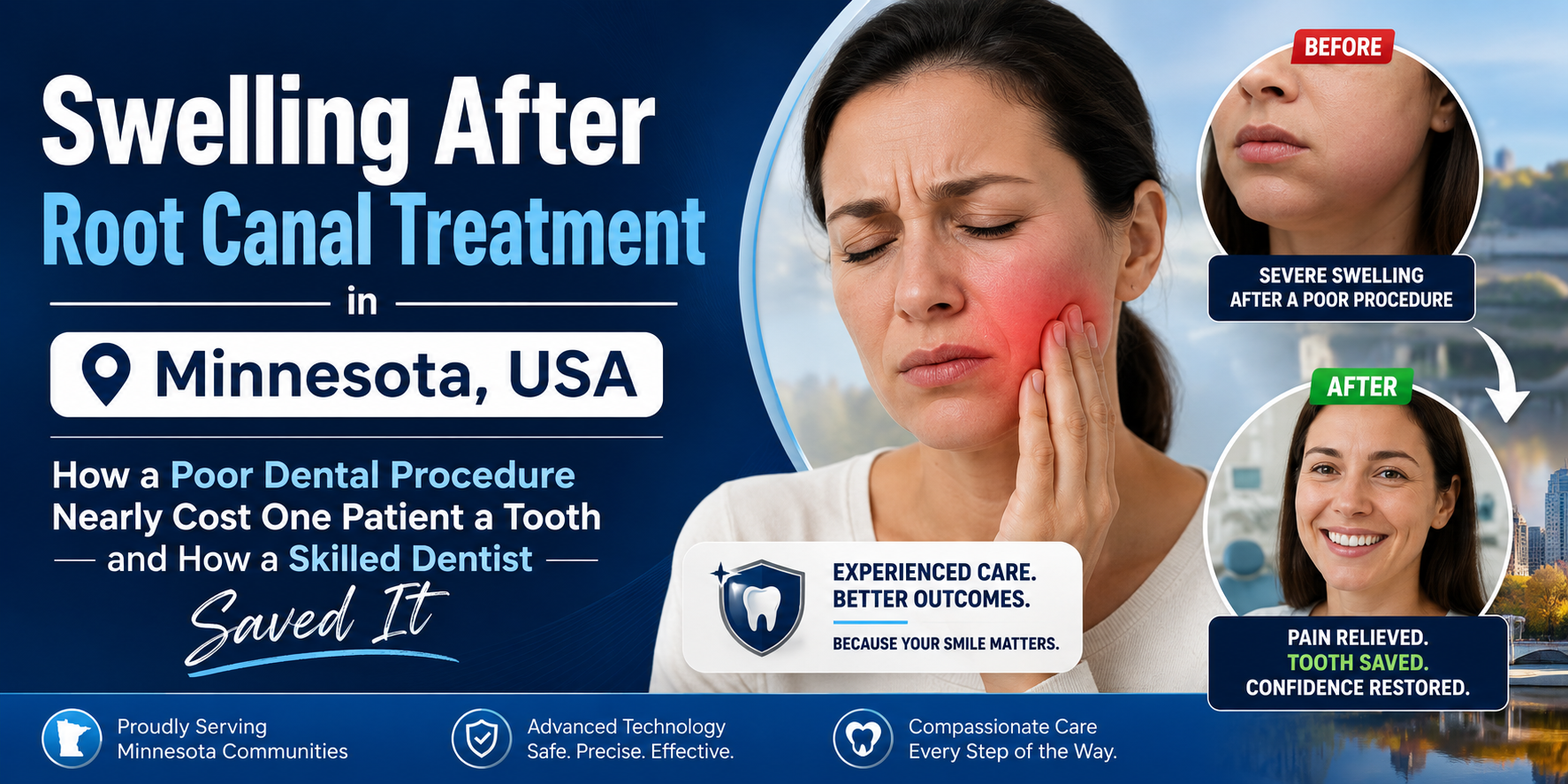
Swelling After Root Canal Treatment in Minnesota, USA: How a Poor Dental Procedure Nearly Cost One Patient a Tooth and How a Skilled Dentist Saved It
Language :
For many patients, hearing the words "root canal treatment" can create anxiety and fear. Yet modern root canal therapy is one of the most successful procedures in dentistry, capable of saving natural teeth that would otherwise require extraction. Every year, millions of Americans undergo root canal treatment and return to normal life without complications.
However, not all root canal treatments are equal.
When performed incorrectly, a root canal can become the beginning of a much larger dental nightmare. Persistent swelling, severe pain, infection, and even bone loss can occur when the procedure is poorly executed. In some cases, patients believe root canal treatment failed because the procedure itself is ineffective. In reality, many failures are linked to incomplete cleaning of the canals, missed anatomy, poor sealing, or delayed diagnosis.
This is the story of a Minnesota patient whose swelling worsened after a root canal procedure performed by an inexperienced provider. It is also the story of how a highly skilled dentist was able to save the tooth before a devastating infection spread further.
As dental professionals across the United States often emphasize, the quality of the diagnosis and treatment can determine whether a tooth survives for decades or is lost forever.
A Simple Toothache That Seemed Routine
Michael, a 42-year-old resident of Minnesota, initially experienced occasional sensitivity while drinking cold beverages. The discomfort was mild and intermittent.
Like many Americans with busy schedules, he delayed seeking treatment.
Several months later, the sensitivity transformed into a persistent toothache. The pain became especially noticeable at night. Over-the-counter medications offered temporary relief, but the symptoms continued to worsen.
Eventually, Michael visited a local dental office where X-rays revealed deep decay extending close to the nerve of a lower molar.
The dentist recommended root canal therapy.
Michael felt relieved.
He believed the procedure would immediately solve the problem.
Unfortunately, things did not go as planned.
What Is a Root Canal Treatment?
Root canal therapy is performed when bacteria infect the soft tissue inside a tooth known as the dental pulp. This must not be taken for granted otherwise it will scale into worse situation.
The pulp contains:
- Blood vessels
- Nerves
- Connective tissue
When bacteria reach this area through deep decay, cracks, trauma, or leaking fillings, infection develops.
The purpose of root canal treatment is to:
- Remove infected tissue.
- Eliminate bacteria. Help eliminate the cause of bateria
- Clean and shape the root canals. Takes time so you need seasons to finish the cleaning.
- Seal the canals to prevent reinfection.
- Preserve the natural tooth.
When completed correctly, the procedure can provide decades of function.
American dental specialists routinely report high success rates exceeding 90% when proper protocols are followed.
The First Warning Sign
Immediately after Michael's root canal treatment, he expected some tenderness.
Minor discomfort for several days can be normal.
However, within a week, his face began to swell.
The swelling appeared around the jawline and lower cheek.
The original dentist reassured him that healing sometimes takes time.
Michael was prescribed antibiotics and instructed to wait.
Initially, the swelling decreased slightly.
But after completing the medication, it returned.
This time it was worse.
Swelling After Root Canal Treatment: Is It Normal?
As dental experts throughout the United States frequently explain, mild tenderness is common after root canal therapy.
However, significant swelling is not considered normal.
Possible causes include:
Residual Infection
Bacteria may remain inside the root canal system.
Missed Canals
Many molars contain complex anatomy.
If a canal is overlooked, infection can continue growing.
Inadequate Cleaning
Failure to fully disinfect the canals leaves bacteria behind.
Cracked Tooth
A hidden fracture may allow bacteria to re-enter the tooth.
Overfilling or Underfilling
Improper sealing can compromise treatment success.
Persistent Abscess
An existing infection may continue spreading into surrounding tissues.
When swelling continues for weeks, a comprehensive evaluation becomes essential.
The Swelling Gets Worse
Two months after treatment, Michael woke up with severe facial swelling.
His lower jaw felt tight.
Eating became difficult.
He noticed a foul taste in his mouth.
Most concerning was a small pimple-like bump on the gums near the treated tooth.
This bump was actually a draining fistula—a pathway allowing infection to escape from the bone.
At this stage, the infection had not been eliminated.
It was actively progressing.
Michael sought a second opinion.
That decision may have saved his tooth.
The Importance of Seeking a Skilled Dentist
When Michael visited a highly respected Minnesota dental specialist, the examination immediately revealed several concerns.
Advanced imaging showed evidence of persistent infection around the roots.
The specialist explained something that shocked Michael.
One of the tooth's canals had never been treated.
A significant portion of the root canal system remained infected.
The infection had continued destroying surrounding bone for months.
The swelling was not a normal healing response.
It was a sign of ongoing disease.
This scenario highlights why expertise matters.
Root canal anatomy can be extremely complex.
Some teeth contain:
- Curved canals
- Narrow canals
- Hidden canals
- Additional branches
Missing even one infected area can compromise treatment success.
Why Poorly Performed Root Canals Fail
Across the United States, dental specialists identify several common causes of root canal failure.
Missed Anatomy
Some molars contain four or more canals.
Without proper magnification and imaging, canals may remain untreated.
Inadequate Disinfection
Bacteria can survive if cleaning protocols are insufficient.
Improper Diagnosis
Treating the wrong tooth or missing fractures can lead to persistent symptoms.
Delayed Crown Placement
After root canal therapy, teeth often require protective crowns.
Delays increase fracture risk.
Poor Seal
Any gap allows bacteria to return.
Limited Experience
Complex cases often require advanced skills and technology.
The Hidden Danger of Chronic Dental Infection
Many patients underestimate the seriousness of a dental abscess.
An untreated infection can spread into:
- Bone
- Facial tissues
- Sinuses
- Neck spaces
In rare cases, severe infections become medical emergencies.
Dentists throughout America emphasize that facial swelling should never be ignored.
Prompt treatment is critical.
The body can only contain infection for so long.
Eventually, bacteria may overwhelm natural defenses.
Advanced Diagnosis Changes Everything
The specialist ordered a three-dimensional CBCT scan.
Unlike traditional dental X-rays, CBCT imaging provides detailed views of:
- Root anatomy
- Bone structure
- Hidden infection
- Fractures
The scan confirmed:
- Persistent infection
- Bone destruction around the root
- Untreated canal anatomy
Fortunately, the tooth remained salvageable.
The specialist recommended root canal retreatment.
What Is Root Canal Retreatment?
Retreatment involves reopening a previously treated tooth and correcting deficiencies.
The process includes:
- Removing old filling materials.
- Locating missed canals.
- Eliminating residual bacteria.
- Cleaning the entire canal system.
- Disinfecting thoroughly.
- Sealing the canals again.
While more challenging than the initial procedure, retreatment often saves teeth that might otherwise be extracted.
A Second Chance to Save the Tooth
Michael decided to proceed.
The retreatment appointment revealed exactly why the infection persisted.
The specialist discovered an untreated canal hidden within the molar.
Bacteria had remained active in this space since the original procedure.
Using advanced magnification and specialized instruments, the canal was carefully cleaned and disinfected.
Antimicrobial solutions were used to eliminate bacterial contamination.
The canals were then sealed with precision.
A temporary restoration was placed while healing began.
The Recovery
Within days, the swelling started improving.
For the first time in months, Michael noticed a difference.
Two weeks later:
- Facial swelling disappeared.
- Pain dramatically decreased.
- Gum tissues looked healthier.
Three months later, follow-up imaging demonstrated significant bone healing.
The infection was finally resolving.
The tooth had been saved.
Why Experience Matters in Dentistry
Dental treatment is not simply about completing procedures.
It is about:
- Accurate diagnosis
- Treatment planning
- Technical execution
- Long-term preservation
Highly skilled dentists invest thousands of hours in continuing education, advanced technology, and specialized training.
These investments directly impact patient outcomes.
A well-executed root canal can last decades.
A poorly executed one may fail within months.
Warning Signs You Should Never Ignore After a Root Canal
Patients should contact their dentist if they experience:
Persistent Swelling
Swelling lasting more than several days requires evaluation.
Severe Pain
Pain that worsens instead of improving may indicate infection.
Gum Pimple
A draining fistula often signals an abscess.
Facial Swelling
This can indicate spreading infection.
Bite Discomfort
Persistent pressure sensitivity may suggest ongoing inflammation.
Fever
Systemic symptoms require immediate attention.
Modern Technology Improves Success Rates
Today's leading American dental practices utilize advanced technology to improve outcomes.
Examples include:
Digital Imaging
Enhanced diagnosis and treatment planning.
CBCT Scans
Three-dimensional evaluation of complex anatomy.
Dental Operating Microscopes
Improved visualization of hidden canals.
Electronic Apex Locators
Precise canal measurements.
Advanced Irrigation Systems
Superior bacterial removal.
Technology cannot replace skill, but it significantly enhances treatment quality when used properly.
Saving Natural Teeth Whenever Possible
The American dental community strongly supports preserving natural teeth whenever feasible.
Advantages include:
- Better chewing efficiency
- Natural appearance
- Preservation of jawbone
- Reduced treatment complexity
- Long-term oral health benefits
Although dental implants are excellent solutions when teeth cannot be saved, retaining a healthy natural tooth remains the preferred option.
Lessons From Michael's Story
Michael's experience teaches several valuable lessons.
First, persistent swelling after a root canal should never be ignored.
Second, seeking a second opinion can be life-changing.
Third, not all treatment outcomes are equal.
Experience, technology, and diagnostic accuracy matter tremendously.
Most importantly, patients should understand that a failed root canal does not automatically mean the tooth is hopeless.
Many teeth can be successfully retreated and preserved.
How to Choose a Skilled Dentist in Minnesota
Patients seeking root canal treatment should consider:
- Clinical experience
- Continuing education
- Advanced imaging capabilities
- Positive patient reviews
- Modern technology
- Comprehensive treatment planning
Asking questions about diagnosis and treatment options is encouraged.
An informed patient is often a healthier patient.
Conclusion
Swelling after root canal treatment can range from a temporary healing response to a serious warning sign of persistent infection. While successful root canal therapy remains one of the most predictable procedures in modern dentistry, treatment quality plays a major role in long-term success.
Michael's Minnesota experience demonstrates how a poorly performed procedure allowed infection to continue damaging bone and surrounding tissues. Fortunately, a skilled dental specialist recognized the underlying problem, corrected the treatment deficiencies, and ultimately saved the tooth.
Across the United States, dental experts consistently emphasize a simple principle: when dealing with infection inside a tooth, precision matters. Accurate diagnosis, advanced technology, and clinical expertise can mean the difference between losing a tooth and preserving it for many years.
If swelling continues after root canal treatment, do not assume it is normal healing. Seek professional evaluation promptly. Early intervention may save not only your tooth but also prevent far more serious complications from developing.
Can tooth extraction cause infection? Mild inflammation is normal, but increasing swelling, fever, or severe pain may indicate infection. Learn more about post-extraction infection warning signs in this detailed guide.
Book a consultation with our Cebu dental specialists for proper evaluation and care.
Ready to get expert guidance?
If you’re experiencing severe pain or delayed healing, book a consultation with our Cebu dental specialists to get proper evaluation and care.
Consultation or contact page .
Book a Consultation
For severe discomfort or delayed healing, book a consultation with our Cebu dental specialists today.
Looking for a dentist? Browse our Cebu dental directory to find trusted clinics near you.
Medical Review and Clinical Basis
This article is based on clinical dental guidelines and real patient recovery patterns observed after tooth extraction procedures. The information reflects common post-extraction healing stages, including normal clot formation, gum tissue repair, and signs of possible complications such as dry socket or infection.
While mild discomfort is expected after a dental extraction, worsening pain after Day 3, bad odor, exposed bone, or spreading pain may require professional evaluation. These symptoms are consistent with known post-extraction complications described in standard dental practice.
About Cebu Dental Implants
Cebu Dental Implants provides comprehensive tooth extraction, surgical procedures, and dental implant services in the Philippines. Our team evaluates post-extraction healing, manages complications such as dry socket, and advises patients on proper aftercare to prevent infection and delayed healing.
If you experience severe pain or unusual symptoms after extraction, early professional assessment is recommended to prevent further complications.
Important Medical Disclaimer
This content is for educational purposes only and does not replace professional dental diagnosis. Every patient heals differently. If symptoms worsen or do not improve within a few days, consult a licensed dentist for proper evaluation and treatment.
Author
This article was prepared by the Cebu Dental Implants content team in consultation with licensed dental professionals experienced in tooth extraction and implant procedures.
Related Clinical Cases
Patients with lower front gum inflammation may also experience tartar buildup, periodontal disease, gum abscesses, or tooth decay. Explore these related clinical case studies.



Other topics:
Other Dental Clinic