Because Every Tooth Deserves Care.

Surgical Root Canal Treatment Needed in Anaheim, California: USA Dentist Explains Diagnosis, Worst-Case Scenarios, Treatment Options, and How Your Tooth Can Still Be Saved
Language :
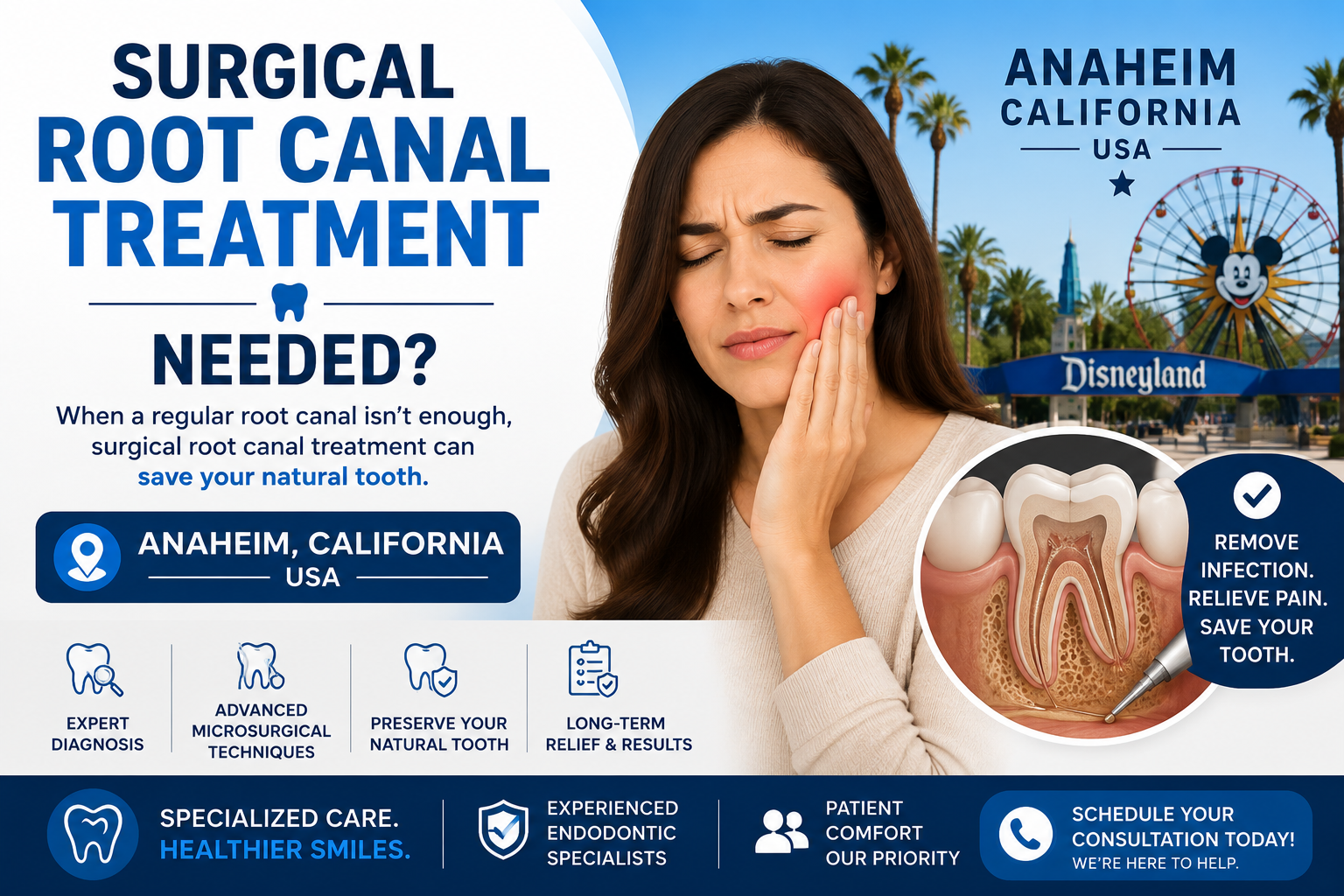
Few dental situations create more anxiety than hearing the words, "You may need surgical root canal treatment."
Many patients in Anaheim, California, arrive at our office believing their tooth is beyond saving. They may have already undergone a root canal years ago, only to experience pain, swelling, tenderness, or recurring infection. Others are told they have a hidden infection at the root tip that conventional treatment cannot fully resolve.
As a USA dentist who has treated complex root canal cases for many years, I want patients to understand something important:
Needing surgical root canal treatment does not automatically mean you will lose your tooth.
In many cases, modern endodontic surgery can eliminate infection, preserve natural teeth, and prevent more extensive procedures such as extraction and dental implants.
This guide explains:
- What surgical root canal treatment is
- Why it becomes necessary
- How dentists diagnose the problem
- Warning signs and symptoms
- Worst-case scenarios if treatment is delayed
- What happens during surgery
- Recovery expectations
- Long-term success rates
- A real-world style story of a tooth that was successfully saved
If you have been told you need surgical root canal treatment in Anaheim, this article will help you understand your options.
What Is Surgical Root Canal Treatment?
Surgical root canal treatment is commonly called an apicoectomy or root-end surgery.
Unlike traditional root canal treatment, which is performed through the crown of the tooth, surgical root canal treatment accesses the infection through the gum and bone surrounding the root tip.
The procedure allows the dentist or endodontist to:
- Remove infected tissue
- Eliminate hidden bacteria
- Remove cysts or lesions
- Seal the root tip
- Preserve the natural tooth
This treatment is often recommended when a previous root canal has not completely healed or when infection remains trapped near the root end.
Why Would a Tooth Need Surgical Root Canal Treatment?
Many patients ask:
"Why can't the dentist just do another regular root canal?"
The answer depends on the cause of the infection.
Common reasons include:
Persistent Infection
Some bacteria survive deep within microscopic canals that are difficult to access during conventional treatment.
Over time these bacteria can cause:
- Chronic infection
- Bone loss
- Gum swelling
- Recurring pain
Hidden Root Anatomy
Every tooth is unique.
Some teeth contain:
- Extra canals
- Curved canals
- Narrow branches
- Complex root structures
These hidden spaces may harbor bacteria even after treatment.
Root-End Leakage
A previously treated root canal may develop leakage near the root tip.
This allows bacteria to re-enter and continue damaging surrounding tissues.
Broken Instruments
Occasionally a small instrument used during root canal treatment may separate inside the canal.
While many broken instruments cause no problems, some may prevent complete cleaning and lead to infection.
Root Fractures
Small cracks near the root tip can permit bacterial invasion and chronic inflammation.
In selected cases surgery helps determine whether the tooth remains salvageable.
Symptoms That May Indicate Surgical Root Canal Treatment Is Needed
Not all infected teeth produce severe pain.
In fact, some serious infections remain silent for months or years.
Warning signs include:
Persistent Toothache
Pain may:
- Come and go
- Worsen when chewing
- Feel deep and throbbing
Gum Swelling
A swollen area near the tooth often indicates underlying infection.
Pimple on the Gum
A draining fistula may appear as:
- Small bump
- White spot
- Recurring blister
This often signals chronic infection.
Tenderness to Pressure
Patients frequently report discomfort when:
- Biting food
- Touching the area
- Clenching teeth
Facial Swelling
More advanced infections may spread into surrounding tissues.
Bone Loss Seen on X-Rays
Sometimes patients experience no symptoms at all.
The infection is discovered during routine dental examination.
How Dentists Diagnose the Need for Surgical Root Canal Treatment
Accurate diagnosis is essential.
Before recommending surgery, we carefully evaluate several factors.
Clinical Examination
The dentist checks:
- Tooth mobility
- Gum health
- Bite pressure
- Swelling
- Drainage
Digital X-Rays
Radiographs reveal:
- Bone destruction
- Root-end lesions
- Existing root canal fillings
3D CBCT Imaging
Cone Beam Computed Tomography has revolutionized diagnosis.
CBCT scans show:
- Hidden infections
- Bone defects
- Fractures
- Complex root anatomy
This technology often identifies problems invisible on traditional x-rays.
Symptom Analysis
Patient history remains important.
We evaluate:
- Pain patterns
- Previous treatments
- Recent flare-ups
- Healing history
Conditions Often Treated With Surgical Root Canal Procedures
Chronic Apical Periodontitis
Persistent inflammation around the root tip.
Root-End Infection
Localized bacterial infection that survives conventional treatment.
Dental Cysts
Some infections stimulate cyst formation within the jawbone.
Foreign Material Reactions
Occasionally filling materials trigger irritation beyond the root tip.
Persistent Lesions
Bone defects that fail to heal despite previous treatment.
What Happens During Surgical Root Canal Treatment?
Patients are often surprised by how comfortable the procedure can be.
Step 1: Local Anesthesia
The area becomes completely numb.
Most patients experience little to no discomfort.
Step 2: Small Gum Opening
A tiny incision allows access to the root area.
Step 3: Infection Removal
The surgeon removes:
- Infected tissue
- Inflammatory lesions
- Granulation tissue
Step 4: Root-End Resection
A small portion of the root tip is removed.
This eliminates infected anatomy.
Step 5: Root-End Filling
A special sealing material is placed.
This prevents bacterial leakage.
Step 6: Sutures
Small stitches close the surgical site.
Healing begins immediately.
Is Surgical Root Canal Treatment Painful?
Most patients expect severe pain.
The reality is usually much different.
During treatment:
- Local anesthesia prevents discomfort.
- Patients often feel only pressure.
After treatment:
- Mild soreness is common.
- Swelling may occur for several days.
- Most patients return to normal activities quickly.
Pain is generally manageable with prescribed medications.
What Happens If You Delay Treatment?
Ignoring infection is one of the biggest mistakes patients make.
The infection rarely disappears on its own.
Instead, it often progresses.
Worst-Case Scenario #1: Significant Bone Loss
The infection gradually destroys supporting jawbone.
Extensive bone loss reduces long-term tooth stability.
Worst-Case Scenario #2: Facial Swelling
Infection may spread into facial tissues.
This can cause:
- Severe swelling
- Difficulty eating
- Difficulty speaking
Worst-Case Scenario #3: Dental Abscess
An abscess forms when pus accumulates around the infection.
This condition can become extremely painful.
Worst-Case Scenario #4: Spread Into Facial Spaces
Advanced infections sometimes spread into deeper anatomical spaces.
This represents a true dental emergency.
Potential symptoms include:
- Fever
- Difficulty swallowing
- Difficulty breathing
Immediate medical attention becomes necessary.
Worst-Case Scenario #5: Tooth Extraction
The longer infection persists, the lower the chance of saving the tooth.
Eventually extraction may become unavoidable.
Worst-Case Scenario #6: Jawbone Damage
Long-standing infections can significantly weaken surrounding bone.
Repair may become more complicated and expensive.
Can a Surgical Root Canal Save a Tooth That Already Had a Root Canal?
Yes.
This is actually one of the most common reasons for the procedure.
Many previously treated teeth can remain functional for years or decades after successful surgical intervention.
Saving a natural tooth is usually preferable whenever possible.
Natural teeth provide:
- Better chewing efficiency
- Natural sensation
- Preservation of jawbone
- Lower long-term complexity
Who Is a Good Candidate?
Ideal candidates generally have:
- Adequate bone support
- Restorable tooth structure
- Localized infection
- Healthy surrounding tissues
The final decision depends on clinical evaluation and imaging findings.
When Might Extraction Be a Better Option?
Unfortunately, not every tooth can be saved.
Extraction may be recommended when:
- Vertical root fracture exists
- Extensive structural damage is present
- Severe bone loss surrounds the tooth
- Tooth cannot support restoration
A thorough examination determines the best path forward.
Recovery After Surgical Root Canal Treatment
Most healing occurs quickly.
Patients typically experience:
First 24 Hours
- Mild discomfort
- Minor bleeding
- Initial swelling
Days 2–3
- Swelling may peak
- Tenderness gradually decreases
Days 4–7
- Significant improvement
- Normal activities resume
One to Three Months
Internal bone healing progresses.
Six Months to One Year
X-rays often demonstrate excellent bone regeneration.
Tips for Faster Healing
Follow your dentist's instructions carefully.
Recommendations include:
- Take medications as directed
- Avoid smoking
- Maintain oral hygiene
- Eat soft foods initially
- Avoid strenuous activity immediately after surgery
These steps promote predictable recovery.
Long-Term Success Rates
Modern surgical root canal procedures have excellent outcomes.
Advancements in:
- CBCT imaging
- Microsurgical instruments
- Biocompatible materials
- Magnification technology
have significantly improved success rates.
Many treated teeth remain healthy for years following surgery.
How Much Does Surgical Root Canal Treatment Cost in Anaheim, California?
Costs vary based on:
- Tooth location
- Complexity
- Specialist involvement
- Imaging requirements
Front teeth are generally less complex than molars.
Insurance may cover a portion of treatment costs.
Patients should request a personalized estimate following examination.
Why Saving a Natural Tooth Matters
Whenever possible, preserving a natural tooth is beneficial.
Natural teeth help maintain:
- Jawbone integrity
- Bite balance
- Chewing function
- Speech
- Smile aesthetics
While dental implants are excellent solutions, retaining a healthy natural tooth is often the preferred first option.
A Short Story: How Surgical Root Canal Treatment Saved Michael's Tooth
Michael, a 46-year-old Anaheim resident, believed he was about to lose his upper molar.
The tooth had received a root canal nearly eight years earlier. Recently he noticed occasional swelling and a small bump on the gum.
At first he ignored it.
A few months later the swelling became more frequent.
His dentist obtained a CBCT scan and discovered a persistent infection surrounding one root tip.
Michael feared extraction.
After consulting with an endodontic specialist, surgical root canal treatment was recommended.
The procedure was completed in a single visit.
The infected tissue was removed, the root tip was sealed, and healing began.
During the first week Michael experienced mild soreness but recovered quickly.
Six months later follow-up imaging showed healthy bone regeneration.
One year later the tooth remained fully functional.
Today Michael enjoys his favorite foods without pain and continues to preserve the natural tooth he thought was lost forever.
His experience demonstrates an important lesson:
Even when a previous root canal appears to have failed, modern surgical treatment can often provide a second chance to save the tooth.
Final Thoughts From a USA Dentist
If you have been told that you need surgical root canal treatment in Anaheim, California, do not assume extraction is your only option.
Modern diagnostic technology allows dentists and endodontists to identify infections with remarkable precision. In many cases, root-end surgery can successfully remove persistent infection, preserve bone, and save a natural tooth for many years.
The key is early diagnosis.
Persistent pain, swelling, recurring gum pimples, facial swelling, or signs of infection should never be ignored.
The sooner treatment is performed, the better the chances of preserving your tooth and avoiding serious complications.
If you are experiencing symptoms or have been informed that a previous root canal is failing, schedule a comprehensive dental evaluation as soon as possible. Early intervention can often mean the difference between saving a tooth and losing it permanently.
Can tooth extraction cause infection? Mild inflammation is normal, but increasing swelling, fever, or severe pain may indicate infection. Learn more about post-extraction infection warning signs in this detailed guide.
Book a consultation with our Cebu dental specialists for proper evaluation and care.
Ready to get expert guidance?
If you’re experiencing severe pain or delayed healing, book a consultation with our Cebu dental specialists to get proper evaluation and care.
Consultation or contact page .
Book a Consultation
For severe discomfort or delayed healing, book a consultation with our Cebu dental specialists today.
Looking for a dentist? Browse our Cebu dental directory to find trusted clinics near you.
Medical Review and Clinical Basis
This article is based on clinical dental guidelines and real patient recovery patterns observed after tooth extraction procedures. The information reflects common post-extraction healing stages, including normal clot formation, gum tissue repair, and signs of possible complications such as dry socket or infection.
While mild discomfort is expected after a dental extraction, worsening pain after Day 3, bad odor, exposed bone, or spreading pain may require professional evaluation. These symptoms are consistent with known post-extraction complications described in standard dental practice.
About Cebu Dental Implants
Cebu Dental Implants provides comprehensive tooth extraction, surgical procedures, and dental implant services in the Philippines. Our team evaluates post-extraction healing, manages complications such as dry socket, and advises patients on proper aftercare to prevent infection and delayed healing.
If you experience severe pain or unusual symptoms after extraction, early professional assessment is recommended to prevent further complications.
Important Medical Disclaimer
This content is for educational purposes only and does not replace professional dental diagnosis. Every patient heals differently. If symptoms worsen or do not improve within a few days, consult a licensed dentist for proper evaluation and treatment.
Author
This article was prepared by the Cebu Dental Implants content team in consultation with licensed dental professionals experienced in tooth extraction and implant procedures.
Related Clinical Cases
Patients with lower front gum inflammation may also experience tartar buildup, periodontal disease, gum abscesses, or tooth decay. Explore these related clinical case studies.