We Bring Back the Sparkle in Your Smile.

All-on-4 Dental Implants Cost: Australia vs Philippines A Senior Dentist’s Expert Perspective on Cost, Quality, and Long-Term Outcomes
Language :
Over the past two decades, I’ve seen dental implants evolve from a specialized procedure into a mainstream solution for full-arch restoration. Among these, All-on-4 dental implants have become one of the most requested treatments for patients seeking a permanent alternative to dentures.
However, one issue consistently shapes patient decisions:
Cost.
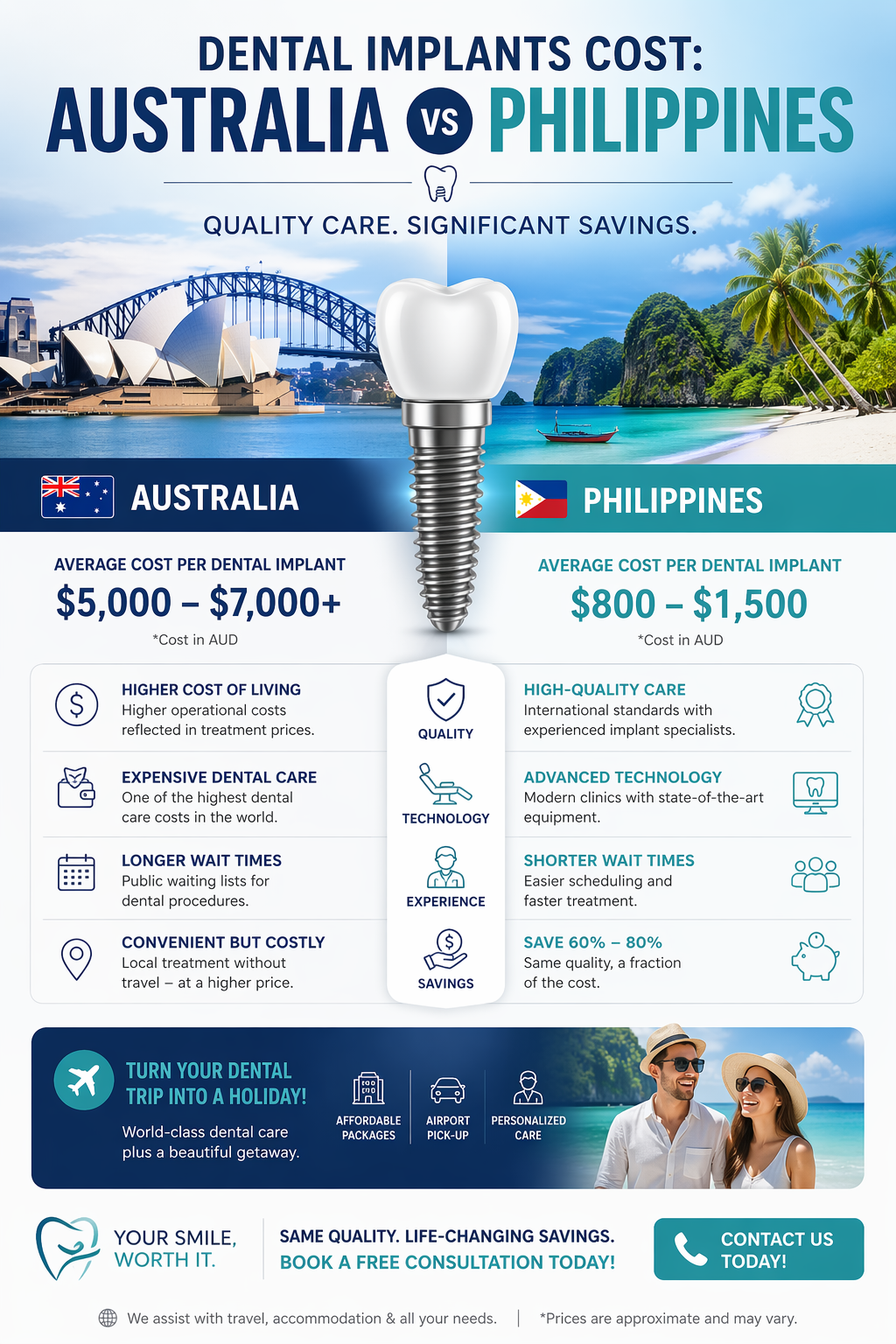
In Australia, All-on-4 treatment can be financially overwhelming for many patients. This has led to a growing interest in dental tourism, particularly in the Philippines, where costs are significantly lower.
As a senior dentist, my role is to provide clarity—not just on pricing, but on clinical quality, risks, and long-term success.
What Are All-on-4 Dental Implants?
All-on-4 is a technique where four implants are placed in strategic positions to support a full arch of fixed teeth.
Key Clinical Advantages
- Reduced number of implants
- Often avoids bone grafting
- Immediate temporary teeth in many cases
- Faster treatment timeline
Ideal Candidates
- Patients with multiple missing teeth
- Those with failing dentition
- Individuals seeking a fixed, long-term solution
Cost Comparison: Australia vs Philippines
Australia Pricing
In Australia, All-on-4 costs typically range:
- Single arch: AUD $25,000 – $40,000
- Full mouth: AUD $50,000 – $90,000+
Converted to USD:
- Approximately $32,000 – $58,000+
Why Is It Expensive?
From a clinical standpoint, Australian costs reflect:
- Highly trained dental specialists
- Advanced imaging and digital planning
- Strict regulatory compliance
- High labor and operational costs
- Premium prosthetic materials
Philippines Pricing
In Philippines, All-on-4 costs are:
- Single arch: $6,000 – $12,000
- Full mouth: $12,000 – $24,000
Even after travel expenses, patients often save 50% to 70%.
Why the Philippines Is More Affordable
The difference is largely economic, not purely clinical.
Key Factors:
- Lower cost of living
- Lower staff wages
- Reduced overhead
- Competitive dental tourism market
However, affordability introduces a critical responsibility:
“Patients must be selective—because quality can vary significantly.”
Total Cost Breakdown
Australia
- Procedure: AUD $60,000 (~$38,000 USD)
- Follow-ups: Included
- Travel: Minimal
Total: ~$38,000+ USD
Philippines
- Procedure: $18,000
- Flights: $800 – $1,200
- Accommodation: $1,000 – $2,000
- Food and transport: $500
Total: ~$20,000 – $22,000
Clinical Quality: Australia vs Philippines
Australia
The Australia offers:
- Strict licensing and regulation
- High clinical standards
- Advanced technology
- Structured follow-up care
From a senior dentist’s perspective:
Continuity of care is the greatest advantage.
Philippines
The Philippines has become a leading destination for dental tourism.
Strengths:
- Internationally trained dentists
- Modern clinics in urban centers
- English-speaking professionals
- Competitive pricing
Considerations:
- Quality varies by provider
- Requires thorough research
Expert Insight: What Truly Determines Success
After years of clinical practice, I can confidently say:
“The success of All-on-4 implants depends more on planning and execution than geography.”
Critical Success Factors
- Accurate Diagnosis
- Bone density evaluation
- Medical history review
- Surgical Precision
- Proper implant placement
- Use of guided technology
- Prosthetic Design
- Bite alignment
- Material quality
- Post-Treatment Care
- Follow-ups
- Maintenance
Common Risks to Consider
Regardless of location, All-on-4 involves:
- Surgical risks
- Healing variability
- Potential implant failure (low but possible)
Additional Risks Abroad
- Limited access to follow-up care
- Travel-related complications
- Inconsistent clinical standards
Who Should Consider the Philippines?
You may consider treatment in the Philippines if:
- Budget is a major concern
- You are in good general health
- You can stay for treatment phases
- You are willing to research thoroughly
Who Should Stay in Australia?
I recommend staying in Australia if:
- You have complex medical conditions
- You require bone grafting or advanced procedures
- You prefer consistent follow-up care
- Budget is not the primary concern
Red Flags When Choosing a Clinic
Watch for:
- Extremely low pricing
- Lack of detailed treatment plans
- No transparency on materials
- No documented patient results
- Poor communication
How to Choose the Right Provider
Wherever you go:
- Request a comprehensive treatment plan
- Confirm implant brand and materials
- Review clinical cases
- Verify credentials
- Understand the full timeline
FAQ: All-on-4 Dental Implants
1. How long do All-on-4 implants last?
With proper care, they can last 20+ years.
2. Is the procedure painful?
It is performed under sedation. Post-operative discomfort is manageable.
3. Can I eat normally after treatment?
Yes. After healing, patients regain strong chewing ability.
4. How long does the process take?
Typically 3–6 months, depending on healing.
5. Are All-on-4 implants worth the cost?
For most patients, yes—especially compared to dentures.
Related Topics
1. All-on-4 vs All-on-6 Implants
Compare stability, cost, and long-term durability.
2. Dental Tourism: Risks and Benefits
Understand what to expect when seeking treatment abroad.
3. Zirconia vs Acrylic Full Arch Teeth
Learn how materials affect longevity and aesthetics.
Short Success Story (Senior Dentist Voice – 300 Words)
I recall a patient named Andrew, a 60-year-old engineer from Australia, who came to me after years of struggling with failing teeth.
He was practical, analytical, and understandably cautious.
When presented with the option of All-on-4 implants locally, the cost—nearly AUD $70,000—gave him pause. He began researching alternatives and soon discovered the Philippines.
Initially, he approached the idea with skepticism.
“Is it safe?” he asked.
“Will the results last?”
These are the right questions.
After thorough research, Andrew selected a clinic—not based on price, but on transparency, credentials, and clinical documentation.
He proceeded with treatment.
The surgery was uneventful, and temporary prosthetics were placed successfully. What struck me most was not just the clinical outcome—but his reaction.
For the first time in years, he smiled without hesitation.
Months later, after receiving his final prosthesis, he returned for a follow-up consultation.
The result was stable, functional, and aesthetically pleasing.
Andrew shared a simple reflection:
“I didn’t just restore my teeth—I restored my confidence.”
From a clinical standpoint, his case reinforced an important principle:
“Successful outcomes are achievable in different settings—provided the standards of care are met.”
Final Thoughts
The cost difference between Australia and the Philippines is substantial—but cost alone should never dictate your decision.
As a senior dentist, my advice is clear:
“Prioritize quality, planning, and long-term care over short-term savings.”
All-on-4 dental implants are a lifelong investment. Choose wisely—and ensure the result is one you can depend on for years to come.
Can tooth extraction cause infection? Mild inflammation is normal, but increasing swelling, fever, or severe pain may indicate infection. Learn more about post-extraction infection warning signs in this detailed guide.
Book a consultation with our Cebu dental specialists for proper evaluation and care.
Ready to get expert guidance?
If you’re experiencing severe pain or delayed healing, book a consultation with our Cebu dental specialists to get proper evaluation and care.
Consultation or contact page .
Book a Consultation
For severe discomfort or delayed healing, book a consultation with our Cebu dental specialists today.
Looking for a dentist? Browse our Cebu dental directory to find trusted clinics near you.
Medical Review and Clinical Basis
This article is based on clinical dental guidelines and real patient recovery patterns observed after tooth extraction procedures. The information reflects common post-extraction healing stages, including normal clot formation, gum tissue repair, and signs of possible complications such as dry socket or infection.
While mild discomfort is expected after a dental extraction, worsening pain after Day 3, bad odor, exposed bone, or spreading pain may require professional evaluation. These symptoms are consistent with known post-extraction complications described in standard dental practice.
About Cebu Dental Implants
Cebu Dental Implants provides comprehensive tooth extraction, surgical procedures, and dental implant services in the Philippines. Our team evaluates post-extraction healing, manages complications such as dry socket, and advises patients on proper aftercare to prevent infection and delayed healing.
If you experience severe pain or unusual symptoms after extraction, early professional assessment is recommended to prevent further complications.
Important Medical Disclaimer
This content is for educational purposes only and does not replace professional dental diagnosis. Every patient heals differently. If symptoms worsen or do not improve within a few days, consult a licensed dentist for proper evaluation and treatment.
Author
This article was prepared by the Cebu Dental Implants content team in consultation with licensed dental professionals experienced in tooth extraction and implant procedures.
Related Clinical Cases
Patients with lower front gum inflammation may also experience tartar buildup, periodontal disease, gum abscesses, or tooth decay. Explore these related clinical case studies.