Transforming Smiles, Restoring Confidence.

Severe Tooth Decay: Can a Badly Decayed Tooth Be Saved? Treatment, Symptoms & When to See a Dentist
Image:
Severity:
Teeth Problems:
Yes — this is a serious-looking dental case, but it is treatable. The most important point is not to wait 14 days before getting it examined.
100% visual assessment
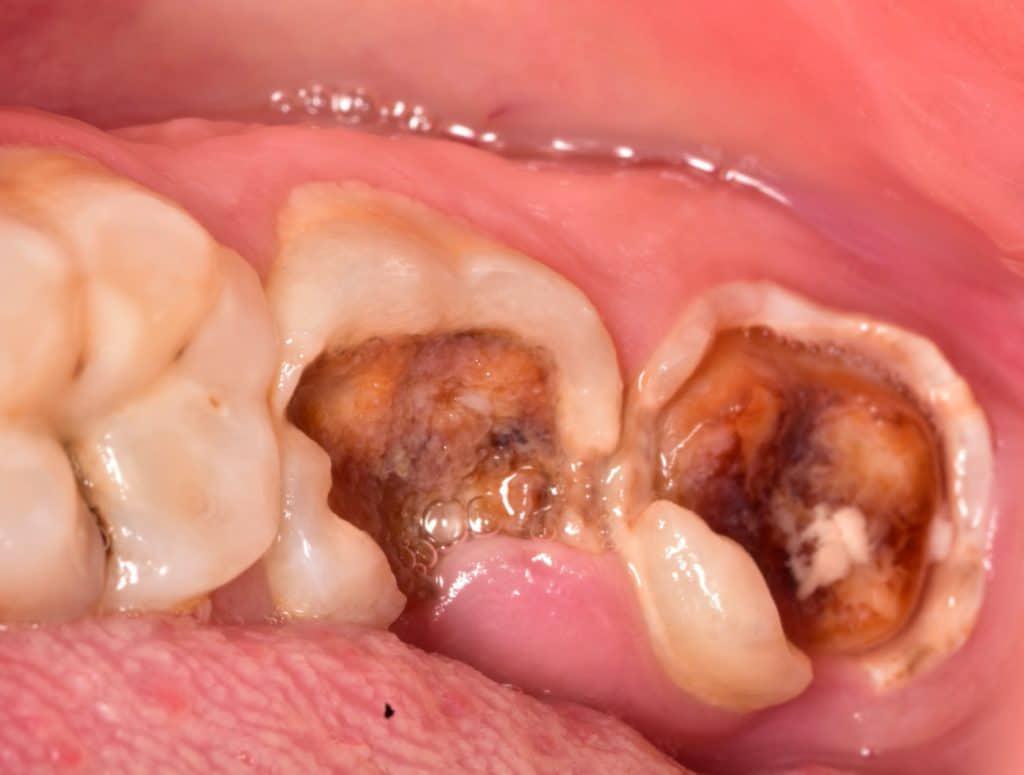
Looking closely at the photograph:
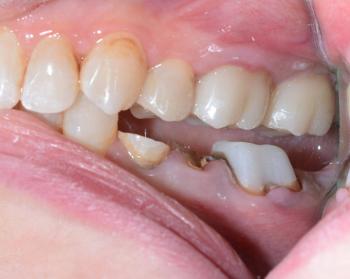
- Back molar: There appears to be extensive cavitation/coronal tooth destruction. A very large portion of the chewing surface is missing.
- The dark brown/black material is highly suspicious for advanced dental caries (tooth decay), although some discoloration can also represent stained or softened tooth structure.
- The cavity appears deep enough that pulp/nerve involvement is a significant concern.
- The adjacent molar also appears to have a large area of decay or a defective/previous restoration with substantial structural loss.
- The surrounding gum tissue is visible but the photograph alone cannot determine whether there is an abscess, bone loss, or infection around the roots.
- The smaller tooth in front appears comparatively more intact, although a clinical examination is needed to assess it properly.
Important limitation: A photograph cannot establish whether the pulp is alive, whether there is an abscess at the root, or whether either molar can be saved. Dental X-rays plus pulp testing are needed.
Advanced decay can progress from a cavity to pulp inflammation/necrosis and eventually a dental abscess.
How worried should you be?
Your fear that it could get worse is understandable. I would not ignore this case. However, the photograph does not mean that the teeth are automatically hopeless or that a dangerous infection is already present.
The biggest risk of waiting is that:
deep cavity → pulp inflammation → pulp death → infection around the root → abscess/swelling → possible spreading infection
A dental abscess does not normally disappear by itself and requires dental treatment.
What should happen next?
Ideally: dental appointment within 24–72 hours, rather than waiting 14 days.
At the appointment, the dentist would typically determine:
- Clinical examination
- Dental X-rays — especially periapical/bitewing imaging
- Pulp vitality testing
- Check for pain when biting/tapping
- Check gum probing and periodontal condition
- Determine whether the tooth has enough remaining structure to restore
- Assess the roots and surrounding bone
- Establish whether there is an abscess
The treatment could then be one of several paths:
If the nerve is still healthy enough:
Decay removal → protective restoration → filling/onlay/crown depending on remaining structure.
If the nerve is irreversibly inflamed or infected but the tooth is structurally salvageable:
Root canal treatment → buildup → usually a crown/onlay to protect the weakened tooth.
If the tooth is too structurally destroyed to predictably restore:
Extraction may be recommended, followed by discussion of replacement options.
The ADA emphasizes definitive dental treatment such as restoration, pulpotomy/pulpectomy, root canal treatment, or drainage when indicated rather than relying on antibiotics alone.
If you wait 14 days
A 14-day delay doesn't guarantee that the condition will deteriorate, but with cavities this extensive, I would not deliberately wait.
Possible escalation during that period:
| Possible development | What it could mean |
|---|---|
| Increasing sensitivity | Decay approaching/involving pulp |
| Severe spontaneous pain | Possible irreversible pulp inflammation |
| Pain suddenly disappears | Not necessarily improvement — pulp may have died |
| Pain when biting | Possible inflammation around the root |
| Bad taste/pus | Possible dental infection/abscess |
| Gum swelling | Infection may be developing |
| Facial/jaw swelling | More advanced infection |
| Fever/malaise | Possible systemic involvement |
An important misconception is that "no pain" doesn't necessarily mean the tooth is okay. Tooth decay can initially be asymptomatic, and infection can develop later.
Do not wait 14 days if these occur
Seek urgent dental care immediately if there is rapidly increasing swelling, severe uncontrolled pain, pus/bad taste with swelling, fever, or difficulty opening the mouth.
Go to an emergency department immediately if swelling is affecting the throat/neck or you have difficulty breathing, swallowing or speaking. Those can indicate potentially dangerous spreading infection.
Visual severity: HIGH.
Confirmed infection: Cannot be determined from the photo.
Probability of needing substantial treatment: HIGH.
Probability the teeth can still be treated: Cannot be determined until X-rays and pulp testing.
Recommended action: Arrange a dentist examination as soon as possible, preferably within a few days.
Most importantly, don't panic and don't assume extraction is inevitable. Even extensively decayed teeth can sometimes be preserved if enough sound structure and healthy root support remain. The X-ray and clinical testing will determine that.
Related Clinical Cases
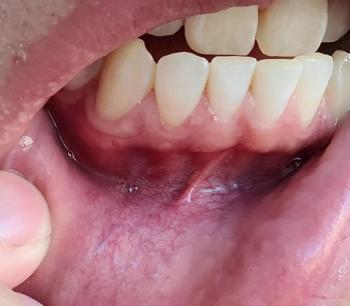
Patients with lower front gum inflammation may also experience tartar buildup, periodontal disease, gum abscesses, or tooth decay. Explore these related clinical case studies.

Other topics:
Other Dental Clinic