Your Smile, Perfected with Precision.

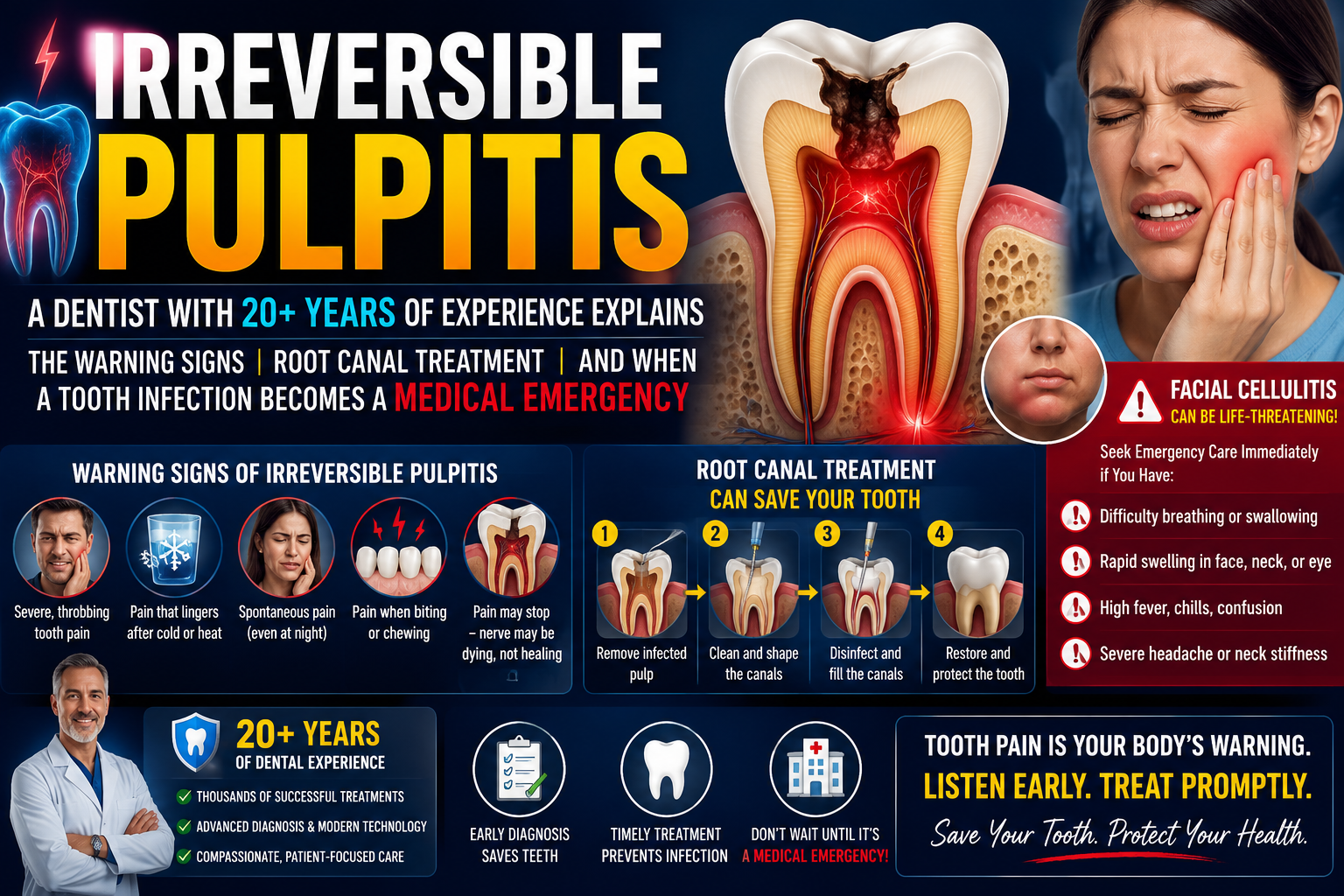
Irreversible Pulpitis: A Dentist with 20+ Years of Experience Explains the Warning Signs, Root Canal Treatment, and When a Tooth Infection Becomes a Medical Emergency
Language :
Topics:
Irreversible Pulpitis: An Experienced Dentist Explains the Warning Signs, Emergency Symptoms, Root Canal Treatment, and When a Tooth Infection Becomes Life-Threatening
Tooth pain is one of the most common reasons patients seek emergency dental care. While some toothaches are caused by minor irritation that can be corrected with a simple filling, others signal a much more serious condition. One of the most painful and urgent dental problems is irreversible pulpitis, a condition that will not heal without professional treatment.
As a dentist with more than two decades of clinical experience, I have treated thousands of patients suffering from severe tooth pain. One of the biggest misconceptions I encounter is the belief that if the pain suddenly disappears, the problem has resolved itself. Unfortunately, the opposite is often true. When the pain stops without treatment, it may indicate that the nerve inside the tooth has died while the infection continues spreading beneath the surface.
Understanding the warning signs of irreversible pulpitis can help you seek treatment before complications become more serious.
Emergency Warning: Facial Cellulitis
Before discussing irreversible pulpitis itself, it is essential to recognize one of the most dangerous complications of an untreated tooth infection.
A severe dental infection can spread beyond the tooth into the surrounding soft tissues of the face. This condition is known as facial cellulitis and is considered a medical emergency rather than simply a dental problem.
If the infection continues to spread, it may involve the deeper spaces of the face, neck, or airway. In severe cases, patients may require hospitalization, intravenous antibiotics, and emergency surgery to control the infection.
Seek immediate emergency medical care if you develop:
- Difficulty breathing
- Difficulty swallowing
- Excessive drooling
- Rapidly increasing facial swelling
- Swelling extending toward the eye
- Swelling spreading into the neck
- Swelling extending toward the chest
- Fever higher than 101°F (38.3°C)
- Chills
- Severe fatigue
- Confusion
- Severe headache
- Neck stiffness
These symptoms indicate that the infection may no longer be confined to the tooth. Emergency hospital treatment should not be delayed.
What Is Irreversible Pulpitis?
Inside every tooth lies a soft tissue called the dental pulp. This living tissue contains:
- Blood vessels
- Nerves
- Connective tissue
- Immune cells
The pulp keeps the tooth alive during development and provides sensation, allowing you to detect heat, cold, pressure, and pain.
When bacteria enter the tooth through deep decay, fractures, leaking fillings, or trauma, they irritate the pulp.
Initially, the inflammation may be mild and reversible. If treated early, removing the decay and placing a filling allows the pulp to recover.
However, when inflammation becomes severe, the blood supply inside the rigid tooth cannot expand enough to relieve the pressure.
As pressure builds, the tiny blood vessels become compressed, reducing oxygen delivery to the pulp.
Eventually, the tissue begins to die.
Once this stage occurs, healing is no longer possible.
This condition is called irreversible pulpitis.
Why Is It So Painful?
Many patients describe irreversible pulpitis as one of the worst pains they have ever experienced.
Unlike muscles or skin, the pulp is enclosed within hard dentin and enamel.
There is no room for swelling.
As inflammation increases, pressure builds around the nerve endings trapped inside the tooth.
This creates intense pain that often feels:
- Sharp
- Throbbing
- Pulsating
- Constant
- Deep inside the jaw
Some patients report that the pain becomes so severe they cannot sleep.
Others cannot identify which tooth hurts because the pain radiates throughout the jaw, ear, temple, or opposite teeth.
Pain may worsen when lying down because increased blood flow to the head further raises pressure inside the inflamed pulp.
Common Symptoms of Irreversible Pulpitis
Although symptoms vary, several warning signs strongly suggest irreversible pulpitis.
Persistent Toothache
Pain lasts for several minutes or even hours rather than disappearing quickly.
Lingering Sensitivity
Drinking cold water or eating ice cream may trigger pain that continues long after the cold stimulus has been removed.
Heat often produces even more severe discomfort.
Spontaneous Pain
Pain occurs without eating or drinking anything.
Patients frequently wake up in the middle of the night because of severe throbbing.
Pain When Biting
Chewing places pressure on the inflamed tissues inside the tooth.
This often causes sharp discomfort.
Referred Pain
The brain sometimes struggles to identify the exact source of dental pain.
Instead, discomfort may spread into:
- The ear
- The jaw joint
- Adjacent teeth
- The temple
- The neck
Why the Pain May Suddenly Stop
One of the most dangerous misunderstandings about irreversible pulpitis is believing that the disappearance of pain means the tooth has healed.
Unfortunately, this is rarely true.
As inflammation progresses, the nerve eventually dies.
Once the nerve is no longer functioning, the severe pain often disappears.
Many patients feel relieved and postpone seeing a dentist.
Meanwhile, bacteria continue multiplying inside the dead tooth.
Without treatment, the infection can spread into:
- The root tip
- The jawbone
- Surrounding gum tissue
- Facial soft tissues
- Nearby muscles
Eventually, an abscess may develop.
At this stage, swelling often replaces pain as the primary symptom.
The infection continues progressing until professional treatment removes its source.
What Causes Irreversible Pulpitis?
In my clinical experience, several factors commonly lead to irreversible pulpitis:
- Deep untreated tooth decay
- Large cavities reaching the pulp
- Cracked or fractured teeth
- Repeated dental procedures on the same tooth
- Leaking crowns or fillings
- Severe tooth wear from grinding (bruxism)
- Dental trauma from accidents or sports injuries
- Advanced gum disease exposing the tooth roots
Regardless of the cause, bacteria are usually responsible for triggering the severe inflammation that eventually destroys the pulp.
Can tooth extraction cause infection? Mild inflammation is normal, but increasing swelling, fever, or severe pain may indicate infection. Learn more about post-extraction infection warning signs in this detailed guide.
Book a consultation with our Cebu dental specialists for proper evaluation and care.
Ready to get expert guidance?
If you’re experiencing severe pain or delayed healing, book a consultation with our Cebu dental specialists to get proper evaluation and care.
Consultation or contact page .
Book a Consultation
For severe discomfort or delayed healing, book a consultation with our Cebu dental specialists today.
Looking for a dentist? Browse our Cebu dental directory to find trusted clinics near you.
Medical Review and Clinical Basis
This article is based on clinical dental guidelines and real patient recovery patterns observed after tooth extraction procedures. The information reflects common post-extraction healing stages, including normal clot formation, gum tissue repair, and signs of possible complications such as dry socket or infection.
While mild discomfort is expected after a dental extraction, worsening pain after Day 3, bad odor, exposed bone, or spreading pain may require professional evaluation. These symptoms are consistent with known post-extraction complications described in standard dental practice.
About Cebu Dental Implants
Cebu Dental Implants provides comprehensive tooth extraction, surgical procedures, and dental implant services in the Philippines. Our team evaluates post-extraction healing, manages complications such as dry socket, and advises patients on proper aftercare to prevent infection and delayed healing.
If you experience severe pain or unusual symptoms after extraction, early professional assessment is recommended to prevent further complications.
Important Medical Disclaimer
This content is for educational purposes only and does not replace professional dental diagnosis. Every patient heals differently. If symptoms worsen or do not improve within a few days, consult a licensed dentist for proper evaluation and treatment.
Author
This article was prepared by the Cebu Dental Implants content team in consultation with licensed dental professionals experienced in tooth extraction and implant procedures.
Related Clinical Cases
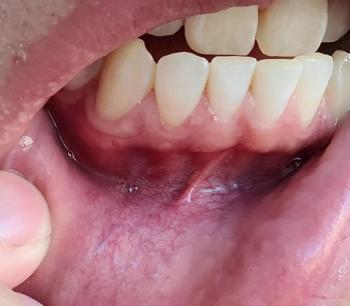
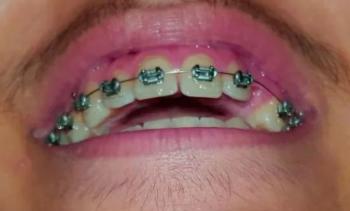
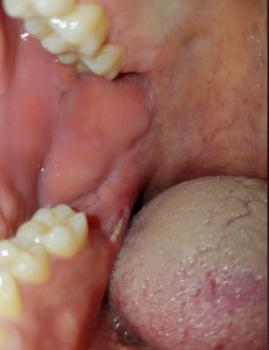
Patients with lower front gum inflammation may also experience tartar buildup, periodontal disease, gum abscesses, or tooth decay. Explore these related clinical case studies.


Other topics:
Other Dental Clinic