Healthy Teeth, Happy Life.

How Much Does a Full Mouth Dental Implant Cost in the Philippines?
Language :
Topics:
If you are considering a full mouth dental implant restoration in the Philippines, one of the first questions is usually: How much will the entire treatment cost?
The answer depends on several factors, including whether you need implants for one or both arches, the number of implants, the implant brand, the final prosthesis material, and whether additional procedures such as tooth extraction or bone grafting are required.
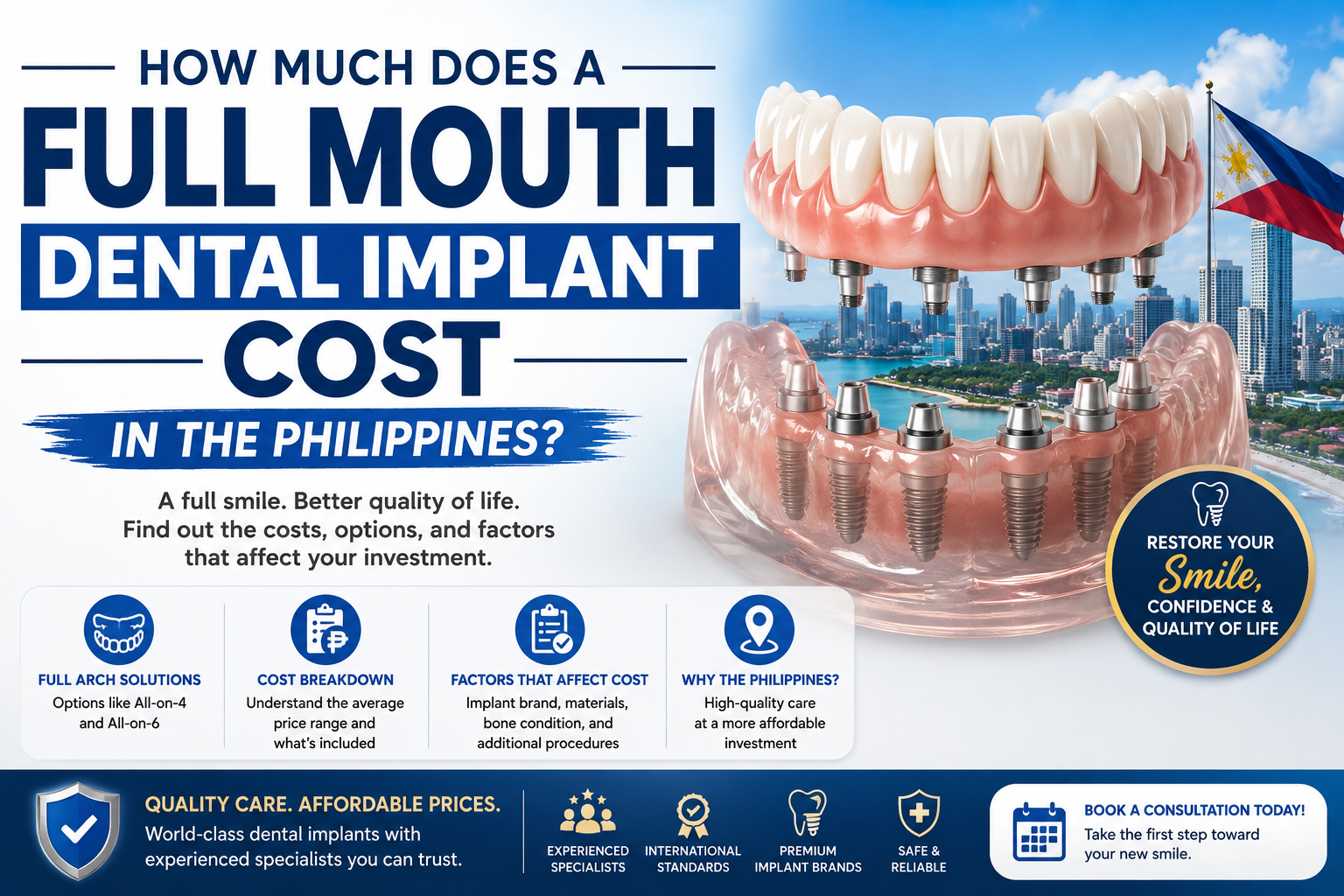
As a general guide, full-mouth implant treatment in the Philippines can range from approximately ₱700,000 to more than ₱2.5 million, depending on the treatment approach.
Full Mouth Dental Implant Cost in the Philippines
| Treatment Type | Estimated Cost per Arch | Estimated Cost for Both Arches |
|---|---|---|
| All-on-4 / All-on-6 fixed full-arch restoration | ₱350,000 – ₱800,000+ | ₱700,000 – ₱1,600,000+ |
| Individual implants replacing most or all teeth | — | ₱1,200,000 – ₱2,500,000+ |
These are general price ranges rather than fixed quotations. Actual costs can vary considerably between clinics and patients.
What Is a Full-Mouth Dental Implant Restoration?
A full-mouth restoration can involve replacing missing or failing teeth in the upper jaw, lower jaw, or both.
There are two main approaches.
1. All-on-4 or All-on-6
With an All-on-4 or All-on-6 treatment concept, a complete fixed arch of replacement teeth is supported by four or six strategically positioned implants.
Instead of placing one implant for every missing tooth, the implants support a full-arch prosthesis.
An arch may restore approximately 10–14 teeth, depending on the design and the patient's anatomy.
All-on-4 uses four implants per arch, while All-on-6 uses six.
All-on-4 is often considered when the goal is to restore a complete arch using fewer implants. All-on-6 may provide additional implant support in appropriately selected patients.
However, neither treatment is automatically suitable for everyone. Bone volume, gum health, bite forces, medical history, and other clinical factors must be evaluated by a dentist or implant specialist.
2. Individual Dental Implants
Another option is to place individual implants to replace individual missing teeth.
This can provide highly individualized tooth replacement, but it can also become significantly more expensive when many teeth need to be replaced.
For patients requiring extensive rehabilitation, the number of implants, abutments, crowns, bone procedures, scans, and laboratory work can substantially increase the total treatment cost.
What Is Included in an All-on-4 or All-on-6 Price?
When comparing implant quotations, it is important to look beyond the headline price.
A full-arch package may include some or all of the following:
-
Implant fixtures
-
Implant abutments or multi-unit components
-
Surgical placement
-
Temporary or provisional teeth
-
Final fixed prosthesis
-
Tooth extractions
-
3D CBCT imaging
-
Digital treatment planning
-
Laboratory fees
-
Follow-up appointments
However, not every clinic includes the same services in its package.
A ₱400,000 quotation and a ₱650,000 quotation may appear very different initially, but the difference can become smaller once you determine exactly what each package includes.
Implant Brand Can Affect the Price
The implant system is another important factor.
Dental implant systems from different manufacturers can have different pricing, components, clinical histories, warranties, and availability of replacement parts.
Commonly encountered implant brands include systems from Korean, Swiss, Swedish, European, and other international manufacturers.
Korean implant systems are often positioned at a more affordable price point, while premium systems such as Straumann and Nobel Biocare may command higher prices.
The most expensive implant is not automatically the best choice for every patient. The more important question is whether the implant system is appropriate for your clinical situation and whether the dentist has extensive experience using that system.
The Final Teeth Can Make a Major Difference
The material used for the final fixed teeth can significantly affect the overall price.
Some full-arch restorations use acrylic or composite-based teeth supported by a titanium framework. Others use more premium materials, including high-strength zirconia.
Acrylic or Composite Full-Arch Prosthesis
These options can be more economical and may be easier to repair or modify.
However, they can have different long-term wear characteristics compared with premium ceramic or zirconia solutions.
Zirconia Full-Arch Restoration
Zirconia can provide a more premium appearance and excellent strength when properly designed and fabricated.
Because laboratory techniques, materials, digital workflows, and manufacturing requirements can be more extensive, zirconia full-arch restorations are generally more expensive.
Important Considerations for Retirees and International Patients
For many U.S. retirees and other international patients, full-mouth dental implant treatment in the Philippines can be financially attractive compared with the cost of similar treatment in the United States. The potential savings may make comprehensive implant rehabilitation more accessible, particularly for patients who have limited dental insurance coverage.
However, affordability should never be the only reason to proceed with full-mouth dental implants.
Full-mouth implant treatment is a major surgical and prosthetic procedure. Patients should avoid making an impulsive decision simply because a treatment package appears inexpensive or because a clinic recommends an immediate solution.
Do Not Rush Into Treatment
Some patients may be told that they need extensive implant treatment, bone grafting, extractions, or other procedures. In complex cases, it is important to understand why each procedure is necessary and whether there are alternative treatment options.
Certain medical conditions, medications, previous treatments, or problems affecting the immune system and bone health may influence whether implant treatment is appropriate. Patients with a history of bone marrow disease, bone marrow transplantation, blood disorders, or other significant medical conditions should have their situation carefully assessed by the appropriate medical and dental professionals.
This does not automatically mean that dental implants are impossible. Instead, the patient's overall health and individual risks need to be evaluated before surgery.
Get a Second or Even Third Opinion
If a dentist recommends a major full-mouth reconstruction, consider obtaining a second opinion—or even a third opinion before committing to treatment.
This is especially important when:
-
All or most remaining teeth are recommended for extraction
-
A full-mouth implant procedure is proposed
-
Extensive bone grafting is recommended
-
The treatment involves a large financial commitment
-
You are being encouraged to start treatment immediately
-
You are travelling internationally specifically for dental treatment
A second or third dentist may confirm the original recommendation, identify a different treatment option, or suggest that some teeth can be preserved.
Compare Treatment Plans, Not Just Prices
When getting multiple opinions, ask each dentist to explain:
-
Which teeth actually need extraction
-
How many implants are recommended and why
-
Whether bone grafting is necessary
-
Which implant system will be used
-
What type of final teeth will be provided
-
The expected treatment timeline
-
Potential complications
-
Long-term maintenance requirements
-
The complete estimated cost
Having several independent opinions can help you make a more informed decision.
Don't Let a Low Price Create Pressure
The Philippines can offer significant savings for dental treatment, but cheap does not automatically mean better, and an expensive clinic is not automatically better either.
Patients should look for a combination of:
Qualified dental professionals + appropriate diagnosis + proven implant systems + quality laboratory work + transparent pricing + proper follow-up care.
For U.S. retirees considering dental treatment in the Philippines, the best approach is to slow down, research carefully, compare treatment plans, and make the decision based on clinical need rather than price or urgency.
A full-mouth dental implant procedure is a long-term investment. Taking additional time to obtain a second or third professional opinion can be one of the most valuable steps before undergoing irreversible treatment.
Additional Procedures Can Increase the Cost
The advertised implant price may not include every procedure a patient needs.
Additional treatment may include:
-
Extraction of severely damaged teeth
-
Bone grafting
-
Sinus augmentation
-
Treatment of gum disease
-
Temporary dentures or provisional teeth
-
Additional CBCT scans
-
Sedation
-
Complex surgical procedures
-
Replacement of an existing failed implant
-
Treatment of infection
For example, a patient with significant bone loss may require additional preparation before implants can be placed.
In selected All-on-4 cases, implant positioning can sometimes take advantage of available bone and reduce the need for extensive grafting. However, bone grafting cannot be ruled out simply because a patient is considering All-on-4.
Why Full-Mouth Implant Costs Differ Between Clinics
Dental implant pricing in the Philippines varies considerably from clinic to clinic.
Several factors contribute to the difference.
Dentist's Experience
Implant surgery and full-arch rehabilitation require careful diagnosis, treatment planning, surgery, prosthetic design, and long-term maintenance.
A dentist or multidisciplinary team with extensive experience in complex implant cases may charge more for treatment.
Clinic Location
Dental practices in major cities such as Manila and Cebu can have substantially higher operating expenses.
Rent, staff salaries, laboratory services, equipment, utilities, regulatory costs, and taxes all contribute to the cost of providing dental care.
Laboratory and Digital Dentistry
Modern full-arch treatment may involve:
-
CBCT scanning
-
Intraoral scanning
-
Digital smile design
-
CAD/CAM prosthetic design
-
Computer-guided surgery
-
3D-printed temporary teeth
-
Milled zirconia
-
Advanced dental laboratories
These technologies can improve treatment planning and efficiency, but they also contribute to the overall treatment cost.
Dental Implant Prices Have Also Been Affected by Rising Costs
Dental treatment costs do not exist independently from the wider economy.
Imported dental implants, prosthetic components, laboratory materials, and equipment can be affected by exchange-rate movements, inflation, shipping costs, and international supply-chain expenses.
For Philippine dental clinics, these factors can be particularly relevant because many implant systems and dental materials are imported.
At the same time, clinics face increasing operational expenses, including commercial rent, wages, utilities, laboratory fees, maintenance, and taxes.
As a result, implant prices can change over time, and an older quotation may no longer reflect current treatment costs.
Is ₱700,000 Enough for a Full Mouth?
It can be possible for a two-arch All-on-4 or All-on-6 treatment to start around this level based on the ranges above, but patients should be careful about assuming that the lowest advertised package represents the final cost.
The final bill may be higher if you require:
-
Additional extractions
-
Bone grafting
-
More extensive surgery
-
Premium implant brands
-
Zirconia final teeth
-
Additional temporary prostheses
-
Complex laboratory work
-
Sedation or other clinical services
Always ask for a complete written treatment plan and quotation before beginning treatment.
How to Compare Full-Mouth Implant Quotes
When comparing two or more dental clinics, ask these questions:
-
How many implants are included?
-
Which implant brand and model will be used?
-
Are the implants genuine and traceable?
-
Is CBCT scanning included?
-
Are extractions included?
-
Are temporary teeth included?
-
What material will be used for the final bridge?
-
Is zirconia an additional charge?
-
Are bone grafting or sinus procedures included if needed?
-
How many follow-up visits are included?
-
What warranty or maintenance policy does the clinic provide?
-
What happens if an implant fails?
These questions can help you compare treatment plans based on total value rather than simply the advertised price.
Does Dental Tourism Make Implants Cheaper?
The Philippines has become an option for patients seeking dental treatment at potentially lower prices than some Western countries.
However, international patients should calculate the complete cost, not just the dental treatment.
Travel, accommodation, transportation, additional appointments, time away from work, and potential follow-up visits all need to be considered.
Complex full-mouth implant treatment may also require multiple stages, making long-distance travel more complicated.
For international patients, having a clear treatment plan before travelling is particularly important.
The Cheapest Implant Treatment Is Not Always the Best Choice
Full-mouth dental implants are a major long-term investment.
Choosing solely on the lowest advertised price can create problems if the treatment does not include necessary components or if compromises are made in diagnosis, implant selection, laboratory work, or follow-up care.
A better approach is to compare:
Dentist experience + implant system + prosthesis material + treatment inclusions + aftercare + total cost.
Final Thoughts
So, how much does a full-mouth dental implant cost in the Philippines?
A reasonable general estimate is:
-
All-on-4 / All-on-6: approximately ₱350,000–₱800,000+ per arch
-
Both arches: approximately ₱700,000–₱1,600,000+
-
Extensive individual implant replacement: approximately ₱1,200,000–₱2,500,000+
These figures should be treated as planning estimates, not guaranteed prices.
The actual cost can only be determined after a proper dental examination, imaging, and treatment planning.
If you are considering full-mouth dental implants, ask your dentist for a detailed itemized quotation showing the implant brand, number of implants, temporary and final teeth, surgical procedures, laboratory fees, and any possible additional costs.
Most importantly, don't choose a full-mouth implant treatment based on price alone. The quality of diagnosis, surgical planning, implant system, prosthetic design, dentist experience, and long-term maintenance can be just as important as the initial cost.
Medical Review and Clinical Basis
This article is based on clinical dental guidelines and real patient recovery patterns observed after tooth extraction procedures. The information reflects common post-extraction healing stages, including normal clot formation, gum tissue repair, and signs of possible complications such as dry socket or infection.
While mild discomfort is expected after a dental extraction, worsening pain after Day 3, bad odor, exposed bone, or spreading pain may require professional evaluation. These symptoms are consistent with known post-extraction complications described in standard dental practice.
About Cebu Dental Implants
Cebu Dental Implants provides comprehensive tooth extraction, surgical procedures, and dental implant services in the Philippines. Our team evaluates post-extraction healing, manages complications such as dry socket, and advises patients on proper aftercare to prevent infection and delayed healing.
If you experience severe pain or unusual symptoms after extraction, early professional assessment is recommended to prevent further complications.
Important Medical Disclaimer
This content is for educational purposes only and does not replace professional dental diagnosis. Every patient heals differently. If symptoms worsen or do not improve within a few days, consult a licensed dentist for proper evaluation and treatment.
Author
This article was prepared by the Cebu Dental Implants content team in consultation with licensed dental professionals experienced in tooth extraction and implant procedures.
Related Clinical Cases
Patients with lower front gum inflammation may also experience tartar buildup, periodontal disease, gum abscesses, or tooth decay. Explore these related clinical case studies.