From Pain to Perfect — We Care for Your Smile.

Full-Mouth Dental Implants in Iceland (2026): Clinical Review, Cost Analysis, and Patient Guide
image hero:
Country:
Full-mouth dental implant rehabilitation is among the most complex and expensive forms of restorative dentistry available to patients in Iceland.
Unlike replacing one missing tooth, full-mouth reconstruction can involve multiple implants, extractions, bone preservation or augmentation, temporary prostheses, definitive crowns or bridges, laboratory work, surgical planning, and long-term maintenance.
For this reason, there is no single "full-mouth implant price" that applies to every patient.
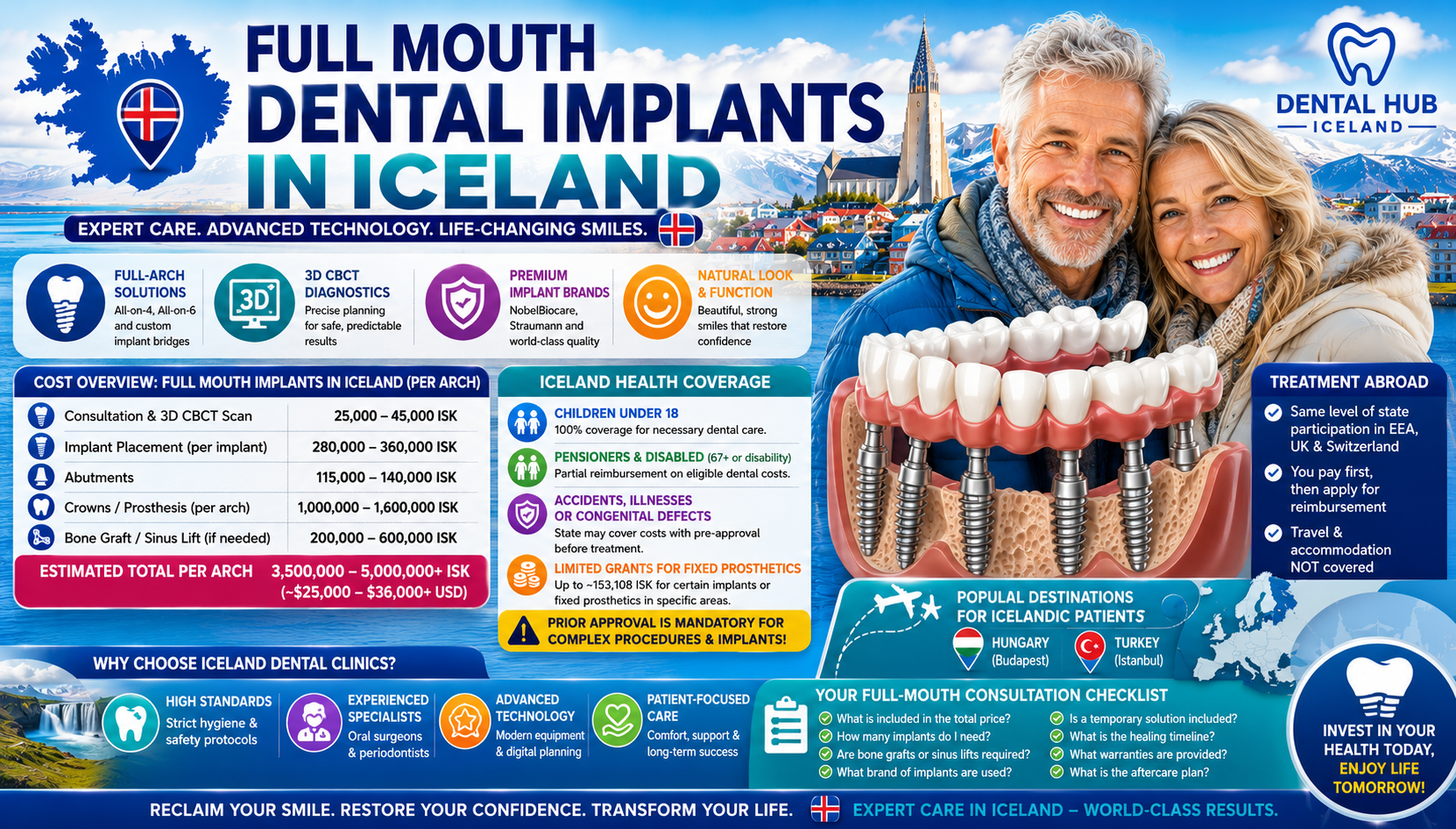
For planning purposes, extensive implant-supported reconstruction in Reykjavík can reach several million Icelandic króna per arch, but patients should obtain an individualized quotation rather than rely on an advertised package price.
Iceland Health's reimbursement rules are also more specific than the commonly used statement that "the government does not cover implants." Certain pensioners and patients with qualifying conditions may receive dental participation, while routine adult implant treatment is not universally reimbursed. (island.is)
1. What Does "Full-Mouth Dental Implants" Mean?
The phrase full-mouth dental implants can describe several different treatment concepts.
A patient may need:
-
replacement of several missing teeth;
-
implant-supported bridges;
-
implant-supported removable dentures;
-
fixed full-arch prostheses;
-
rehabilitation of both upper and lower jaws;
-
replacement of failing natural teeth;
-
complete reconstruction following severe periodontal disease.
These treatments are not clinically interchangeable.
A patient with six healthy remaining teeth and a patient with no remaining teeth may both search for "full-mouth implants," but their treatment plans can be completely different.
As an Icelandic dental clinician, I would begin with one question:
What teeth can safely be retained?
Saving a healthy natural tooth may be preferable to extracting it simply to create a full-arch implant reconstruction.
2. Comprehensive Clinical Assessment
Full-mouth implant treatment begins with a comprehensive examination.
The assessment may include:
Dental Examination
The dentist evaluates:
-
remaining teeth;
-
periodontal health;
-
cavities;
-
fractures;
-
existing crowns and bridges;
-
occlusion;
-
mobility;
-
infection;
-
soft tissues.
Radiographic Assessment
Depending on the case, imaging may include:
-
intraoral radiographs;
-
panoramic imaging;
-
CBCT.
CBCT can provide three-dimensional information about:
-
bone volume;
-
ridge anatomy;
-
sinus anatomy;
-
nerve location;
-
implant positioning;
-
surgical risks.
CBCT should be selected according to clinical need rather than automatically assuming every patient requires the same imaging protocol.
3. Periodontal Disease Must Be Addressed
One of the most important issues in full-mouth implant planning is periodontal disease.
A patient with severe gum disease may have:
-
bleeding;
-
deep periodontal pockets;
-
bone loss;
-
tooth mobility;
-
bacterial inflammation.
Simply extracting teeth and placing implants does not eliminate the underlying biological risk.
The patient must have a long-term strategy for:
-
plaque control;
-
periodontal maintenance;
-
professional hygiene;
-
implant maintenance.
A history of periodontal disease can also increase the risk of peri-implant disease.
4. Bone Loss and Bone Reconstruction
Long-standing tooth loss can produce substantial jawbone resorption.
Depending on the anatomy, treatment may require:
-
ridge preservation;
-
guided bone regeneration;
-
localized bone grafting;
-
sinus augmentation;
-
ridge expansion;
-
other reconstructive procedures.
These additional procedures can significantly increase the total cost.
Therefore, patients should never compare two full-mouth implant quotations without determining whether both treatment plans include the same surgical procedures.
5. Immediate Implants vs. Delayed Treatment
Some patients can receive implants immediately following extraction.
Other patients require a healing period before implant placement.
The decision depends on factors including:
-
infection;
-
bone quality;
-
primary stability;
-
soft-tissue condition;
-
implant position;
-
prosthetic requirements.
Immediate placement is not automatically superior.
The correct objective is predictable biological and prosthetic treatment, not simply the shortest possible timeline.
6. Full-Mouth Implant Cost in Iceland
There is no standardized nationwide full-mouth implant package price.
The final cost depends on:
-
number of implants;
-
number of extractions;
-
bone grafting;
-
sinus procedures;
-
temporary prostheses;
-
definitive prostheses;
-
laboratory fees;
-
implant system;
-
surgical complexity;
-
sedation;
-
specialist involvement;
-
number of appointments.
For extensive full-arch reconstruction, a planning range of approximately:
3,500,000–5,000,000+ ISK per arch
may be encountered in high-cost treatment scenarios.
However, this should be treated as a planning estimate rather than an official Iceland-wide 2026 tariff.
A bilateral upper-and-lower-jaw reconstruction could therefore become substantially more expensive than a single-arch case.
7. Why Full-Mouth Quotes Vary So Much
Consider two patients.
Patient A
-
adequate bone;
-
no active infection;
-
four implants required;
-
uncomplicated prosthetic design.
Patient B
-
advanced periodontal disease;
-
multiple extractions;
-
severe bone loss;
-
sinus augmentation;
-
extensive temporary prosthesis;
-
complex definitive restoration.
Both patients may request "All-on-4."
But they are not equivalent clinical cases.
Patient B can require substantially more treatment before the final prosthesis is delivered.
8. What Should Be Included in a Full-Mouth Quote?
A professional quotation should identify the major components.
Ask whether the price includes:
| Treatment component | Included? |
|---|---|
| Consultation | Yes / No |
| Full-mouth examination | Yes / No |
| X-rays | Yes / No |
| CBCT | Yes / No |
| Extractions | Yes / No |
| Bone grafting | Yes / No |
| Sinus lift | Yes / No |
| Implant fixtures | Yes / No |
| Surgical placement | Yes / No |
| Temporary prosthesis | Yes / No |
| Abutments | Yes / No |
| Final prosthesis | Yes / No |
| Laboratory fees | Yes / No |
| Sedation | Yes / No |
| Follow-up adjustments | Yes / No |
| Maintenance | Yes / No |
This is the best way to compare clinics.
9. Implant Brand and Prosthetic Components
Patients undergoing extensive reconstruction should request documentation of the implant system.
Ask for:
-
manufacturer;
-
implant model;
-
implant dimensions;
-
implant positions;
-
abutment system;
-
prosthetic components;
-
laboratory details.
Recognized implant systems can make future component identification easier.
However, patients should not assume that every dentist in Iceland will automatically service every foreign implant system.
The patient's treatment records remain extremely important.
10. Temporary Teeth Are an Important Cost Question
Full-arch patients often need temporary teeth during the healing and transition period.
The temporary prosthesis may be:
-
removable;
-
fixed;
-
acrylic;
-
reinforced;
-
supported by implants.
Patients should ask:
"Is the temporary full-arch prosthesis included in the quoted price?"
A quotation that excludes the temporary prosthesis may appear cheaper than another clinic's comprehensive package.
11. Final Prosthesis: Zirconia, Acrylic, or Other Designs
The final prosthesis can significantly affect the total cost.
Depending on the clinical plan, options may include:
-
acrylic-based prostheses;
-
composite-based solutions;
-
zirconia;
-
ceramic;
-
metal-reinforced prostheses;
-
hybrid designs.
The most expensive material is not automatically the best choice for every patient.
The dentist must consider:
-
occlusion;
-
available space;
-
implant position;
-
hygiene access;
-
aesthetics;
-
functional demands;
-
repairability;
-
long-term maintenance.
12. Iceland Health and Full-Mouth Implant Reimbursement
Patients should be careful with the statement:
"Iceland Health does not cover full-mouth implants."
That is too broad.
The actual rules depend on the patient's eligibility and whether the jaw is dentate or edentulous.
Iceland Health states that pensioners can receive 75% participation for covered general dentistry, including dentures under the applicable rules. (island.is)
For implant treatment in an edentulous jaw, Iceland Health states that it can pay 75% of a pensioner's cost of inserting dental implants to support dentures, subject to approval and the applicable rules. If approved, participation can apply to the first two implants in the lower jaw or four implants in the upper jaw. (island.is)
This does not mean that every All-on-4 treatment is automatically reimbursed at 75%.
The patient's eligibility and the applicable Iceland Health fee basis must be established before treatment.
13. Dentate Jaw vs. Edentulous Jaw
This distinction is critical.
Dentate Jaw
At least one natural tooth remains.
For qualifying pensioners, Iceland Health states that up to 146,677 ISK may be granted for certain dental implants or fixed prostheses in a dentate jaw in front of the 12-year molars during each 12-month period. (island.is)
Edentulous Jaw
No natural teeth remain.
For qualifying pensioners, approved implant-supported denture treatment can receive participation under the specific rules, including the first two lower-jaw or four upper-jaw implants. (island.is)
Therefore, a patient considering full-mouth rehabilitation needs to know which reimbursement category applies to each jaw.
14. Prior Approval
Prior approval is particularly important for qualifying implant treatment.
Iceland Health states that payment participation for specified implant procedures in an edentulous jaw is subject to approval before treatment begins. (island.is)
Iceland Health also announced that certain implant treatment requiring participation for elderly and disabled people would require a pre-approved application. (island.is)
Correct sequence
Examination → treatment plan → reimbursement application → approval → treatment
Do not reverse this sequence when prior approval is required.
15. Full-Mouth Implant Treatment Abroad
Because of the high potential cost of extensive reconstruction, some Icelandic patients investigate treatment abroad.
The important issue is to compare total treatment economics, not simply the foreign clinic's advertised price.
Foreign treatment calculation
Dental treatment
Airfare
Accommodation
Transportation
Time away from work
Additional appointments
Local follow-up
Potential revision treatment
=
True treatment cost
A foreign clinic advertising a dramatically lower price does not automatically produce the same percentage saving after all expenses are considered.
16. Iceland Health Reimbursement for Dental Treatment Abroad
Iceland Health provides specific rules for dental treatment abroad.
For qualifying dental expenses abroad, patients generally pay the foreign provider and then submit the necessary documentation for reimbursement. (island.is)
Certain procedures require prior approval.
Patients should therefore establish eligibility before traveling, especially for extensive implant treatment.
Iceland Health currently lists an average processing time of approximately:
-
4–6 weeks for dental work abroad requiring an application;
-
16–24 weeks for processing foreign dental expenses after the required documentation is received. (island.is)
These are processing averages, not guarantees.
17. Important Correction About Medical Tourism Savings
It is tempting to publish:
"Icelandic patients save 50–70% by going abroad."
That should be presented cautiously.
Actual savings vary according to:
-
treatment complexity;
-
foreign clinic;
-
currency exchange;
-
travel costs;
-
number of visits;
-
hotel costs;
-
reimbursement;
-
follow-up;
-
complications.
A more clinically responsible statement is:
Dental treatment abroad can offer substantial gross price differences for some patients, but the true financial saving must be calculated after travel, accommodation, reimbursement, follow-up, and potential revision costs.
This is a much stronger statement for a professional Dental Hub article.
18. Patient Review and Market Sentiment
Patients evaluating full-mouth implant treatment often focus on two issues:
Clinical quality
Patients value:
-
cleanliness;
-
communication;
-
modern equipment;
-
professional staff;
-
treatment planning;
-
perceived technical quality.
Financial accessibility
The second major issue is the overall treatment price.
A patient may be satisfied with the clinical standard of a Reykjavík clinic but still find a multi-million-ISK treatment plan financially difficult.
That is why patients often investigate:
-
staged treatment;
-
financing;
-
insurance;
-
union benefits;
-
treatment abroad.
However, patient reviews should be treated as experience reports, not clinical evidence.
19. Clinical Case Study: Failing Dentition
Patient
A 62-year-old patient presents with:
-
multiple missing teeth;
-
advanced periodontal disease;
-
several mobile teeth;
-
extensive bone loss;
-
difficulty chewing.
The patient asks for:
"All my teeth removed and implants placed immediately."
Clinical Response
An experienced implant dentist should not automatically agree.
The treatment plan should first determine:
-
Which teeth can be predictably retained?
-
Is periodontal disease controlled?
-
Is bone volume adequate?
-
Are grafting procedures required?
-
What is the occlusal relationship?
-
What temporary prosthesis is required?
-
What definitive prosthesis is appropriate?
-
Can the patient maintain the implants long term?
Only after these questions are answered should the final treatment plan be established.
20. Clinical Case Study: Completely Edentulous Patient
Consider a pensioner who has no natural teeth in the upper jaw.
The patient is struggling with a conventional denture.
A possible treatment may involve:
Assessment → CBCT when clinically indicated → implant planning → approved implant placement → healing → implant-supported denture → maintenance
Under Iceland Health's current rules, qualifying pensioners may receive participation for approved implant-supported treatment in an edentulous jaw, including the first four implants in the upper jaw. (island.is)
The final patient contribution depends on the applicable treatment and fee framework.
21. Long-Term Maintenance
Full-mouth implant treatment is not the end of dental care.
Patients require ongoing maintenance.
A long-term program can include:
-
professional hygiene;
-
implant evaluation;
-
periodontal monitoring;
-
prosthetic inspection;
-
bite assessment;
-
radiographic monitoring when clinically indicated;
-
home-care instruction.
Patients should budget for maintenance.
An implant-supported full-mouth reconstruction should be viewed as a long-term treatment commitment, not a one-time purchase.
22. Questions to Ask a Reykjavík Implant Clinic
Before signing a major treatment agreement, ask:
Clinical
-
Which teeth can be saved?
-
Why do I need extraction?
-
How many implants do I actually need?
-
Do I need bone grafting?
-
Do I need sinus augmentation?
-
What imaging is required?
-
What is my expected healing period?
Financial
-
What is the complete price per jaw?
-
Are extractions included?
-
Is CBCT included?
-
Are temporary teeth included?
-
Are final teeth included?
-
Are laboratory costs included?
-
Are bone grafts included?
-
Are follow-up adjustments included?
-
What happens if an implant fails?
Reimbursement
-
Do I qualify for Iceland Health participation?
-
Does my case require prior approval?
-
How much will Iceland Health contribute?
-
What will I personally pay?
-
Does the same reimbursement apply if treatment is performed abroad?
23. U.S. and Icelandic Dental Expert Perspective
From both a clinical and financial perspective, I would strongly advise against choosing a full-mouth implant provider based solely on price.
A successful reconstruction requires coordination between:
Surgery + Periodontics + Prosthodontics + Dental Laboratory + Maintenance
The cheapest initial quotation can become expensive if:
-
implants fail;
-
prosthetic components break;
-
the bite is unstable;
-
hygiene access is poor;
-
the patient develops peri-implant disease;
-
the definitive prosthesis requires replacement.
The best treatment plan is therefore not necessarily the cheapest.
It is the plan that provides:
appropriate diagnosis + predictable surgery + appropriate prosthetics + transparent pricing + long-term maintenance.
24. Final 2026 Assessment
Full-mouth dental implants in Iceland can represent a major financial commitment, particularly when extensive reconstruction is required.
A planning figure of approximately 3.5–5 million ISK or more per arch may be relevant for complex private treatment, but patients should never treat this as a universal Iceland-wide price.
The actual cost can change dramatically depending on:
-
number of implants;
-
extractions;
-
bone grafting;
-
sinus procedures;
-
temporary teeth;
-
definitive prosthesis;
-
laboratory work;
-
specialist fees;
-
maintenance.
Iceland Health provides important dental participation for eligible groups, but the rules are specific. Pensioners may receive 75% participation for qualifying general dentistry, while implant treatment has separate rules depending on whether the jaw is dentate or edentulous. (island.is)
For qualifying pensioners with an edentulous jaw, Iceland Health states that approved implant-supported denture treatment can receive 75% participation, with the stated implant limits of two in the lower jaw or four in the upper jaw. (island.is)
Bottom Line
Full-mouth implant treatment should be evaluated as a complete clinical reconstruction—not as a price per implant.
Before proceeding, obtain:
1. Complete clinical diagnosis
2. Written treatment plan
3. Itemized quotation
4. Iceland Health eligibility assessment
5. Prior approval where required
6. Long-term maintenance plan
For treatment abroad, calculate the true total cost, including travel and follow-up, rather than relying on an advertised percentage of savings.
Official Iceland Health Sources
Medical disclaimer: This Dental Hub article is for educational purposes and does not diagnose an individual patient or determine eligibility for Iceland Health reimbursement. Full-mouth implant treatment requires an individualized clinical examination, appropriate imaging, treatment planning, and confirmation of current reimbursement rules before treatment begins.
Related Clinical Cases
Patients with lower front gum inflammation may also experience tartar buildup, periodontal disease, gum abscesses, or tooth decay. Explore these related clinical case studies.