From Pain to Perfect — We Care for Your Smile.

Bone Health and Dental Health: Why Your Bone Density Matters to Your Teeth and Jaw
image hero:
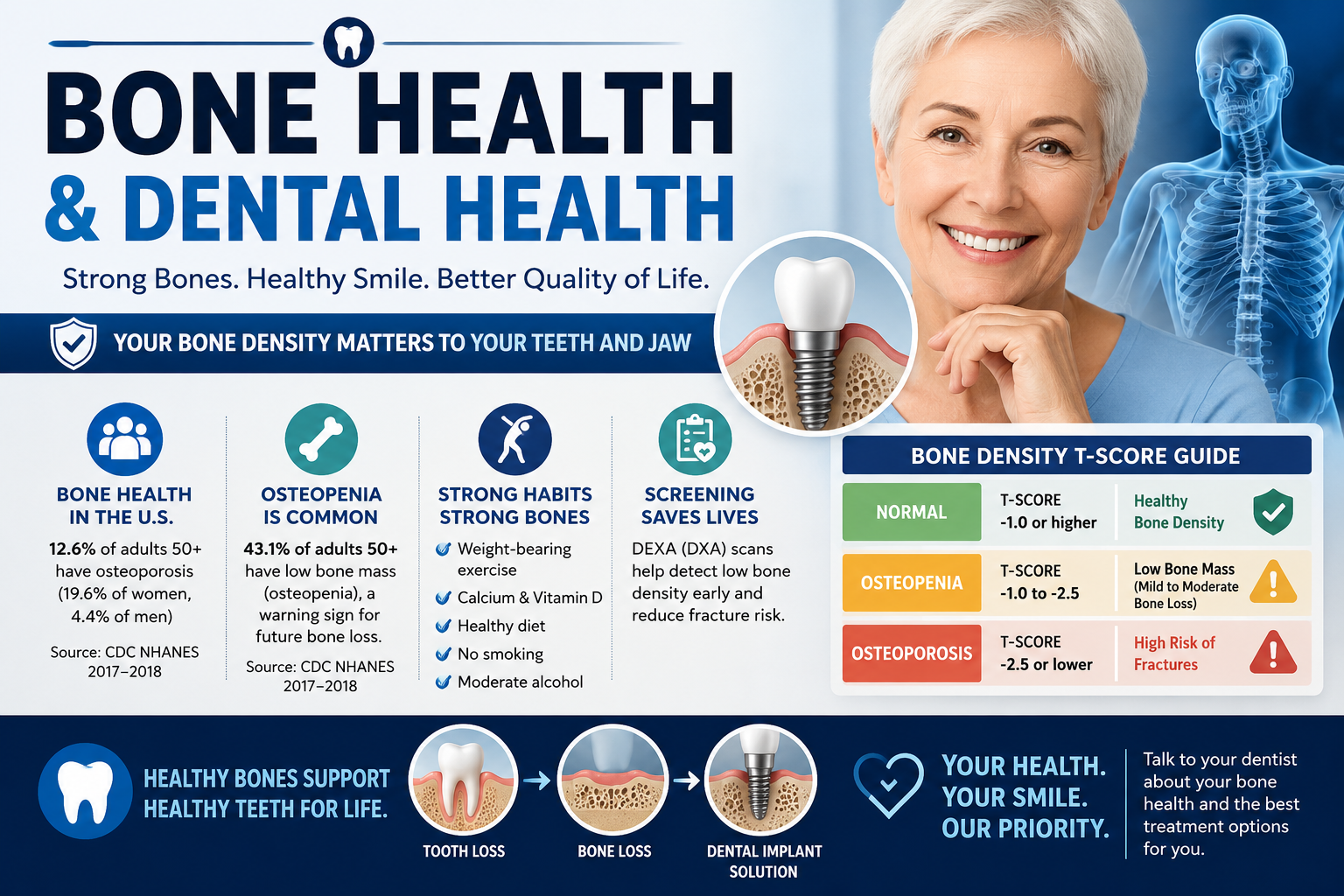
Bone health is often discussed in terms of hip and spine fractures, but healthy bones also matter in dentistry. The jawbones provide the foundation that supports your teeth, periodontal tissues, and dental implants.
As people age, changes in bone density can become an increasingly important part of overall health. Osteoporosis and osteopenia affect millions of older Americans, making bone health an important subject for patients undergoing tooth extraction, periodontal treatment, dentures, bone grafting, or dental implant treatment.
However, an important distinction should be made: a diagnosis of osteoporosis does not automatically mean that the jawbone is too weak for dental treatment or dental implants. Dental treatment decisions require an individualized evaluation of the patient's oral condition, medical history, medications, local jawbone anatomy, and overall fracture and healing risk.
The U.S. Bone Health Picture
According to CDC National Center for Health Statistics data from the 2017–2018 National Health and Nutrition Examination Survey (NHANES), approximately 12.6% of U.S. adults aged 50 and older had osteoporosis based on bone mineral density measured at the femoral neck or lumbar spine.
The prevalence was substantially higher among women than men:
-
Women: 19.6%
-
Men: 4.4%
-
Adults aged 50 and older overall: 12.6%
CDC data also found that approximately 43.1% of adults aged 50 and older had low bone mass, commonly referred to as osteopenia when the appropriate diagnostic criteria are met.
The CDC also reported an increase in overall osteoporosis prevalence among adults 50 and older from 9.4% in 2007–2008 to 12.6% in 2017–2018. Among women, prevalence increased from 14.0% to 19.6% during those survey periods.
These statistics demonstrate why bone health deserves attention as the population ages.
What Is Osteoporosis?
Osteoporosis is a skeletal disorder characterized by reduced bone mass and increased bone fragility.
Healthy bone is living tissue that continuously undergoes remodeling. Old bone is removed and new bone is formed. With aging and certain medical or lifestyle factors, bone loss can outpace bone formation.
The result can be weaker bones and an increased susceptibility to fractures.
Osteoporosis commonly affects areas such as:
-
Hip
-
Spine
-
Wrist
-
Other skeletal sites vulnerable to fragility fractures
Importantly, osteoporosis is a whole-body skeletal condition. It is not simply a disease of the jaw.
What Is Osteopenia?
Osteopenia generally describes bone mineral density that is below the normal range but does not meet the diagnostic threshold for osteoporosis.
It can be considered a warning sign that bone health deserves attention.
Not everyone with osteopenia will develop osteoporosis. Bone health is influenced by age, genetics, physical activity, nutrition, medications, hormonal status, medical conditions, and other factors.
Understanding the T-Score
A bone density examination commonly uses a T-score to compare a person's bone mineral density with that of a healthy young-adult reference population.
A commonly used classification is:
| Bone Density Category | T-Score |
|---|---|
| Normal | -1.0 or higher |
| Osteopenia | Between -1.0 and -2.5 |
| Osteoporosis | -2.5 or lower |
A T-score is an important measurement, but it is not the entire fracture-risk assessment.
Doctors may also consider age, previous fractures, medications, medical conditions, family history, and other clinical risk factors.
What Is a DEXA or DXA Scan?
A DXA scan, also called a DEXA scan, is a low-dose X-ray examination used to measure bone mineral density.
It is commonly used to evaluate bone density at sites such as the hip and spine.
The U.S. Preventive Services Task Force currently recommends osteoporosis screening for women 65 years and older and recommends risk assessment followed by screening for postmenopausal women younger than 65 who are at increased risk.
For men, the USPSTF states that current evidence is insufficient to determine the balance of benefits and harms of population screening, although individual clinical circumstances may justify testing.
Why Bone Health Matters in Dentistry
The jaw is made of bone, but jawbone health cannot simply be determined from a patient's hip or spine DXA result.
Dentists evaluate the mouth and jaw directly using clinical examination and, when appropriate, dental imaging.
Dental evaluation may include:
-
Clinical examination
-
Periodontal examination
-
Dental X-rays
-
Panoramic imaging
-
Cone-beam computed tomography (CBCT)
-
Assessment of remaining bone around teeth
-
Evaluation of bone volume for implant placement
-
Assessment of infection and inflammation
-
Review of medical history and medications
This is particularly important when a patient is considering dental implants.
Bone Loss Around Teeth Is Different From Osteoporosis
One of the most important concepts for patients is that periodontal bone loss and osteoporosis are not the same disease.
Periodontitis is an inflammatory disease affecting the tissues supporting the teeth. Advanced periodontal disease can cause destruction of the bone surrounding individual teeth.
Osteoporosis, on the other hand, is a systemic skeletal disorder characterized by reduced bone strength and increased fracture risk.
A patient can have:
-
Osteoporosis without severe periodontal disease
-
Periodontitis without osteoporosis
-
Both conditions
-
Neither condition
Therefore, a dental professional should not diagnose osteoporosis simply because bone loss is visible around a tooth.
Missing Teeth and Jawbone Loss
When a tooth is lost, the surrounding alveolar bone no longer receives the same mechanical stimulation associated with the tooth and periodontal structures.
The bone in the area can gradually remodel and decrease in volume.
This can create challenges for future dental treatment.
For example, significant bone loss may affect:
-
Dental implant positioning
-
Implant diameter and length
-
Implant stability
-
Prosthetic planning
-
Denture stability
-
Bone grafting requirements
This is one reason dentists often evaluate bone volume carefully before implant treatment.
Does Osteoporosis Prevent Dental Implants?
Not necessarily.
A diagnosis of osteoporosis is not automatically a contraindication to dental implants.
A recent systematic review of clinical studies found that implant survival was generally high in patients with osteoporosis, although individual studies have reported differences in implant stability and other outcomes. The authors concluded that osteoporosis should not automatically exclude a patient from implant treatment, but implant planning should be cautious and individualized.
A 2025 systematic review and meta-analysis likewise found no significant difference in implant survival between osteoporotic and control groups in the pooled analysis.
This means the question should not simply be:
"Do I have osteoporosis?"
Instead, the dental team should ask:
"What is the condition of my jawbone, what medications am I taking, and what factors could affect my treatment and healing?"
Osteoporosis Medications and Dental Treatment
Medication history is especially important.
Some patients with osteoporosis receive medications that affect bone remodeling, including antiresorptive medications.
Examples include certain:
-
Bisphosphonates
-
Denosumab
-
Other osteoporosis medications
These medications can be highly effective for reducing fracture risk, but dentists and physicians should know about them when invasive dental procedures are being considered.
Patients should never stop osteoporosis medication on their own because of planned dental treatment.
The dentist and prescribing physician should coordinate when medication-related risks need to be evaluated.
Why a Medical History Matters Before Dental Surgery
Before procedures such as extraction, implant placement, or bone grafting, the dental team may need information about:
-
Osteoporosis diagnosis
-
Previous fractures
-
Current medications
-
Previous osteoporosis medications
-
Steroid use
-
Cancer treatments
-
Diabetes
-
Smoking
-
Kidney disease
-
Immune-system conditions
-
Previous radiation therapy
-
Previous dental complications
-
History of delayed healing
This information helps the dentist develop a safer treatment plan.
Bone Health and Aging
Bone density naturally changes with age.
Peak bone mass is generally achieved earlier in adulthood, after which bone remodeling continues throughout life.
The rate of bone loss can increase with aging and may be influenced by hormonal changes, physical inactivity, inadequate nutrition, certain medications, and medical conditions.
The goal is not simply to "stop aging."
The goal is to identify modifiable risk factors and maintain bone strength for as long as possible.
Lifestyle Habits That Support Bone Health
Bone health is influenced by several lifestyle factors.
Weight-Bearing Exercise
Activities that place appropriate mechanical demands on the skeleton can support bone health.
Examples include:
-
Walking
-
Resistance training
-
Stair climbing
-
Dancing
-
Other appropriately selected weight-bearing activities
Exercise should be adapted to the individual's age, fitness level, fracture risk, and medical condition.
Adequate Nutrition
Bone remodeling requires adequate nutrients.
Important nutritional factors include:
-
Calcium
-
Vitamin D
-
Protein
-
Overall adequate energy and nutrient intake
Patients should discuss supplementation with their healthcare professional rather than assuming that taking large doses is automatically beneficial.
Avoid Smoking
Smoking is associated with poorer bone health and can also negatively affect oral health and periodontal tissues.
Moderate Alcohol Consumption
Excessive alcohol consumption can negatively affect bone health and increases the risk of falls and fractures.
Maintain Oral Hygiene
Good oral hygiene remains important even when a patient has osteoporosis.
Daily plaque control and regular professional dental care can help reduce the risk of periodontal disease, tooth loss, and oral infection.
Dental Bone Health: What Patients Should Ask
Patients concerned about bone health and dental treatment can ask their dentist:
-
Is there enough bone for my planned dental treatment?
-
Do I have periodontal bone loss?
-
Do I need dental X-rays or CBCT imaging?
-
Does my medical history affect my treatment?
-
Are any of my medications important for dental surgery?
-
Do I need to discuss my dental treatment with my physician?
-
If I need an implant, is bone grafting necessary?
-
How will you evaluate implant stability?
-
What alternatives exist if an implant is not appropriate?
-
How should my oral health be monitored after treatment?
The Bigger Picture: Bone Health Is Part of Whole-Body Health
Dental health does not exist separately from general health.
A patient with osteoporosis may require coordination between:
Primary-care physician → Bone-health evaluation → Dentist → Periodontal assessment → Dental imaging → Treatment planning
This approach is particularly important for older adults and patients undergoing complex dental procedures.
The goal is not to treat a DXA number.
The goal is to understand the patient's overall fracture risk, medical condition, medication profile, oral health, jawbone anatomy, and treatment objectives.
When Should You Consider a Bone Density Evaluation?
According to the current USPSTF recommendation, women aged 65 and older should undergo osteoporosis screening. Postmenopausal women younger than 65 may also benefit from screening when they have risk factors that place them at increased risk.
Men may also need individualized evaluation depending on their risk factors and clinical circumstances, even though the USPSTF currently considers evidence insufficient for a population-wide screening recommendation in men.
A healthcare professional can determine whether DXA testing or another evaluation is appropriate.
Dental Takeaway
Strong bones and healthy teeth are connected through the larger picture of aging, nutrition, physical activity, systemic disease, and overall health—but osteoporosis and dental bone loss are not interchangeable diagnoses.
If you have osteoporosis, osteopenia, or risk factors for bone loss, tell your dentist.
If you have significant tooth loss, periodontal disease, or are considering dental implants, ask your dentist to evaluate the condition and volume of your jawbone.
Most importantly, do not assume that an osteoporosis diagnosis automatically means you cannot receive dental implants or other dental treatment. Modern treatment planning allows many patients with reduced systemic bone density to receive appropriate dental care when their individual risks are properly assessed.
Medical Disclaimer
This dental hub provides general educational information and is not a substitute for diagnosis or individualized medical or dental treatment. Bone density results, medications, fracture risk, periodontal condition, and dental imaging should be evaluated by qualified healthcare professionals. Do not start, stop, or change osteoporosis medication without consulting the prescribing clinician.
Introduction:
Dental Hub Sections
- Bone Density Evaluation: DEXA Scan Explained
- Osteoporosis and Dental Implants
- Osteopenia and Dental Implants
- Does Osteoporosis Cause Jawbone Loss?
- Osteoporosis Medications and Dental Surgery
- Bisphosphonates and Tooth Extraction
- Denosumab and Dental Treatment
- Bone Grafting for Dental Implants
- Jawbone Loss After Tooth Extraction
- Periodontal Bone Loss vs. Osteoporosis
- Dental Implants After Bone Loss
- CBCT Scan Before Dental Implants
- Calcium, Vitamin D and Dental Health
- Aging, Bone Density and Tooth Loss
- Bone Health Checklist Before Dental Implant Surgery
Conditions Diagnosed:
Related Clinical Cases
Patients with lower front gum inflammation may also experience tartar buildup, periodontal disease, gum abscesses, or tooth decay. Explore these related clinical case studies.

Other topics:
Other Dental Clinic
 |
 |
 |
 |