Missing Teeth? Find Your Smile Again.

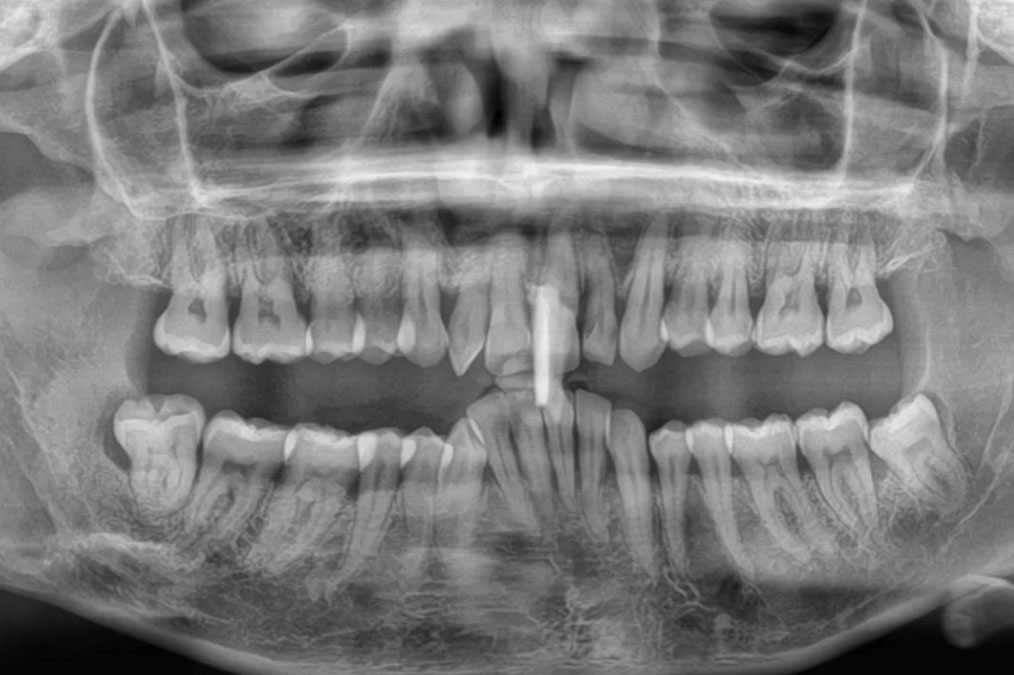
Panoramic X-Ray Showing Generalized Bone Loss Case Analysis
Image:
Severity:
Clinical Guide: What Generalized Bone Loss on a Panoramic Dental X-Ray Really Means
How Dentists Evaluate Widespread Jawbone Loss
When a panoramic dental X-ray shows reduced bone height around multiple teeth, the finding deserves a comprehensive periodontal assessment. The bone surrounding the roots, known as the alveolar bone, helps support the teeth during chewing. When this supporting tissue is lost, teeth may become mobile and their long-term prognosis may worsen.
Generalized bone loss means that reduced bone support appears in several areas of the mouth rather than being limited to one tooth. One important possible cause is periodontitis, a chronic inflammatory disease affecting the gums and the supporting structures of the teeth.
However, a panoramic X-ray alone cannot establish the exact cause, activity, or severity of the disease. A dentist must interpret the image alongside the patient's symptoms, medical history, periodontal measurements, and other appropriate dental images.
1. What Radiographic Signs Suggest Periodontal Bone Loss?
During a clinical evaluation, a dentist may examine the following features:
-
Reduced alveolar bone height: The supporting bone appears farther down the tooth roots than expected.
-
Horizontal bone loss: Bone height is reduced relatively evenly across several teeth.
-
Vertical or angular bone defects: Bone loss extends farther down one side of a tooth or root.
-
Changes in the bone crest: The normally defined margin of the supporting bone may appear irregular.
-
Uneven patterns of bone support: Different teeth may show different degrees of bone loss, suggesting areas that need closer examination.
These findings can raise suspicion of periodontal disease, but they do not independently confirm an active infection or prove that every affected tooth needs extraction.
Panoramic images also have limitations. Magnification, distortion, overlapping structures, and image positioning can affect interpretation. Bitewing or periapical X-rays may be needed to evaluate particular teeth more closely.
2. Does Generalized Bone Loss Always Mean Severe Periodontitis?
Not necessarily. The amount and pattern of bone loss, the patient's age, clinical attachment loss, periodontal pocket depths, bleeding on probing, tooth mobility, and other risk factors all contribute to the diagnosis.
A dentist may consider:
-
Previous or currently active periodontitis.
-
Plaque and calculus accumulation.
-
Gum recession and loss of periodontal attachment.
-
Localized infection around particular teeth.
-
Previous dental trauma or other conditions that affect bone.
-
Medical and behavioral risk factors, including diabetes and tobacco use.
Bone loss visible on an X-ray reflects structural changes that have occurred over time. It does not, by itself, show whether the disease is currently progressing. Comparing previous images and performing a periodontal examination can help clarify the situation.
3. What Should Happen After Generalized Bone Loss Is Detected?
The next step is to determine which teeth can be preserved and what treatment is necessary to control the underlying condition.
Step 1: Complete periodontal assessment
The dentist should examine gum health, measure periodontal pockets, assess bleeding, check gum recession, evaluate tooth mobility, and review the patient's dental and medical history.
Step 2: Identify teeth with additional problems
Teeth with deep decay, suspected root infections, fractures, or localized swelling may need separate diagnostic tests. A radiographic finding should not automatically be interpreted as a dental abscess.
Step 3: Control plaque and periodontal inflammation
Depending on the diagnosis, treatment may include professional scaling, subgingival instrumentation, and scaling and root planing. These procedures remove plaque and calculus from the tooth surfaces and root areas that cannot be adequately cleaned at home.
Step 4: Reassess healing and treatment response
After initial periodontal therapy, the dentist evaluates pocket depths, bleeding, symptoms, and remaining problem areas. Some patients need additional periodontal treatment or referral to a periodontist.
Step 5: Establish long-term maintenance
Periodontitis often requires continuing professional maintenance and careful home care. Follow-up intervals should be individualized according to disease severity, risk factors, and treatment response.
4. Can Lost Jawbone Grow Back?
Bone lost through periodontitis does not normally return simply because the gums stop bleeding or become less swollen. Successful treatment can control inflammation and help prevent further destruction, but the amount of existing bone loss may remain visible on subsequent X-rays.
In selected cases, periodontal regenerative procedures may improve supporting tissues around certain bone defects. Their suitability depends on the defect's shape, the tooth's condition, the patient's overall health, and the ability to maintain good oral hygiene.
Bone grafting may also be considered when there is insufficient bone for a planned dental implant. However, not every patient with generalized bone loss needs a graft, and a graft does not replace the need to control periodontal disease.
5. Does Generalized Bone Loss Mean All Teeth Must Be Removed?
No. Extraction decisions should be made tooth by tooth after a thorough examination.
A tooth with reduced bone support may still be maintainable if infection and inflammation can be controlled, the tooth is sufficiently stable, and the patient can maintain appropriate hygiene. Other teeth may have a poor prognosis because of advanced attachment loss, severe mobility, extensive decay, root fracture, or combined problems.
Preserving natural teeth should be considered whenever a predictable outcome is possible. If extraction is necessary, the dentist should explain the reason and discuss appropriate replacement options.
6. Is Dental Implant Treatment Possible With Generalized Bone Loss?
Potentially, yes. Generalized periodontal bone loss does not automatically disqualify someone from dental implant treatment. However, active periodontal disease should be treated and controlled before implant placement is considered.
The implant assessment may include:
-
Evaluation of periodontal stability and remaining teeth.
-
Assessment of the available bone volume and quality.
-
Review of smoking, diabetes control, and other relevant risk factors.
-
A discussion of implant alternatives, costs, maintenance, and possible complications.
-
Three-dimensional CBCT imaging when indicated for detailed surgical planning.
A panoramic X-ray provides a useful overview but does not reliably show the full three-dimensional width of the jawbone. CBCT may be appropriate when additional anatomical information is necessary for implant planning.
Patients with a history of periodontitis may have an increased risk of peri-implant disease. Long-term success therefore depends on careful case selection, disease control, oral hygiene, and regular professional maintenance.
7. Warning Signs That Need Prompt Dental Attention
Arrange a dental appointment promptly if you notice persistent gum bleeding, increasing tooth mobility, gum recession, pain while chewing, pus around a tooth, or recurrent gum swelling.
Seek urgent dental care for facial swelling, fever associated with dental symptoms, or rapidly worsening pain. Difficulty swallowing or breathing, or swelling that is spreading rapidly toward the neck or eye, requires emergency medical assessment.
Do not wait for severe pain before seeking an evaluation. Periodontitis may progress with few noticeable symptoms.
8. Practical Home Care While Awaiting Treatment
-
Brush twice daily with fluoride toothpaste and a soft-bristled toothbrush.
-
Clean between teeth daily with floss or appropriately sized interdental brushes.
-
Follow the dentist's instructions for cleaning around loose teeth, bridges, or other dental restorations.
-
Avoid tobacco use and discuss smoking cessation support if needed.
-
If you have diabetes, work with your healthcare team to improve glucose control.
-
Attend recommended periodontal maintenance appointments.
Antibiotics are not routinely required for uncomplicated periodontitis. They should only be prescribed when clinically indicated; they do not replace professional removal of plaque and calculus.
Frequently Asked Questions About Generalized Bone Loss on Panoramic X-Rays
1. What does generalized bone loss mean on a dental panoramic X-ray?
It means the supporting bone around multiple teeth appears reduced. Periodontitis is an important possible cause, but a dentist must confirm the diagnosis through clinical examination and appropriate imaging.
2. Can a panoramic X-ray diagnose gum disease by itself?
No. It can reveal bone changes associated with periodontal disease, but it cannot measure gum pocket depths, directly establish current disease activity, or fully determine the severity of periodontal attachment loss. Periodontal probing and other clinical findings are essential.
3. Can generalized bone loss cause loose teeth?
Yes. As supporting bone and periodontal attachment are lost, teeth may become mobile. However, tooth mobility can have other causes, including trauma or excessive biting forces, so the dentist must determine the reason.
4. Is generalized bone loss an emergency?
It is not automatically a dental emergency, but it should not be ignored. Arrange a comprehensive periodontal evaluation. Facial swelling, fever with dental symptoms, rapidly worsening pain, or difficulty swallowing or breathing requires urgent assessment.
5. Can professional cleaning stop bone loss?
Professional periodontal treatment can control inflammation and reduce the risk of further destruction. The outcome depends on disease severity, treatment response, risk factors, and ongoing maintenance. Routine cleaning alone may not be sufficient for advanced periodontitis.
6. Can lost periodontal bone be restored naturally?
Significant bone lost through periodontitis does not usually regenerate naturally. Selected defects may respond to periodontal regenerative treatment, but results vary. Controlling disease progression is the first priority.
7. Do I need a CBCT scan if my panoramic X-ray shows bone loss?
Not always. A dentist may recommend additional imaging if the panoramic image does not provide enough information to answer a specific diagnostic or treatment-planning question. CBCT is particularly useful in selected implant and surgical cases, but it is not routinely necessary for every patient with periodontal bone loss.
8. Can I receive dental implants if I have generalized bone loss?
Possibly. The dentist must first assess periodontal stability, the condition of the remaining teeth, and the amount of available bone. Some patients may require additional treatment or bone augmentation before implant placement.
9. Will antibiotics rebuild the bone around my teeth?
No. Antibiotics do not rebuild lost supporting bone and are not a substitute for periodontal therapy. They are reserved for situations in which a clinician determines that they are indicated.
10. How often should I return for periodontal follow-up?
The interval depends on the severity of the disease, risk factors, and response to treatment. Patients with a history of periodontitis often need individualized maintenance visits at intervals shorter than routine six-month checkups.
11. Can diabetes make periodontal bone loss worse?
Diabetes, particularly when poorly controlled, is associated with a higher risk of periodontitis and poorer periodontal outcomes. Managing blood glucose and treating gum disease are important complementary parts of care.
12. Can I wait if my gums do not hurt?
It is better not to delay evaluation. Periodontitis can be relatively painless even when supporting tissues are being damaged. A dental examination can help identify problems before additional bone and teeth are lost.
Professional Clinical Comment
Generalized bone loss on a panoramic dental X-ray is an important finding that warrants a comprehensive periodontal assessment. The image may suggest reduced support around multiple teeth, but it cannot independently establish active infection, determine the prognosis of every tooth, or justify full-mouth extraction.
The appropriate approach is to confirm the diagnosis, assess periodontal pocket depths and tooth stability, identify additional dental problems, control inflammation, and establish a personalized maintenance plan. When tooth replacement is being considered, periodontal stability and adequate anatomical assessment should come before implant surgery.
Patient guidance: If your panoramic X-ray report mentions generalized bone loss, arrange a consultation with a licensed dentist or periodontist. Bring previous dental X-rays if available so the clinician can compare changes over time.
Related Dental Resources
Medical information note: This educational article does not replace an in-person dental examination or a formal interpretation of a patient's radiographs. Final diagnosis and treatment decisions should be made by a qualified dental professional.
Panoramic X-Ray Showing Generalized Bone Loss and Infection Risk Case Analysis
What Is Seen in This Case
The panoramic X-ray shows both upper and lower jaws with multiple teeth present, but the bone levels around many tooth roots appear reduced. In several areas, the bone looks uneven and lower than normal, especially around the front teeth and molar regions. There is also evidence of previous dental treatment on at least one tooth.
Overall, this image suggests generalized bone loss, not limited to a single tooth.
Most Likely Diagnosis
Based on the panoramic X-ray findings, the most likely conditions include:
-
Generalized periodontal bone loss
-
Chronic gum disease (periodontitis)
-
Increased risk of multiple tooth abscesses
-
Reduced bone support for several teeth
-
Possible past or ongoing dental infections
This is a whole-mouth condition, not a localized problem.
What Causes Generalized Bone Loss
Common causes include:
-
Long-term untreated gum disease
-
Chronic plaque and tartar buildup
-
Smoking or systemic health conditions
-
Poor oral hygiene over many years
-
Delayed or irregular dental visits
Bone loss usually develops slowly and may not cause pain early on.
Is This a Serious Problem
Yes. Generalized bone loss is progressive. If not treated, it may scale up into:
-
Loose teeth
-
Multiple dental abscesses
-
Tooth loss in several areas
-
Bite collapse and chewing difficulty
-
Need for complex dental rehabilitation
Early management can slow or stop progression.
Recommended Treatment Process
Initial Assessment (Days 1–3)
-
Full dental and periodontal examination
-
Review of panoramic X-ray findings
-
Gum pocket measurements
-
Assessment of tooth stability
Active Treatment Phase (Days 4–10)
Treatment may include:
-
Deep cleaning (scaling and root planing)
-
Treatment of infected teeth
-
Periodontal therapy
-
Adjustment of oral hygiene routine
-
Medication if active infection is present
Healing and Monitoring Phase (Days 11–14)
-
Reduction in gum inflammation
-
Stabilization of bone loss
-
Planning for long-term maintenance
Bone already lost does not fully regenerate but can be stabilized.
Expected Healing Time
-
Gum inflammation improvement: 7–14 days
-
Infection control: 1–2 weeks
-
Long-term bone stabilization: months with maintenance care
Regular follow-ups are essential.
What Happens If Treatment Is Delayed
Delaying care may result in:
-
Continued bone destruction
-
Progressive tooth loosening
-
Multiple abscess formation
-
Eventual tooth loss
-
More expensive and invasive treatment
This condition does not reverse on its own.
Home Care While Under Treatment
Patients should:
-
Brush twice daily with proper technique
-
Floss or use interdental cleaners daily
-
Use dentist-recommended mouth rinse
-
Avoid smoking
-
Attend regular dental cleanings
Home care is critical to stop further bone loss.
Professional Comment
This panoramic X-ray shows generalized periodontal bone loss affecting multiple teeth, placing the patient at high risk for abscesses and tooth loss. Early periodontal intervention can preserve remaining bone and teeth.
Visit a Dental Clinic Near You
For full periodontal evaluation and treatment planning, visit:
https://cebudentalimplants.com/map-dental-clinic
Related Clinical Cases
Patients with lower front gum inflammation may also experience tartar buildup, periodontal disease, gum abscesses, or tooth decay. Explore these related clinical case studies.