Transforming Smiles, Restoring Confidence.

I See a Black Spot on My Root Canal Tooth and I Cannot Sleep Well in Fremont, California, USA: A German Dentist's Expert Analysis and Advice
Language :
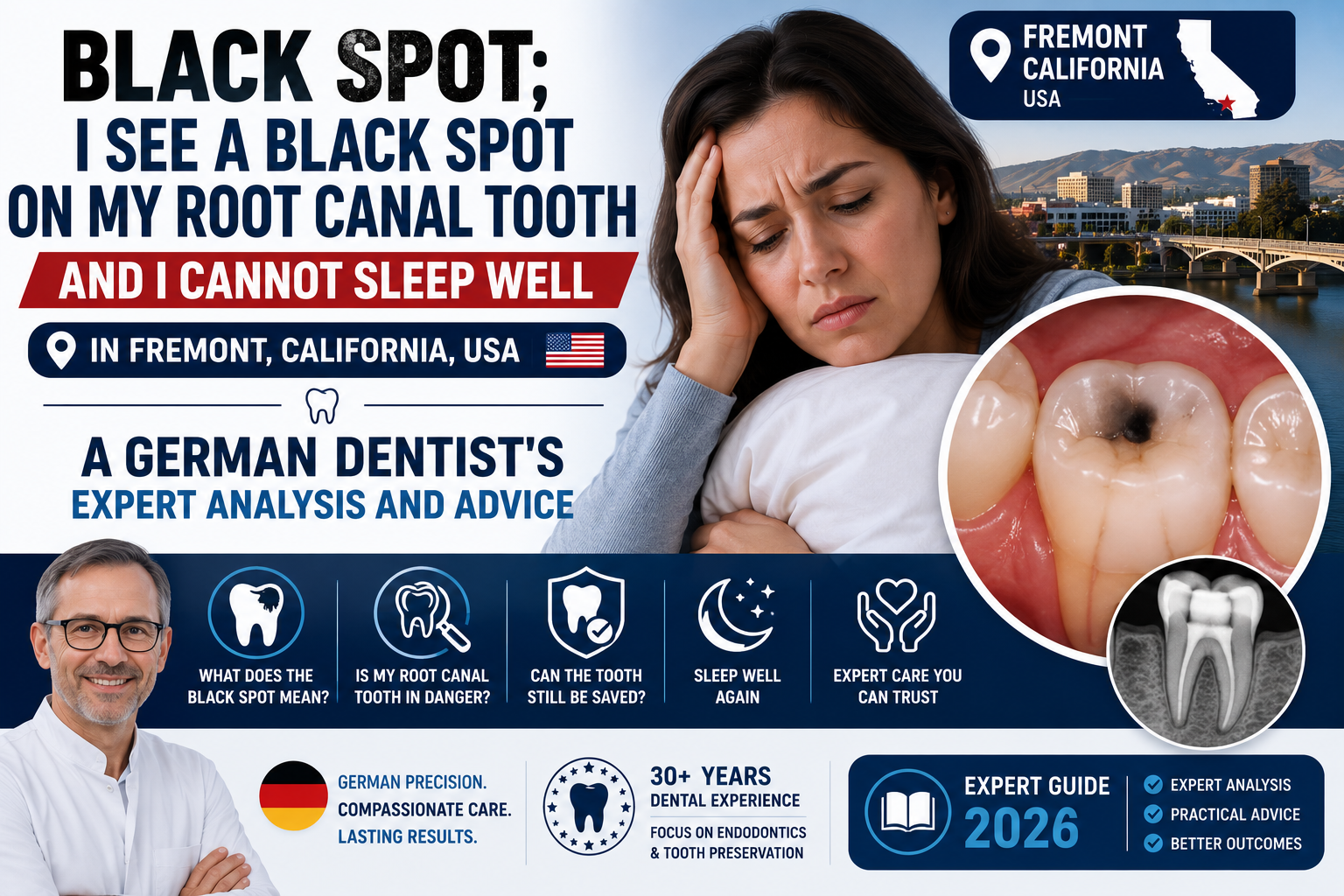
Discovering a black spot on a tooth that has already undergone root canal treatment can be alarming. Many patients in Fremont, California, immediately fear the worst: infection, tooth loss, failed root canal therapy, or the need for extraction. The anxiety often becomes so overwhelming that sleep becomes difficult.
As a dentist trained in the German approach to dental diagnosis and treatment planning, I often tell patients that a black spot does not automatically mean the tooth is beyond saving. However, it should never be ignored.
A root canal-treated tooth is different from a natural healthy tooth. Since the nerve has been removed, warning signs such as sensitivity to cold and heat may no longer be present. As a result, problems can progress quietly until visible changes appear.
If you are lying awake at night wondering why a black spot has appeared on your root canal tooth, this guide will help you understand possible causes, diagnostic procedures, treatment options, and whether the tooth can still be rescued.
Why a Black Spot Appears on a Root Canal Tooth
A black spot can develop for several reasons.
Some causes are minor and easily treatable, while others require immediate professional attention.
Common Causes
Surface Staining
Not every black area is decay.
Coffee, tea, red wine, tobacco, and certain foods can stain teeth.
A root canal-treated tooth is often more porous than a healthy tooth and may absorb stains more easily.
Characteristics include:
- Smooth surface
- No pain
- No swelling
- Dark discoloration limited to enamel
Professional cleaning may solve the problem.
Tooth Decay Around Existing Filling
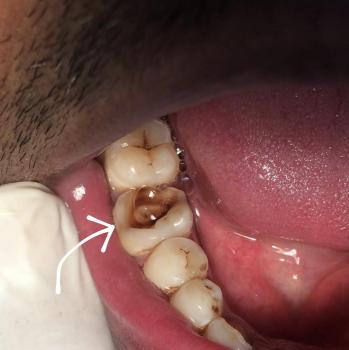
One of the most common reasons for black spots is recurrent decay.
Even after a successful root canal treatment, the outer tooth structure remains vulnerable.
Bacteria can enter through:
- Old fillings
- Cracked fillings
- Leaking crowns
- Open margins
This creates decay around the restoration.
Signs include:
- Visible black area
- Rough texture
- Food trapping
- Bad taste
Internal Tooth Discoloration
Root canal-treated teeth often darken over time.
This happens because:
- Blood pigments remain inside the tooth
- Old filling materials stain dentin
- Tissue remnants cause discoloration
The tooth may appear:
- Gray
- Brown
- Black
This is not always active decay.
Cracked Tooth
A crack can allow bacteria to penetrate deeply into the tooth.
The dark area may represent:
- Bacterial infiltration
- Stained crack lines
- Internal structural damage
Cracked teeth are among the most challenging conditions in dentistry.
Failed Root Canal Treatment
Sometimes the black spot is only the visible symptom of a deeper problem.
The root canal may have:
- Missed canals
- Remaining bacteria
- Reinfection
- Incomplete sealing
In these cases infection can develop underneath the tooth.
Why You Cannot Sleep Well
Many patients from Fremont tell me:
"Dentist, the tooth does not hurt much during the day, but at night I cannot sleep."
This is very common.
Increased Blood Pressure While Lying Down
When you lie flat:
- Blood flow increases to the head
- Pressure around inflamed tissues rises
- Pain signals become stronger
Small infections may feel much worse at night.
Anxiety and Fear
The brain becomes more focused on discomfort during quiet nighttime hours.
Patients begin asking:
- Will I lose the tooth?
- Is the infection spreading?
- Will I need surgery?
- Is it dangerous?
This mental stress can significantly affect sleep quality.
Hidden Infection
Root canal teeth can become infected without obvious symptoms.
Signs include:
- Mild throbbing
- Pressure sensation
- Gum tenderness
- Intermittent pain
These symptoms often intensify at night.
Expert German Dentist Analysis
German dentistry emphasizes comprehensive diagnostics before making treatment decisions.
A black spot should never be judged solely by visual appearance.
Several examinations are required.
Step 1: Clinical Examination
Your dentist will evaluate:
Tooth Structure
Questions include:
- Is the tooth cracked?
- Is the restoration leaking?
- Is the crown damaged?
- Is decay visible?
The location of the black spot provides important clues.
Gum Evaluation
The surrounding gums reveal valuable information.
Dentists look for:
- Redness
- Swelling
- Gum pockets
- Drainage
These signs may indicate infection.
Bite Analysis
Root canal teeth sometimes develop pain due to excessive biting pressure.
The dentist checks:
- Bite alignment
- Grinding patterns
- Fracture risk
Step 2: Dental X-Rays
Radiographs help determine whether infection exists beneath the surface.
Important findings include:
Healthy Root Canal
- Dense filling material
- No dark shadow around root
Possible Infection
- Dark area around root tip
- Bone loss
- Incomplete root filling
The X-ray often reveals problems not visible externally.
Step 3: CBCT Scan
A Cone Beam CT scan provides three-dimensional imaging.
German dental specialists frequently use CBCT technology when conventional X-rays are inconclusive.
CBCT can reveal:
- Hidden infections
- Vertical root fractures
- Missed canals
- Bone defects
This technology dramatically improves diagnostic accuracy.
What If the Black Spot Is Decay?
Many patients assume a root canal tooth cannot get cavities.
This is incorrect.
The nerve has been removed, but bacteria can still attack the tooth.
Treatment Options
Small Decay
Treatment may involve:
- Cleaning decay
- Composite filling
- Monitoring
The prognosis is usually excellent.
Moderate Decay
A larger restoration may be needed.
Options include:
- Onlay
- Crown
- Core build-up
The objective is preserving remaining tooth structure.
Deep Decay
If decay approaches the root area:
- Retreatment may be necessary
- Crown replacement may be required
- Long-term prognosis must be evaluated carefully
What If the Root Canal Has Failed?
Root canal failure does not always mean extraction.
Many teeth can still be saved.
Root Canal Retreatment
This procedure removes previous filling material.
The dentist:
- Opens the tooth
- Removes old root filling
- Cleans canals again
- Eliminates bacteria
- Refills the canals
Success rates remain favorable when properly performed.
Microscope-Assisted Treatment
Modern German endodontics often uses dental microscopes.
Advantages include:
- Better visualization
- Detection of missed canals
- Improved cleaning
- Increased success rates
Microscopic treatment has significantly improved outcomes.
Apicoectomy Surgery
When retreatment alone cannot solve the problem, surgery may help.
An apicoectomy involves:
- Removing infected root tip
- Cleaning surrounding infection
- Sealing the root end
This allows many teeth to remain functional for years.
Could It Be a Tooth Fracture?
A fracture is one of the most serious possibilities.
Root canal-treated teeth are more brittle than vital teeth.
Risk factors include:
- Large fillings
- Teeth grinding
- Trauma
- Lack of crown protection
Warning Signs
Possible indicators include:
- Sharp pain while chewing
- Intermittent discomfort
- Gum swelling
- Black line on tooth
Diagnosis often requires advanced imaging.
Can a Cracked Root Canal Tooth Be Saved?
The answer depends on fracture location.
Favorable Fracture
If limited to the crown portion:
- Crown placement may help
- Prognosis can be good
Vertical Root Fracture
This is more severe.
The crack extends into the root.
Often associated with:
- Persistent infection
- Bone loss
- Recurrent swelling
Treatment options become limited.
Signs You Need Immediate Dental Attention
Do not wait if you experience:
Facial Swelling
This may indicate spreading infection.
Fever
Systemic symptoms require urgent evaluation.
Severe Pain
Uncontrolled pain often suggests advanced inflammation.
Pus Drainage
Active infection should be addressed promptly.
Difficulty Swallowing
This is a potential emergency.
Seek immediate medical care.
Can the Tooth Still Be Saved?
One of the most common questions I hear is:
"Dentist, can my tooth still be rescued?"
In many cases, yes.
Factors that influence success include:
Amount of Remaining Tooth Structure
More healthy structure generally means a better prognosis.
Bone Support
Healthy surrounding bone increases long-term stability.
Fracture Presence
Absence of fractures significantly improves outcomes.
Infection Severity
Earlier intervention generally leads to better results.
German Dentistry Philosophy: Save Before Removing
A key principle in German dentistry is preservation whenever possible.
Before recommending extraction, we ask:
- Can retreatment work?
- Can surgery help?
- Can the crown be replaced?
- Can the tooth be reinforced?
Extraction should not be the first choice if predictable alternatives exist.
What Happens If the Tooth Must Be Removed?
Sometimes extraction becomes necessary.
Common reasons include:
- Severe fracture
- Extensive decay
- Non-restorable structure
- Advanced infection
Fortunately, modern dentistry offers excellent replacement options.
Dental Implant Option
A dental implant replaces the missing root.
Advantages include:
- Natural appearance
- Strong function
- Bone preservation
- Long lifespan
Implants have become a predictable solution when teeth cannot be saved.
Dental Bridge Option
A bridge replaces missing teeth using adjacent teeth for support.
Benefits include:
- Faster treatment
- No surgery required
Limitations include:
- Preparation of neighboring teeth
Partial Denture Option
A removable prosthesis may be appropriate for some patients.
Advantages include:
- Lower cost
- Non-surgical solution
Home Care While Waiting for Your Appointment
If you are unable to see a dentist immediately, consider the following measures.
Maintain Excellent Oral Hygiene
Brush carefully around the affected tooth.
Plaque accumulation can worsen inflammation.
Warm Salt Water Rinse
A gentle rinse may reduce irritation.
Mix:
- One cup warm water
- Half teaspoon salt
Use several times daily.
Avoid Excessive Chewing
Do not chew hard foods on the affected side.
Examples include:
- Nuts
- Ice
- Hard candies
Manage Stress
Anxiety often amplifies pain perception.
Improving sleep habits may reduce discomfort.
Stay Hydrated
Adequate hydration supports overall oral health.
Common Patient Questions
Is a Black Spot Always a Cavity?
No.
It may represent:
- Stain
- Internal discoloration
- Crack
- Decay
- Restoration failure
Only examination can determine the cause.
Can a Root Canal Tooth Become Infected Again?
Yes.
Reinfection is possible if bacteria enter the root canal system.
Why Does My Root Canal Tooth Look Dark?
The tooth may darken because it no longer contains living pulp tissue.
This does not automatically indicate infection.
Can a Crown Prevent Problems?
A well-made crown can significantly reduce fracture risk and bacterial leakage.
Should I Go to the Emergency Dentist?
If swelling, severe pain, fever, or pus develops, immediate care is recommended.
Fremont, California Considerations
Residents of Fremont often delay dental visits because of busy work schedules, family commitments, and concerns about treatment costs.
Unfortunately, root canal complications rarely improve on their own.
A small black spot today can become:
- Larger decay
- Structural fracture
- Bone infection
- Tooth loss
Early diagnosis usually means less invasive treatment and better long-term outcomes.
Long-Term Prevention After Root Canal Treatment
To protect a root canal-treated tooth:
Attend Regular Dental Exams
Routine evaluations detect problems early.
Obtain Recommended Crowns
Many root canal-treated teeth benefit from crown protection.
Wear a Night Guard
Patients who grind their teeth should consider protective appliances.
Avoid Excessive Force
Do not use teeth as tools.
Avoid biting:
- Ice
- Pens
- Hard objects
Maintain Excellent Hygiene
Consistent brushing and flossing remain essential.
Conclusion
Seeing a black spot on a root canal-treated tooth while struggling to sleep can be frightening, especially if you live in Fremont, California and worry that the tooth is already lost. However, a black spot does not automatically mean extraction is necessary.
The cause may range from simple staining and minor decay to crown leakage, root canal reinfection, or tooth fracture. Proper diagnosis through clinical examination, digital X-rays, and sometimes CBCT imaging is essential before determining the best course of treatment.
From a German dentist's perspective, the priority is always to preserve the natural tooth whenever predictable treatment options exist. Many root canal-treated teeth with black spots can still be successfully restored through fillings, crown replacement, root canal retreatment, or surgical endodontic procedures.
If the black spot is growing, causing discomfort, or keeping you awake at night, do not delay evaluation. Early intervention offers the highest chance of saving the tooth, protecting your oral health, and allowing you to return to comfortable, restful sleep.
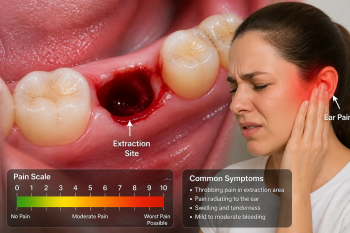
Can tooth extraction cause infection? Mild inflammation is normal, but increasing swelling, fever, or severe pain may indicate infection. Learn more about post-extraction infection warning signs in this detailed guide.
Book a consultation with our Cebu dental specialists for proper evaluation and care.
Ready to get expert guidance?
If you’re experiencing severe pain or delayed healing, book a consultation with our Cebu dental specialists to get proper evaluation and care.
Consultation or contact page .
Book a Consultation
For severe discomfort or delayed healing, book a consultation with our Cebu dental specialists today.
Looking for a dentist? Browse our Cebu dental directory to find trusted clinics near you.
Medical Review and Clinical Basis
This article is based on clinical dental guidelines and real patient recovery patterns observed after tooth extraction procedures. The information reflects common post-extraction healing stages, including normal clot formation, gum tissue repair, and signs of possible complications such as dry socket or infection.
While mild discomfort is expected after a dental extraction, worsening pain after Day 3, bad odor, exposed bone, or spreading pain may require professional evaluation. These symptoms are consistent with known post-extraction complications described in standard dental practice.
About Cebu Dental Implants
Cebu Dental Implants provides comprehensive tooth extraction, surgical procedures, and dental implant services in the Philippines. Our team evaluates post-extraction healing, manages complications such as dry socket, and advises patients on proper aftercare to prevent infection and delayed healing.
If you experience severe pain or unusual symptoms after extraction, early professional assessment is recommended to prevent further complications.
Important Medical Disclaimer
This content is for educational purposes only and does not replace professional dental diagnosis. Every patient heals differently. If symptoms worsen or do not improve within a few days, consult a licensed dentist for proper evaluation and treatment.
Author
This article was prepared by the Cebu Dental Implants content team in consultation with licensed dental professionals experienced in tooth extraction and implant procedures.
Related Clinical Cases
Patients with lower front gum inflammation may also experience tartar buildup, periodontal disease, gum abscesses, or tooth decay. Explore these related clinical case studies.

Other topics:
Other Dental Clinic