Your Smile, Perfected with Precision.

Dental Implants in Reykjavik (2026): Clinical Research, Cost Analysis, and Patient Guide
image hero:
Country:
Reykjavík is the center of Iceland's dental market and offers modern restorative and implant dentistry, including implant placement, bone augmentation, sinus-lift procedures, and prosthetic reconstruction.
For patients considering dental implants in Reykjavík, however, the advertised price of an "implant" should not be confused with the price of a complete implant-supported tooth. A complete treatment can involve diagnostic imaging, surgery, the implant fixture, abutment, laboratory work, crown, temporary restoration, and additional procedures when bone or soft-tissue deficiencies are present.
Current Icelandic sources also show that the country's dental reimbursement system is more nuanced than simply describing adult dental care as "100% private." Iceland Health provides dental participation for children, pensioners, and certain patients affected by congenital defects, accidents, and diseases. Specific implant assistance is available for eligible pensioners and certain edentulous-jaw cases.
This article examines the clinical pathway, pricing considerations, reimbursement rules, patient-review considerations, and medical-tourism economics surrounding dental implants in Reykjavík in 2026.
1. Clinical Diagnosis and Treatment Planning
A predictable dental implant begins with diagnosis—not with the implant itself.
A Reykjavík implant consultation may involve:
-
Comprehensive oral examination
-
Periodontal evaluation
-
Dental radiographs
-
CBCT imaging when clinically indicated
-
Evaluation of bone height and width
-
Assessment of adjacent teeth
-
Evaluation of the maxillary sinus
-
Assessment of the inferior alveolar nerve in the mandible
-
Occlusal analysis
-
Review of medical and dental history
-
Prosthetic treatment planning
Why CBCT Can Matter
A CBCT scan provides three-dimensional information that conventional two-dimensional radiographs cannot provide.
For an implant in the posterior mandible, the clinician needs to understand the relationship between the planned implant and important anatomical structures such as the inferior alveolar canal.
For a posterior maxillary implant, the clinician may need to evaluate:
-
residual bone height;
-
sinus anatomy;
-
sinus pathology;
-
ridge width;
-
implant angulation.
However, CBCT should be ordered based on clinical need rather than automatically for every patient.
2. Bone Grafting and Sinus-Lift Assessment
Bone deficiency is one of the most important factors that can change the economics and timeline of implant treatment.
A patient who has recently lost a tooth may have sufficient bone for conventional implant placement.
Another patient may have experienced:
-
advanced periodontal disease;
-
traumatic tooth loss;
-
long-standing edentulism;
-
ridge resorption;
-
infection;
-
sinus pneumatization.
In those situations, additional augmentation may be required.
Possible Procedures
Depending on the anatomy, treatment may include:
Ridge preservation
Used around the time of extraction to reduce post-extraction bone loss.
Guided bone regeneration
A technique used to reconstruct localized bone deficiencies.
Ridge augmentation
Used when the available ridge is insufficient for the planned implant.
Sinus augmentation
Used in selected posterior maxillary cases when vertical bone availability is inadequate.
The correct procedure cannot be determined from a price list alone. It requires clinical examination and imaging.
3. Osseointegration and Treatment Timeline
After implant placement, the implant must biologically integrate with the surrounding bone.
The timeline varies considerably according to:
-
bone quality;
-
implant location;
-
primary stability;
-
grafting;
-
infection;
-
systemic factors;
-
loading protocol;
-
prosthetic strategy.
A commonly encountered treatment sequence is:
Diagnosis → CBCT → surgical planning → implant placement → healing → prosthetic phase → crown delivery → maintenance
Some cases can be managed with immediate or early loading, while other cases require a longer healing period.
Therefore, the statement that every implant requires exactly "3–6 months" should be avoided. Healing time is case-specific.
4. Dental Implant Cost in Reykjavík
There is no single universal Reykjavík implant price.
The final fee depends on what the clinic includes in its quotation and on the patient's clinical complexity.
A useful planning framework is:
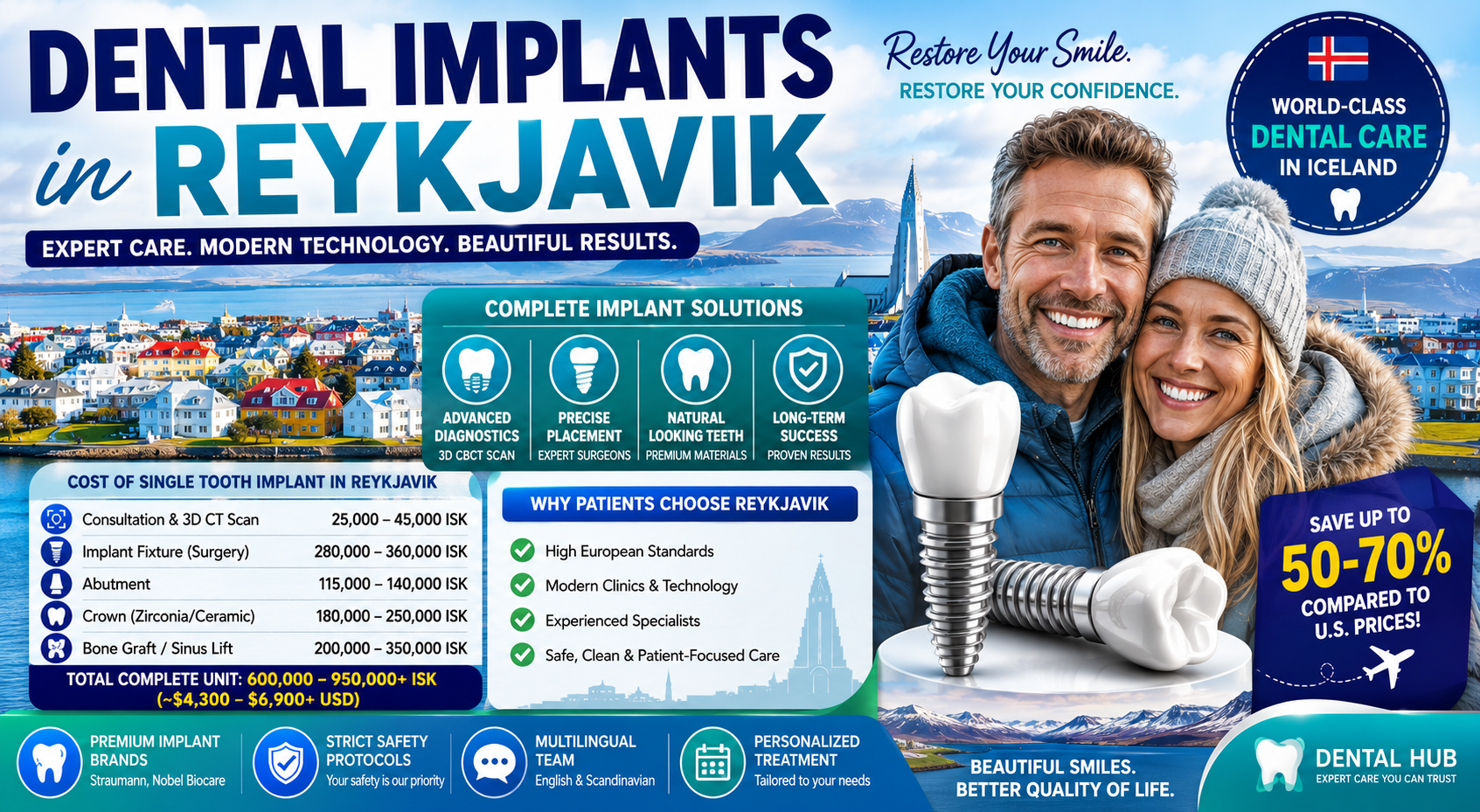
| Treatment Stage | Indicative Planning Range |
|---|---|
| Consultation and diagnostic assessment | ~25,000–45,000 ISK |
| Implant surgery | ~280,000–360,000 ISK |
| Abutment | ~115,000–140,000 ISK |
| Crown | ~180,000–250,000 ISK |
| Bone grafting / sinus augmentation | ~200,000–350,000 ISK |
| Complex complete single-tooth case | Potentially ~600,000–950,000+ ISK |
Important: These figures are planning estimates rather than an official Reykjavík-wide 2026 implant tariff. Patients should obtain a written quotation from the treating clinic.
A useful real-world reference is Krýna Dental Clinic in Reykjavík, which publishes a 2025 reference fee schedule. Its published schedule lists, for example, 255,184 ISK for a porcelain full crown on a premolar, including anesthesia, a temporary crown, and dental-laboratory work. The clinic specifically notes that individual cases must be assessed and that specialist fees are not included in that reference schedule.
That illustrates an important point: the price of the final restoration can represent a significant portion of the overall implant treatment cost.
5. Why Implant Advertisements Can Be Misleading
Imagine seeing:
"Dental implant — 300,000 ISK"
The patient should immediately ask:
What exactly does the 300,000 ISK include?
Does it include:
-
implant fixture?
-
surgery?
-
CBCT?
-
abutment?
-
temporary crown?
-
final crown?
-
laboratory fees?
-
anesthesia?
-
follow-up?
-
bone graft?
-
sinus lift?
If several components are excluded, the final cost may be substantially higher.
The Correct Comparison
Instead of comparing:
Clinic A: implant = 300,000 ISK
against:
Clinic B: implant = 400,000 ISK
compare:
Complete treatment from diagnosis through final crown = total price.
This is a much more meaningful financial comparison.
6. Reykjavík Dental Clinics and Implant Services
Reykjavík has established dental practices offering implant-related treatment.
For example, Krýna states that its Reykjavík clinic provides dental implants with or without bone augmentation and sinus-lift treatment. It also reports having prosthodontic expertise within its clinical team.
Its published information states that the clinic opened its current Reykjavík location in 2022 and that its staff includes English speakers as well as personnel who speak Danish and Bulgarian.
These details are useful for international patients, but patients should still evaluate the specific clinician, treatment plan, implant system, prosthetic components, and clinical indications rather than selecting a clinic solely from its website.
7. Patient Review Analysis
Online reviews can provide useful information about a dental clinic, but they need to be interpreted correctly.
For example, third-party review listings can provide information about overall patient satisfaction and the volume of reviews for individual Reykjavík practices.
Reviews are particularly useful for evaluating:
-
communication;
-
appointment organization;
-
staff behavior;
-
perceived cleanliness;
-
billing communication;
-
waiting times;
-
general patient experience.
However, reviews cannot establish whether an implant treatment is clinically appropriate.
A patient should not choose an implant surgeon solely because a clinic has a high online rating.
What I Would Look for as a U.S. Dental Expert
I would give greater weight to:
-
Appropriate diagnosis
-
Relevant clinical qualifications
-
Quality of treatment planning
-
Appropriate imaging
-
Clear implant documentation
-
Transparent pricing
-
Prosthetic planning
-
Long-term maintenance strategy
-
Complication management
-
Clear informed consent
8. Iceland Health: An Important Correction About Dental Coverage
One of the most important issues for this topic is accurately describing Iceland's reimbursement system.
It is not correct to state broadly that Iceland Health provides virtually no assistance for adult dental implants in every circumstance.
Iceland Health states that it contributes to dental costs for children, pensioners, and certain serious consequences of congenital defects, accidents, and diseases.
For eligible pensioners, Iceland Health currently states that:
-
up to ISK 146,677 may be granted during each 12-month period for certain dental implants or other fixed prostheses in a dentate jaw in specified locations;
-
Iceland Health pays 75% of the pensioner's cost for qualifying implant treatment supporting dentures in an edentulous jaw;
-
when an edentulous-jaw implant application is approved, the first two implants in the lower jaw and first four implants in the upper jaw can be subsidized under the stated rules.
The reimbursement is generally handled through the dentist, who reduces the patient's bill by the applicable participation rather than simply reimbursing the patient afterward.
This distinction is important when publishing a 2026 dental-cost article.
9. Dental Treatment Abroad
The possibility of treatment abroad is an important part of the economic discussion.
Iceland Health allows certain dental expenses abroad to qualify for participation under specified conditions.
However, patients should not assume that every dental-tourism procedure automatically qualifies for reimbursement.
Iceland Health states that dental implants in an edentulous jaw and regional jawbone CT imaging are among the procedures requiring prior application and approval before treatment.
The agency currently states that applications requiring prior approval for dental treatment abroad generally take approximately 4–6 weeks after all required information has been received.
10. The Hidden Cost of Dental Tourism
Patients sometimes compare an Icelandic quotation with a foreign clinic's advertisement and immediately calculate the difference as "savings."
That is incomplete.
The real equation is:
Foreign Dental Cost + Airfare + Hotel + Transportation + Meals + Time Away From Work + Follow-Up + Possible Revision
The apparent savings may become smaller once these costs are included.
There is also a clinical continuity issue.
If a patient returns to Reykjavík after receiving treatment abroad and develops:
-
loose prosthetic components;
-
crown fracture;
-
peri-implant inflammation;
-
implant mobility;
-
bite problems;
-
infection;
-
prosthetic complications;
the patient may need local evaluation and additional treatment.
Iceland Health explicitly states that travel expenses for dental treatment abroad are not reimbursed and that incidents occurring during dental treatment abroad are not covered by the Patient Insurance Act.
11. Should Icelandic Patients Choose Reykjavík or Treatment Abroad?
There is no universal answer.
Local Reykjavík Treatment May Be Attractive When:
-
the patient wants continuity of care;
-
treatment is relatively straightforward;
-
follow-up is expected to be extensive;
-
the patient has complex medical or dental needs;
-
the patient values local access if complications develop;
-
the total price difference is relatively small.
Overseas Treatment May Be Considered When:
-
treatment is extensive;
-
the foreign clinic has appropriate qualifications;
-
the complete price is substantially lower;
-
the patient can accommodate multiple visits;
-
implant and prosthetic documentation will be provided;
-
follow-up has been carefully planned.
The decision should be based on total clinical and financial risk, not simply the advertised implant price.
12. Case Analysis: Single Missing Molar
Patient
A 48-year-old patient loses a mandibular first molar.
Clinical findings:
-
no active infection;
-
healthy adjacent teeth;
-
adequate bone width;
-
adequate vertical bone;
-
stable periodontal condition;
-
favorable occlusion.
Possible Treatment
Step 1: Clinical examination
Step 2: Appropriate radiographic assessment
Step 3: Implant placement
Step 4: Healing
Step 5: Abutment/prosthetic phase
Step 6: Final crown
Step 7: Maintenance
This is a relatively straightforward implant case.
The major financial question becomes:
What is the complete price from diagnosis to final crown?
13. Case Analysis: Posterior Maxillary Implant With Bone Deficiency
Now consider a patient who lost an upper molar several years ago.
CBCT reveals:
-
reduced vertical bone height;
-
sinus proximity;
-
ridge resorption.
The treatment may require:
CBCT → surgical planning → sinus augmentation and/or bone augmentation → healing → implant placement → integration → restoration
The price and treatment duration can therefore be substantially greater than for the straightforward molar case.
This is why a patient should never use a single "implant price" to estimate the cost of a complex reconstruction.
14. Implant Brand and Long-Term Documentation
Patients should request the implant manufacturer's documentation after treatment.
Keep records of:
-
manufacturer;
-
implant model;
-
implant dimensions;
-
implant position;
-
abutment;
-
prosthetic components;
-
crown material;
-
radiographs;
-
CBCT records when appropriate;
-
surgical records;
-
laboratory information.
Internationally recognized implant systems may make component identification easier, but a brand name alone does not guarantee that every dentist will automatically provide maintenance or replacement treatment.
15. Questions to Ask a Reykjavík Dentist Before Treatment
Clinical Questions
-
Do I need a CBCT?
-
Is there enough bone for implant placement?
-
Do I need a bone graft?
-
Do I need a sinus lift?
-
Is periodontal treatment required first?
-
Can the implant be placed immediately after extraction?
-
How long will treatment take?
-
What are the major clinical risks?
Financial Questions
-
What is the complete treatment price?
-
Is the CBCT included?
-
Is the implant fixture included?
-
Is the abutment included?
-
Is the crown included?
-
Are laboratory fees included?
-
Is the temporary restoration included?
-
Are grafting procedures included?
-
What happens if the implant fails?
-
What maintenance costs should I expect?
16. U.S. Dental Expert Assessment
From a U.S. dental perspective, I would advise patients to avoid selecting implant treatment based solely on price.
Dental implants are a biological and prosthetic treatment, not simply a manufactured product.
Long-term success depends on:
-
appropriate patient selection;
-
periodontal health;
-
adequate bone;
-
accurate implant positioning;
-
prosthetic design;
-
occlusal management;
-
oral hygiene;
-
regular maintenance;
-
management of biological and mechanical complications.
The cheapest treatment is therefore not necessarily the least expensive treatment over 10 or 15 years.
Likewise, the most expensive clinic is not automatically the best clinic.
The strongest decision is based on clinical quality + transparent pricing + documented components + long-term follow-up.
17. Final Verdict: Dental Implants in Reykjavík in 2026
Reykjavík offers patients access to modern implant and restorative dentistry, but implant treatment can represent a significant financial commitment.
The most important lesson is to distinguish between:
implant fixture price
and
complete implant restoration price.
Patients should request an itemized quotation that clearly identifies every component of treatment.
Iceland's reimbursement system should also be checked before treatment because eligible groups can receive meaningful assistance under specific conditions.
For patients considering treatment abroad, Iceland Health's current rules should be reviewed before travel, particularly where prior approval is required.
Bottom Line
For a patient in Reykjavík, the best implant decision is not necessarily the cheapest quotation. It is the treatment plan that provides appropriate diagnosis, predictable surgery, quality prosthetic reconstruction, transparent pricing, and reliable long-term follow-up.
Official Iceland Health References
Reykjavík Clinical Reference
Krýna Dental Clinic publishes its own information about implant treatment, bone augmentation, sinus lifts, and its current reference fee schedule.
Medical disclaimer: This article is for educational purposes and does not diagnose or recommend treatment for an individual patient. Dental implant candidacy, surgical technique, treatment timing, and final cost require examination, appropriate imaging, and a personalized treatment plan from a licensed dental professional.
Related Clinical Cases
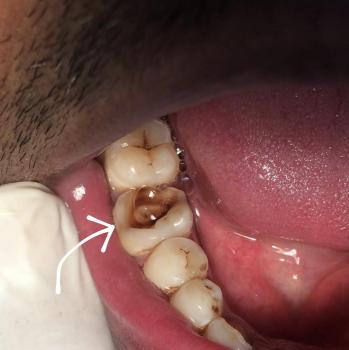
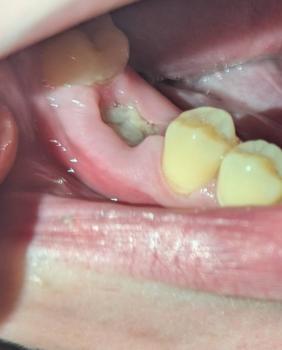
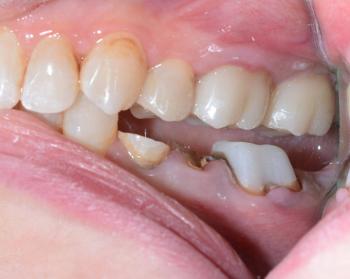
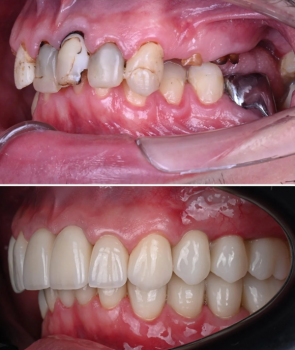
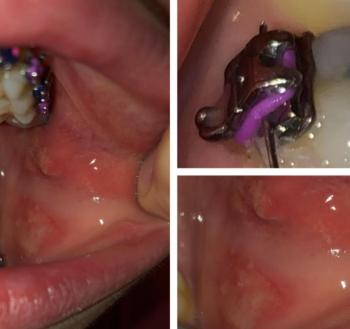
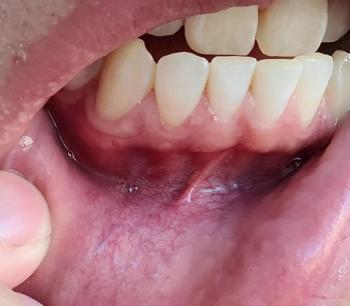
Patients with lower front gum inflammation may also experience tartar buildup, periodontal disease, gum abscesses, or tooth decay. Explore these related clinical case studies.
Other topics:
Other Dental Clinic