From Pain to Perfect — We Care for Your Smile.

Dental Implant Reimbursement in Iceland (2026): Comprehensive Clinical, Cost, and Patient Guide
image hero:
Country:
Dental Implant Reimbursement in Iceland (2026): Comprehensive Clinical, Cost, and Patient Guide
Dental Hub | Iceland Expert Dentist Perspective
Executive Summary
Dental implant reimbursement in Iceland is more complicated than simply stating that "adult implants are not covered."
Iceland Health (Sjúkratryggingar Íslands) provides dental cost participation under specific statutory and eligibility conditions. The level of assistance depends on factors including age, pensioner status, the type and location of treatment, whether the jaw is dentate or edentulous, and whether the treatment falls within a qualifying medical or dental category.
For patients considering implants in 2026, the most important distinction is between:
-
routine implant treatment for a general adult;
-
qualifying treatment for pensioners;
-
implant-supported treatment in an edentulous jaw;
-
treatment associated with congenital defects, accidents, or illness;
-
dental treatment performed abroad.
The reimbursement system also distinguishes between treatment that requires prior approval and treatment for which reimbursement can be requested after the procedure.
Therefore, patients should confirm eligibility with Iceland Health before committing to treatment or travel.
1. How Dental Implant Reimbursement Works in Iceland
Iceland Health does not generally operate as a system where every patient receives a percentage reimbursement for every dental implant.
Instead, the agency applies specific rules governing payment participation.
Iceland Health explains that its dental participation is not normally a direct cash refund to the individual. Instead, where participation applies, the health insurance share is paid to the dentist, who charges the patient the remaining amount.
This distinction matters when calculating the patient's true out-of-pocket cost.
The basic calculation
Patient cost = Eligible dental fee − Iceland Health participation
However, the calculation is subject to the applicable treatment category, eligibility rules, fee schedules, and any maximum reimbursement amount.
2. General Adult Patients
For a generally healthy working-age adult requiring a routine single-tooth implant, patients should not assume that Iceland Health will pay a standard percentage of the entire implant bill.
The reimbursement framework is selective.
The patient's eligibility should be checked according to:
-
age;
-
pensioner status;
-
dental condition;
-
location of the tooth;
-
whether the jaw is dentate or edentulous;
-
medical circumstances;
-
applicable Iceland Health rules;
-
whether the treatment is domestic or abroad.
This is why an article should avoid an absolute statement such as:
"All adult dental implants receive zero reimbursement."
That wording is too broad.
A safer clinical statement is:
Routine adult dental implants are not universally reimbursed; eligibility and payment participation depend on the patient's circumstances and the specific treatment category.
3. Pensioners and Dental Implant Participation
Pensioners have additional dental participation rights under Iceland's system.
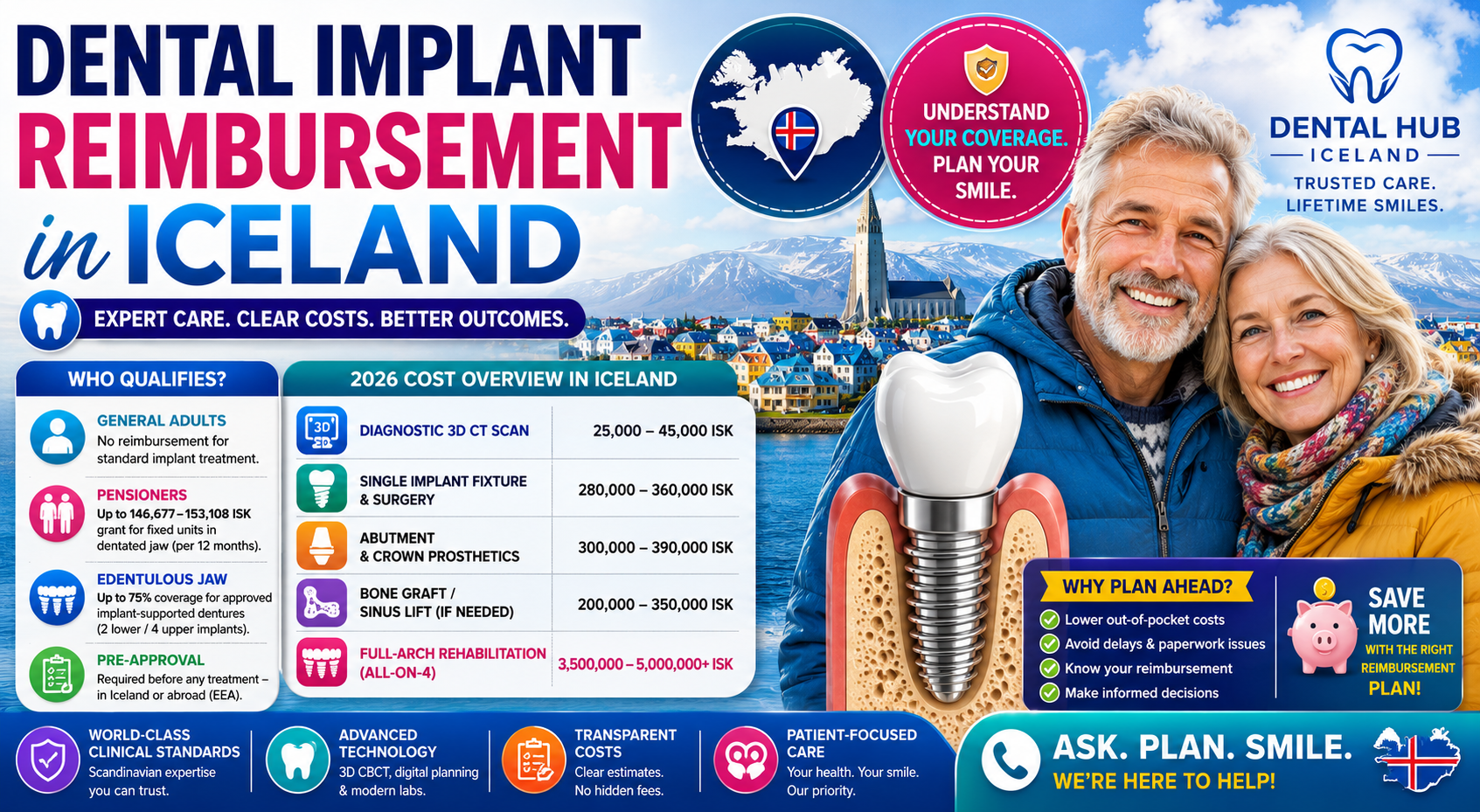
Iceland Health states that pensioners can receive 75% participation in general dentistry, subject to the applicable rules and fee schedules.
However, implant treatment does not automatically receive the same 75% treatment.
For fixed prostheses and dental implants in a dentate jaw, Iceland Health states that these treatments are not covered under the general 75% pensioner co-payment arrangement. Instead, a grant is available up to a specified maximum.
The current Iceland Health information gives a maximum of ISK 146,677 in each 12-month period for qualifying fixed dentures or dental implants in a dentate jaw in front of the 12-year molars.
This is an important distinction.
Example
Suppose a qualifying pensioner's complete implant-supported tooth costs substantially more than ISK 146,677.
The patient should not interpret the grant as meaning that 75% of the complete implant invoice will be paid.
Instead, the applicable fixed grant may cover only part of the eligible expense, leaving the remaining balance payable by the patient.
4. Edentulous Jaw and Implant-Supported Dentures
The reimbursement rules can be different when a patient has lost all teeth in a jaw.
Iceland Health states that it pays 75% of the cost of both the dentist and dental technician for dentures, including full dentures, implant dentures, and partial dentures, for pensioners under the applicable rules and replacement periods.
For approved implant-supported treatment involving an edentulous jaw, the rules specify particular implant limits.
Iceland Health's published information indicates that, under the relevant arrangements, the first:
-
two implants in the lower jaw, or
-
four implants in the upper jaw
can qualify under the specified reimbursement framework.
The exact amount payable depends on the applicable fee schedule and eligibility requirements.
Therefore, patients should not interpret this as:
"Iceland pays 75% of any All-on-4 treatment."
That would be an inaccurate simplification.
5. Prior Approval: One of the Most Important Rules
Patients considering dental implants abroad need to pay particular attention to prior approval.
Iceland Health states that dental implants in edentulous jaws and regional CT imaging of the jawbone are among dental procedures abroad that require a prior application and approval before treatment takes place.
This means:
Application → Iceland Health assessment → Approval → Treatment
rather than:
Treatment → Application → Hope for reimbursement
The distinction can have major financial consequences.
If prior approval is required and the patient proceeds without obtaining it, reimbursement may not be available under the applicable rules.
6. Treatment Abroad: EEA, UK, and Switzerland
Iceland Health explains that dental treatment carried out within the EEA, the United Kingdom, and Switzerland can be considered for payment participation under the applicable Icelandic rules.
However, the foreign clinic's price does not determine the reimbursement.
Iceland Health assesses participation using the applicable Icelandic laws, regulations, agreements, and fee schedules—not simply by reimbursing a percentage of whatever the foreign clinic charges.
This is extremely important for patients comparing:
Iceland clinic price
versus
Hungary/Türkiye/other foreign clinic price.
A low foreign quotation does not mean Iceland Health will reimburse the same proportion of that quotation.
7. Reimbursement Processing Times in 2026
Processing time is an important part of the financial planning process.
Iceland Health currently lists:
Foreign dental expense reimbursement
Approximately 16–24 weeks after all required documents have been received.
Dental work abroad requiring an application
Approximately 4–6 weeks after all necessary documentation has been received.
Domestic dental reimbursement
Iceland Health currently lists approximately 7–10 business days for domestic invoices in the relevant process, while more extensive applications can take substantially longer.
The agency also warns that delays can occur, including during summer holidays.
Important financial lesson
Patients should not assume that reimbursement means receiving money immediately after treatment.
If a patient must initially pay the foreign dental clinic, the patient needs sufficient cash flow to cover the treatment while waiting for the reimbursement assessment.
8. Documentation Requirements
Documentation is critical.
For dental treatment abroad, Iceland Health states that reimbursement applications require documentation such as:
-
completed application;
-
itemized invoice;
-
payment documentation;
-
treatment dates;
-
prices for individual procedures;
-
tooth or quadrant information where applicable;
-
additional clinical documentation when requested.
The agency may request further documentation if necessary.
Documents must be submitted in Icelandic or English. If documents are provided in another language, certified translation may be required, and the translation cost is not reimbursed.
This is particularly important for Icelandic patients traveling to foreign dental clinics.
9. CBCT and Diagnostic Documentation
CBCT imaging can play an important role in implant treatment planning.
The clinician may use three-dimensional imaging to evaluate:
-
bone height;
-
bone width;
-
anatomical structures;
-
implant positioning;
-
sinus anatomy;
-
surgical risks.
However, patients should distinguish between:
clinical necessity
and
reimbursement eligibility.
Iceland Health identifies regional jawbone CT imaging among procedures abroad that require prior application and approval.
Therefore, patients should confirm the reimbursement requirements before obtaining an expensive diagnostic examination abroad.
10. Costing Analysis: What the Patient Really Pays
A useful financial model for an implant patient is:
| Cost component | Patient should verify |
|---|---|
| Consultation | Included or separate? |
| X-rays | Included? |
| CBCT | Included? |
| Implant surgery | Included? |
| Implant fixture | Which system? |
| Abutment | Included? |
| Temporary restoration | Included? |
| Final crown | Included? |
| Laboratory fees | Included? |
| Bone graft | Additional? |
| Sinus lift | Additional? |
| Follow-up | Included? |
| Complication treatment | Who pays? |
| Maintenance | Future cost? |
This approach prevents the common mistake of comparing a surgical implant price with the total price of an implant-supported tooth.
11. Case Analysis: Working-Age Adult With One Missing Tooth
Patient profile
A 45-year-old adult loses a mandibular molar.
The patient has:
-
adequate bone;
-
healthy adjacent teeth;
-
no active infection;
-
stable periodontal tissues.
The proposed treatment is:
CBCT/diagnostic assessment → implant placement → healing → abutment → crown
For a routine adult case, the patient should not assume that Iceland Health will cover a large percentage of the entire implant restoration.
The patient should instead obtain:
-
a written clinical diagnosis;
-
an itemized treatment estimate;
-
an explanation of any applicable Iceland Health participation;
-
the expected patient contribution.
12. Case Analysis: Pensioner With Multiple Missing Teeth
Now consider a pensioner who has lost multiple teeth.
The clinical situation may require:
-
dentures;
-
implant-supported dentures;
-
fixed prostheses;
-
several implants;
-
additional restorative treatment.
The reimbursement calculation becomes substantially more complex.
The patient should ask the dentist to determine:
Which procedures qualify?
What is the Iceland Health contribution?
What is the maximum applicable amount?
What remains payable by the patient?
The pensioner's eligibility does not automatically mean that the entire reconstruction is covered.
13. Case Analysis: Completely Edentulous Jaw
A completely edentulous patient considering implant-supported dentures represents a different reimbursement category.
For eligible pensioners, Iceland Health provides participation for dentures, and specified implant-supported denture arrangements may receive payment participation under the applicable rules.
The patient should obtain written confirmation of:
-
number of implants eligible;
-
eligible prosthesis;
-
applicable fee basis;
-
reimbursement amount;
-
patient's expected contribution.
This is particularly important before committing to an extensive full-arch treatment plan.
14. Does Reimbursement Make Dental Tourism Cheaper?
Sometimes—but it cannot be assumed.
Consider a hypothetical patient who receives:
Iceland treatment quotation: 2,500,000 ISK
versus:
Foreign clinic quotation: 1,300,000 ISK
The apparent difference is:
1,200,000 ISK
But the foreign-treatment calculation must also include:
-
flights;
-
hotel;
-
transportation;
-
meals;
-
additional visits;
-
time away from work;
-
local follow-up;
-
possible complications;
-
possible revision surgery.
Iceland Health explicitly states that travel and subsistence expenses for dental treatment abroad are not reimbursed.
Therefore:
Foreign clinic price ≠ true foreign treatment cost.
15. Patient Review Analysis
Patients commonly focus on three issues when evaluating reimbursement:
1. Eligibility
"Do I qualify?"
2. Amount
"How much will Iceland Health actually contribute?"
3. Timing
"When will the reimbursement be processed?"
These are more useful questions than simply asking whether Iceland has "free dental implants."
Online patient reviews can help identify frustration with paperwork, communication, billing, and processing delays, but reviews should not be treated as authoritative evidence of reimbursement eligibility.
For reimbursement information, the official Iceland Health rules should take priority over social-media posts or anonymous reviews.
16. Important Correction Regarding "Mandatory CBCT"
A common misconception is that every implant patient must automatically receive a CBCT.
As an Iceland dental expert, I would describe this more carefully:
Three-dimensional imaging should be used when clinically justified for diagnosis and implant planning.
CBCT can provide valuable information, but the imaging protocol should be selected according to the patient's anatomy, clinical situation, and treatment requirements.
Similarly, reimbursement rules for imaging are separate from the clinical decision about whether imaging is appropriate.
17. Important Correction Regarding "50–70% Savings Abroad"
Dental tourism can produce substantial savings in some cases, especially for extensive private treatment.
However, it is not appropriate to state as a universal clinical fact that Icelandic patients "frequently save 50–70%" after travel expenses.
The actual saving depends on:
-
treatment complexity;
-
foreign clinic pricing;
-
number of visits;
-
airfare;
-
accommodation;
-
currency exchange;
-
reimbursement eligibility;
-
follow-up requirements;
-
complications.
A stronger Dental Hub formulation is:
International treatment can offer substantial gross price differences for some patients, but the true saving should be calculated only after travel, accommodation, reimbursement, follow-up, and potential revision costs are included.
18. U.S. Dental Expert and Iceland Expert Perspective
From a clinical standpoint, reimbursement should never drive the diagnosis.
The sequence should be:
Diagnosis → Treatment options → Clinical risk assessment → Cost → Reimbursement → Patient decision
not:
Reimbursement → Cheapest procedure → Treatment
A dental implant should be recommended because it is clinically appropriate—not simply because the patient qualifies for financial assistance.
Patients should also understand that the least expensive treatment may not be the least expensive over the long term.
Implant maintenance can continue for many years.
19. 2026 Patient Checklist
Before accepting an implant treatment plan, ask:
-
What is my exact diagnosis?
-
Is an implant clinically appropriate?
-
Do I need periodontal treatment first?
-
Do I need bone grafting?
-
Do I need a sinus lift?
-
Is CBCT clinically indicated?
-
What implant system will be used?
-
What crown material will be used?
-
What is the complete treatment price?
-
Which components are excluded?
-
Do I qualify for Iceland Health participation?
-
Is prior approval required?
-
What documents must I submit?
-
How much will I personally pay?
-
If treatment is abroad, who will provide follow-up care?
20. Final Clinical Assessment
Dental implant reimbursement in Iceland in 2026 is eligibility-based rather than universally available.
The strongest source of information is Iceland Health itself, which publishes its current dental rules, fee schedules, implant procedures, reimbursement requirements, and processing times.
For eligible pensioners, meaningful dental participation exists, but implant-related reimbursement may be subject to specific grants, treatment categories, maximum amounts, and implant-location rules.
For treatment abroad, patients must be especially careful because certain procedures—including implants in edentulous jaws—require prior approval before treatment.
Bottom Line
Do not make a dental implant decision based on the advertised price or an assumed reimbursement percentage.
Instead, obtain:
Clinical diagnosis + itemized quotation + Iceland Health eligibility assessment + written reimbursement information + long-term treatment plan.
That approach gives the patient a much more accurate picture of the real financial commitment.
Official Iceland Health Sources
Medical disclaimer: This article is educational and does not provide an individual diagnosis, reimbursement determination, or treatment recommendation. Dental implant treatment and eligibility for Iceland Health participation must be assessed on an individual basis by the treating dental professional and Iceland Health.
Related Clinical Cases
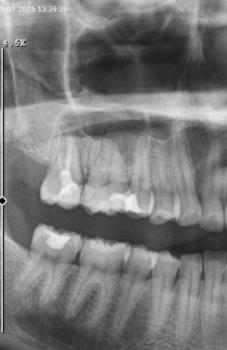
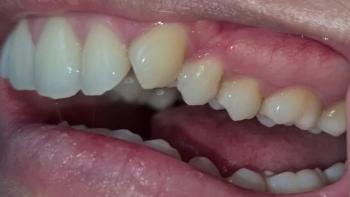
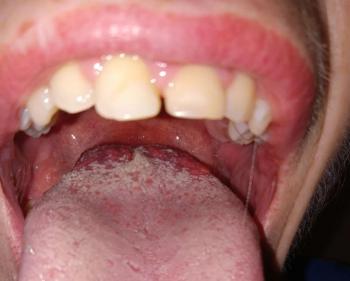
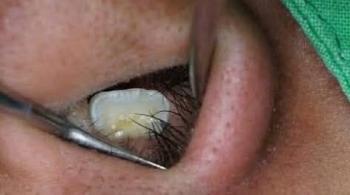
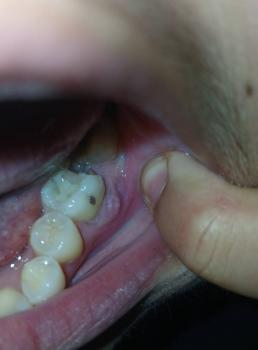
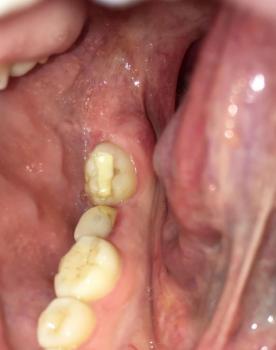
Patients with lower front gum inflammation may also experience tartar buildup, periodontal disease, gum abscesses, or tooth decay. Explore these related clinical case studies.


Other topics:
Other Dental Clinic