Your Smile, Perfected with Precision.

Teeth Alignment: How to Fix Crooked, Crowded and Gapped Teeth in 14 Days
Image:
Severity:
Teeth Problems:
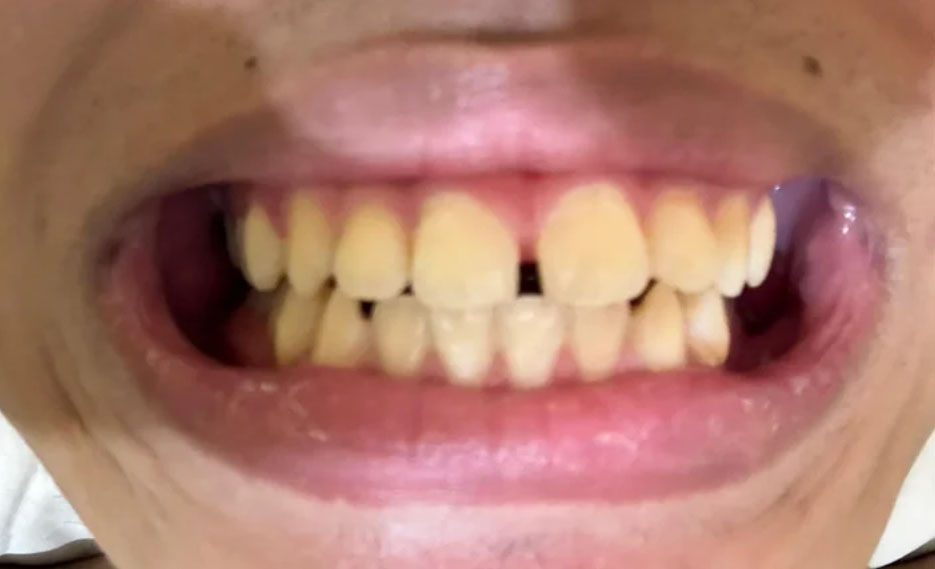
I examined the photograph at full available resolution and enlarged it for closer inspection. A photograph can show alignment and visible gum/tooth conditions, but it cannot establish a definitive dental diagnosis. X-rays, periodontal probing, bite examination, and clinical testing are needed.
Initial Clinical Assessment From the Photo
1. Upper front teeth
The most obvious issue is irregular alignment of the upper anterior teeth.
I can see:
- Spacing or a gap between the upper central incisors.
- Irregular positioning and possible rotation of neighboring upper teeth.
- Some teeth positioned slightly forward or backward relative to others.
- The upper anterior teeth do not form a completely smooth arch.
- Some asymmetry between the right and left sides.
This can affect the appearance of the smile and may explain why the client feels uncomfortable smiling.
2. Lower front teeth
The lower incisors also appear to have mild-to-moderate crowding and irregularity.
Some lower teeth appear rotated or positioned unevenly. If the goal is a stable correction, the lower arch should also be evaluated rather than focusing only on the upper teeth.
3. Tooth color and surface
The teeth appear somewhat yellowish. From the photograph alone, I would not diagnose decay.
Before cosmetic treatment, the dentist should check for:
- Calculus and tartar
- Plaque
- Enamel wear
- Existing restorations
- Caries
- Cracks
- Gum inflammation
- Tooth sensitivity
4. Gums
The gingival margins do not appear severely swollen in this photograph, although there appears to be some redness around portions of the upper gumline.
Before moving teeth or placing extensive cosmetic restorations, gum health should be established first.
Can This Be Fixed in 14 Days?
If by "alignment" the client means actually moving the teeth, 14 days is not realistic.
Orthodontic tooth movement generally requires months, not two weeks.
A 14-day treatment can potentially improve the appearance of the alignment, but this is different from biologically moving the teeth into their correct positions.
| Treatment | Approximate timeframe | What it accomplishes |
|---|---|---|
| Cleaning/scaling | 1–2 visits | Removes calculus and plaque and improves gum condition |
| Composite bonding/reshaping | 1–14 days | Can camouflage small spaces and improve tooth shape |
| Veneers/cosmetic restorations | Approximately 1–14+ days | Can substantially change the visible smile |
| Clear aligners | Several months or longer | Actually moves teeth |
| Fixed braces | Several months to 2 years or longer | Comprehensive orthodontic correction |
The exact timeframe depends on the diagnosis and treatment plan.
If the Client Wants a 14-Day Smile
The dentist needs to distinguish between a "smile makeover" and "orthodontic treatment."
Days 1–2: Full examination
Perform:
- Comprehensive dental examination
- Periodontal assessment
- Clinical photographs
- Dental X-rays where indicated
- Occlusion and bite assessment
- Caries evaluation
- Tooth vitality testing where necessary
- Assessment of existing restorations
- Digital scan or impressions if cosmetic treatment is planned
Do not begin aggressive cosmetic preparation simply because the client wants the treatment completed within 14 days.
Days 2–4: Stabilize the mouth
If there is significant calculus or gingival inflammation:
Scaling, oral-hygiene improvement, and allowing the tissues to settle should come first.
If decay, infection, or periodontal disease is discovered, those conditions take priority.
Days 4–7: Treatment planning
Determine whether the appearance can be improved conservatively through:
- Orthodontics
- Composite bonding
- Enamel recontouring
- Veneers
- Or a combination of treatments
A diagnostic wax-up or digital smile design can help the dentist evaluate the proposed result before irreversible treatment.
Days 7–14: Cosmetic treatment
If the teeth and gums are healthy and the case is suitable, cosmetic treatment may be completed relatively quickly.
However, this primarily camouflages the alignment rather than actually correcting the underlying tooth positions.
What Could Become a Problem If Everything Is Forced Into 14 Days?
1. Excessive removal of tooth structure
If significantly rotated or crowded teeth are aggressively prepared for veneers simply to make them appear straight, more tooth structure may have to be removed than would otherwise be desirable.
Healthy tooth structure should not be sacrificed merely to meet a 14-day deadline.
2. Bite problems
The front teeth do not function independently.
Changing their shape and thickness can alter:
- Overbite
- Overjet
- Incisal guidance
- Contact points
- Canine guidance
- Chewing contacts
A smile can look attractive in photographs but feel wrong when the patient bites.
3. Gum problems
If restorations extend too far toward the gumline or have poor contours, they can contribute to:
- Plaque retention
- Gingival inflammation
- Bleeding
- Periodontal problems
Restoration margins and gum health are therefore very important.
4. The gap needs investigation
The space between the upper front teeth should be evaluated rather than automatically closed cosmetically.
The dentist should determine whether the space is related to:
- Tooth position
- The labial frenum
- Tooth size
- Missing or undersized teeth
- Periodontal conditions
- The patient's bite
Closing the space without understanding its cause can potentially result in an unstable or unattractive result.
Examination Needed Before Treatment
For this case, I would recommend:
- Full-mouth clinical examination
- Panoramic X-ray where indicated
- Periapical X-rays of the anterior teeth where clinically indicated
- Periodontal probing
- Occlusal and bite analysis
- Digital intraoral scan
- Tooth vitality testing where necessary
- Measurement of the spaces and crowding
- Assessment of tooth proportions
- Orthodontic evaluation to determine whether actual tooth movement is necessary
The photograph only shows the visible front surfaces. It cannot reveal root positions, bone levels, hidden decay, or the complete occlusion.
Overall Assessment
Based on the photograph, the primary visible problem appears to be anterior dental malalignment with spacing and irregular positioning, particularly in the upper front teeth, together with some lower anterior irregularity.
The case should not automatically be treated by aggressively reshaping all the teeth.
If the client wants true alignment, an orthodontic or clear-aligner assessment would be appropriate.
If the client wants a significantly better-looking smile within approximately 14 days, a conservative cosmetic approach may be possible after confirming healthy teeth, healthy gums, adequate enamel, and a stable bite.
The key distinction is:
14 days can potentially produce a cosmetic smile improvement.
14 days cannot realistically produce complete biological orthodontic alignment.
If "scale all teeth" means professional scaling and cleaning, that can be appropriate when calculus or gingival inflammation is present, but scaling itself will not correct the tooth positions.
Accurate medical guidance
Important correction about “14 days”:
A 14-day period may refer to an early visible improvement, consultation, digital treatment planning, temporary cosmetic change, or a specific short-term dental procedure, but it should not be presented as a general timeframe for permanently correcting crooked, crowded, or gapped teeth.
Orthodontic tooth movement occurs gradually because the supporting bone and periodontal tissues must remodel. Depending on the individual case, treatment with clear aligners or braces commonly takes months rather than days. Some minor tooth-position problems may be treated faster than complex cases, but only a dentist or orthodontist can determine an appropriate timeline after an examination.
FAQ section
1. Can crooked teeth really be fixed in 14 days?
Usually, no. Permanent orthodontic tooth movement generally requires more than 14 days. The treatment time depends on the severity of crowding, spacing, bite problems, tooth position, bone and gum health, and the treatment method.
2. What is the fastest way to straighten crooked teeth?
For some mild cases, clear aligners or limited orthodontic treatment may provide relatively rapid improvement. However, the fastest option is not necessarily the safest or most appropriate. An orthodontist should determine the treatment plan.
3. Can clear aligners fix crowded teeth?
Yes. Clear aligners can correct many mild-to-moderate cases of crowding, spacing, and certain bite problems. More severe cases may require braces, additional orthodontic procedures, or another treatment approach.
4. Can gaps between teeth be permanently closed?
Often, yes. Orthodontic treatment can move teeth together to close many spaces. However, the cause of the gap should be identified first. Gaps can be related to tooth size, missing teeth, gum disease, a frenum, or other factors.
5. Is it safe to move teeth very quickly?
Moving teeth excessively fast can increase the risk of complications, including damage to the tooth roots, gum problems, pain, and problems with the supporting bone. Orthodontic treatment should be controlled and monitored by a qualified dental professional.
6. How long does teeth alignment normally take?
Treatment varies considerably. Some minor corrections may take several months, while moderate or complex orthodontic cases can take considerably longer. Your dentist or orthodontist can provide a more individualized estimate after an examination.
7. Can adults straighten their teeth?
Yes. Adults can receive orthodontic treatment, including clear aligners and braces. Treatment planning may need to account for gum health, bone levels, previous dental work, missing teeth, and other oral-health conditions.
8. Can teeth be straightened without braces?
Sometimes. Clear aligners are one alternative to traditional braces. However, not every orthodontic problem can be predictably treated with aligners alone.
9. Can veneers fix crooked or gapped teeth?
Veneers can sometimes improve the appearance of mildly irregular or spaced teeth, but they do not physically move the teeth into a new orthodontic position. They also require careful evaluation because tooth preparation may be irreversible.
10. What happens if crowded teeth are left untreated?
Crowding can make brushing and flossing more difficult and may contribute to plaque accumulation and gum problems. The significance depends on the individual's dental and periodontal health.
11. Should I get an X-ray before orthodontic treatment?
Your dentist or orthodontist may recommend dental X-rays or other diagnostic records when clinically appropriate. These can help evaluate tooth roots, bone, unerupted teeth, missing teeth, and other conditions that may affect treatment.
12. Can teeth move again after orthodontic treatment?
Yes. Teeth can shift after treatment. Retainers are commonly prescribed to help maintain the corrected positions, and long-term retention is often necessary.
13. Is teeth alignment painful?
Some pressure, tenderness, or mild discomfort can occur after braces or aligners are introduced or adjusted. Significant or persistent pain should be discussed with your dentist or orthodontist.
14. Can I straighten my teeth at home without seeing a dentist?
It is not recommended to attempt uncontrolled tooth movement yourself. Orthodontic treatment requires assessment of the teeth, gums, supporting bone, bite, and overall oral health.
15. When should I see a dentist or orthodontist?
Arrange an evaluation if you have significant crowding, gaps that are changing, difficulty cleaning between teeth, bleeding or swollen gums, abnormal biting, loose teeth, jaw discomfort, or concerns about how quickly your teeth can be aligned.
medical disclaimer
Medical information: This article is for general educational purposes and is not a substitute for an examination, diagnosis, or individualized treatment plan from a dentist or orthodontist. Treatment time varies from person to person. Claims that crooked, crowded, or gapped teeth can generally be permanently corrected in 14 days should not be interpreted as a guaranteed treatment timeframe. A qualified dental professional should evaluate your teeth, gums, bite, and supporting bone before orthodontic treatment.
Related Clinical Cases
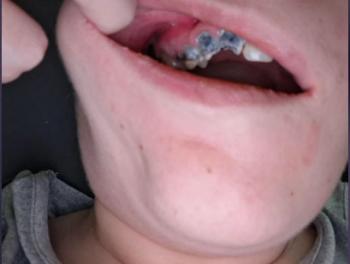
Patients with lower front gum inflammation may also experience tartar buildup, periodontal disease, gum abscesses, or tooth decay. Explore these related clinical case studies.



Other topics:
Other Dental Clinic